Short-Term Rentals in Madeira: How to Protect Your Property Against Misuse, Blockages and False Guest Complaints
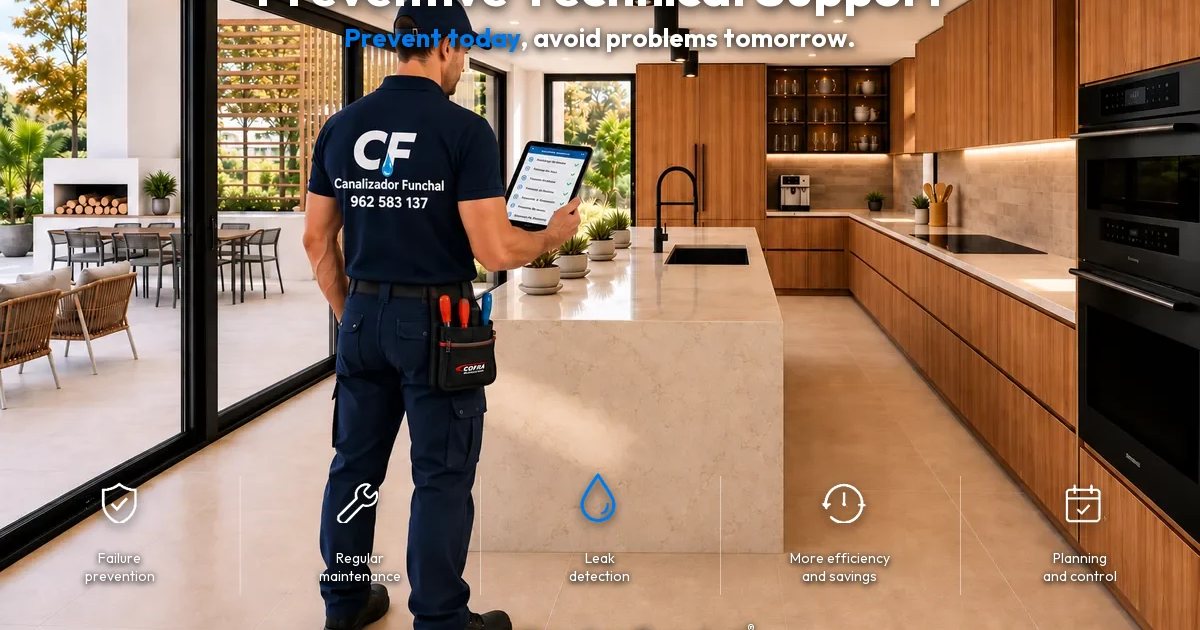
Short-term rental is now one of the most relevant economic activities in Funchal, Caniço, Santa Cruz, Machico and Calheta — and also one of the biggest sources of emergency call-outs we attend. The vast majority of the jobs we do in rental units are not caused by old pipework or poor materials: they are caused by misuse during the stay. Wet wipes flushed down the toilet, rigid plastic rim blocks falling into the pan, cooking fat poured down the kitchen sink and hair building up in the drains explain almost every weekend call. And the owner's loss is not only the unblocking fee: it is the complaint that reaches the platform hours later, almost always with a refund request, without any proof that the property was handed over in full working order. This article gathers what we have learned on the ground, across hundreds of units in Madeira, and shows how to turn every check-in into solid technical evidence.
⚖️ The Owner's Challenge: Platform Asymmetry
1) On booking platforms the guest's word carries, in practice, more initial weight than the host's: a single photo of a blocked toilet is enough to open a refund request. 2) The owner is asked to prove a negative — that the problem did not exist before — which is impossible without check-in documentation. 3) Most of the damage behind these complaints is behavioural: wet wipes and hygiene products flushed away, plastic rim blocks, fats and food waste in the kitchen sink. 4) The loss is rarely just the repair cost; add the partial refund, the blocked calendar for the next booking and the impact on the property's public rating. 5) In high season in Funchal and Santa Cruz, losing two nights to an avoidable blockage costs far more than any preventive maintenance plan. 6) The answer is not to distrust guests — it is to move the discussion out of opinion and into documented evidence.
🚫 Plastic Rim Blocks: the Costliest Mistake in Rentals
1) The hanging toilet rim block with a rigid plastic cage is the single most frequent cause of serious unblocking jobs we carry out in short-term rentals in Madeira. 2) The cage works loose during cleaning or use, falls into the pan and travels down to the toilet trap, where it jams because it is rigid and does not break down. 3) From that moment no plunger and no auger will solve it: the toilet must be unbolted from the floor, the object removed and the pan reseated with a new seal. 4) The cost multiplies three or four times compared with a simple unblocking, and the property is out of service for several hours. 5) The technical alternative is simple: use only liquid or gel products applied inside the pan, or in-cistern blocks where compatible with the seals. 6) We recommend removing every plastic-caged block from your units and briefing the cleaning team accordingly. 7) The same applies to rigid air fresheners placed on the toilet rim or inside the shower tray.
🧻 Wipes, Hygiene Products and Courteous Signage
1) Baby wipes, make-up pads, cotton buds, dental floss and feminine hygiene products do not disintegrate in water and form the tangle that blocks the branch pipe. 2) The most effective measure is also the cheapest: a closed, lined bin with a lid in every bathroom — where there is no bin, the guest uses the toilet. 3) Signage must be courteous and informative, never accusatory: a discreet plate next to the toilet, in Portuguese and English, explaining that the island's sewer network only accepts toilet paper. 4) Wording that works: "Please help us protect this home — only toilet paper in the WC. Thank you!" 5) Repeat the same information in the digital house manual and in the platform's automated welcome message, so it is logged in the booking conversation. 6) In high-turnover units in Funchal and Caniço, this simple combination drastically reduces emergency call-outs.
🍳 The Kitchen: Fats, Oils and High-Turnover Drains
1) Frying oil and fats poured into the sink cool inside the pipe, solidify and reduce the usable diameter until it blocks completely. 2) In rental flats, with different guests every week, the process accelerates: a pipe that would last years in a family home blocks within one high season. 3) Always provide a dedicated container for used oil and point out the nearest collection point in the house manual. 4) Fit a stainless steel drain filter in the sink and shower tray — it holds food waste and hair and is cleaned in seconds by the housekeeping team. 5) Instruct the cleaning team to remove the filters, wash them and run plenty of hot water after every departure. 6) Avoid food waste disposers in unsupervised rentals: in older Funchal buildings with narrow branch pipes they increase the risk of blockage. 7) A preventive clean of the kitchen branch once or twice a year costs a fraction of a Sunday emergency.
📄 The Check-In Inspection Report: the Game Changer
1) Publish the check-in functional inspection requirement in your house rules, on the platform itself, before the booking is accepted — so the guest accepts the condition at the moment of booking. 2) At check-in, run a five-minute functional test with the guest present: open every tap, confirm hot water, flush every toilet and check drainage in showers, bathtubs and the kitchen sink. 3) Record a continuous 30-second to one-minute video, uncut, showing each fixture working and the general condition of the property. 4) Complete and sign the Check-In Inspection, Operation and Conformity Report together with the guest — in Portuguese and English, so there is no room for interpretation. 5) Attach the signed document and the video to the Airbnb or Booking reservation conversation immediately after check-in: the evidence is then stored on the platform, time-stamped, and it is exactly what the mediation team reviews in a dispute. 6) Never keep this evidence only on WhatsApp or personal email — for decision purposes, what is not in the platform conversation might as well not exist. 7) Complement it with photos of the sanitary ware and worktops carrying the same time stamp.
⏱️ The 24-Hour Transition Clause
1) The 24-hour clause is the fairest and most effective mechanism we know to separate responsibilities without friction with the guest. 2) Standard wording: during the first 24 hours after check-in, any fault or anomaly is fully assumed by the owner, who guarantees immediate repair or relocation. 3) After that period, and given that the property was handed over and verified in full working order, blockages and damage caused by improper use are attributable to the current guest's stay. 4) The clause is reasonable, transparent and easy to defend before any platform — precisely because it also protects the guest in the first hours. 5) It must appear in the house rules, in the property manual and in the inspection report signed at check-in. 6) Combined with the check-in video, this clause resolves the vast majority of blockage-related refund requests at source. 7) We also recommend recording the technical support contact in the report, so the guest reports immediately — a problem reported on time is always cheaper than one discovered at checkout.
🎯 Definitive Technical Solution
1) Smart motorised anti-flood valves (Wi-Fi or Zigbee): fit a motorised main shut-off valve at the property's water inlet, linked to wireless leak sensors placed on the kitchen floor, in the bathrooms and next to the water heater. When water is detected the system closes the supply in under 3 seconds and sends an instant alert to the owner's or property manager's smartphone — the only effective way to stop a burst flexible hose during a long absence or between check-outs. 2) Anti-tamper flow limiters: fit flow regulators with concealed threads in the showers, capping consumption at 8–9 L/min. This cuts the hot water wasted on very long showers without losing the sensation of pressure, protecting the water heater's autonomy on fully booked days.
🛠️ Preventive Maintenance and Technical Support in Madeira
1) Functional checks between longer stays: taps, hot water, pressure, drainage and seals — thirty minutes that prevent a high-season emergency. 2) Preventive replacement of flexible supply hoses every five to seven years, especially in kitchens and under toilets: it is the most frequent burst and the most expensive in terms of water damage. 3) Technical cleaning of floor gully traps and kitchen branch pipes once or twice a year, depending on occupancy. 4) Checking water seals in units left empty for weeks — trap evaporation is the classic cause of a bad smell on the guest's first day. 5) A photographic technical report after every intervention, a decisive document in any discussion with platforms or insurers. 6) We support short-term rentals in Funchal, Caniço, Santa Cruz, Machico, Câmara de Lobos, Ribeira Brava, Ponta do Sol, Calheta, Santana, São Vicente and Porto Moniz. 7) For owners with several units, we organise maintenance calendars aligned with lower-occupancy periods.
FAQ
How can I prevent flooding in a short-term rental while I am away?
With a motorised main shut-off valve (Wi-Fi or Zigbee) at the water inlet, paired with leak sensors on the kitchen floor, in the bathrooms and next to the water heater. On detecting water it closes the supply in under 3 seconds and alerts the manager's phone.
How do I cut guests' hot water use without complaints about pressure?
By fitting flow limiters with concealed threads in the showers, set to 8–9 L/min. Guests keep the sensation of pressure, consumption drops and the water heater copes with back-to-back showers on fully booked days.
Can I require a signed check-in inspection from the guest?
You can, provided the condition is published in your house rules and visible before the booking is accepted. By booking, the guest accepts the published rules. In practice, presented as a quick functional test in the guest's own interest — confirming hot water, pressure and drainage — the inspection is well received and rarely refused.
Why are plastic toilet rim blocks such a serious problem?
Because the cage is rigid and does not break down. Once it falls into the pan it travels to the trap and jams. No plunger or auger will clear it: the toilet must be unbolted from the floor, the object removed and the pan reseated with a new seal — several times more expensive than a normal unblocking, with the property out of service for hours.
Where should I store the video and the inspection report?
In the reservation conversation inside Airbnb or Booking, right after check-in. That is the channel mediation teams review in a dispute, with the date and time stamped by the platform itself. Keeping it only on your phone, WhatsApp or personal email seriously weakens your position.
Is the 24-hour clause fair to the guest?
It is, and that is exactly why it works. During the first 24 hours the owner fully assumes any property fault and guarantees immediate repair. Only after that period, and with proof of handover in full working order, are blockages from improper use attributed to the ongoing stay.
How often should a rental in Madeira have preventive maintenance?
For high-occupancy units in Funchal, Caniço and Santa Cruz we recommend a functional check every six months and technical cleaning of kitchen branches and floor gully traps once or twice a year. For seasonal units, a check before the season opens is usually enough.
Need technical support for your rental property? Fast response on WhatsApp.
We provide technical support to short-term rental units in Funchal, Caniço, Santa Cruz, Machico, Câmara de Lobos, Ribeira Brava, Ponta do Sol, Calheta, Santana, São Vicente, Porto Moniz and Porto Santo.