Home Insurance in Madeira: The Trap of Water Damage and Leak Coverages
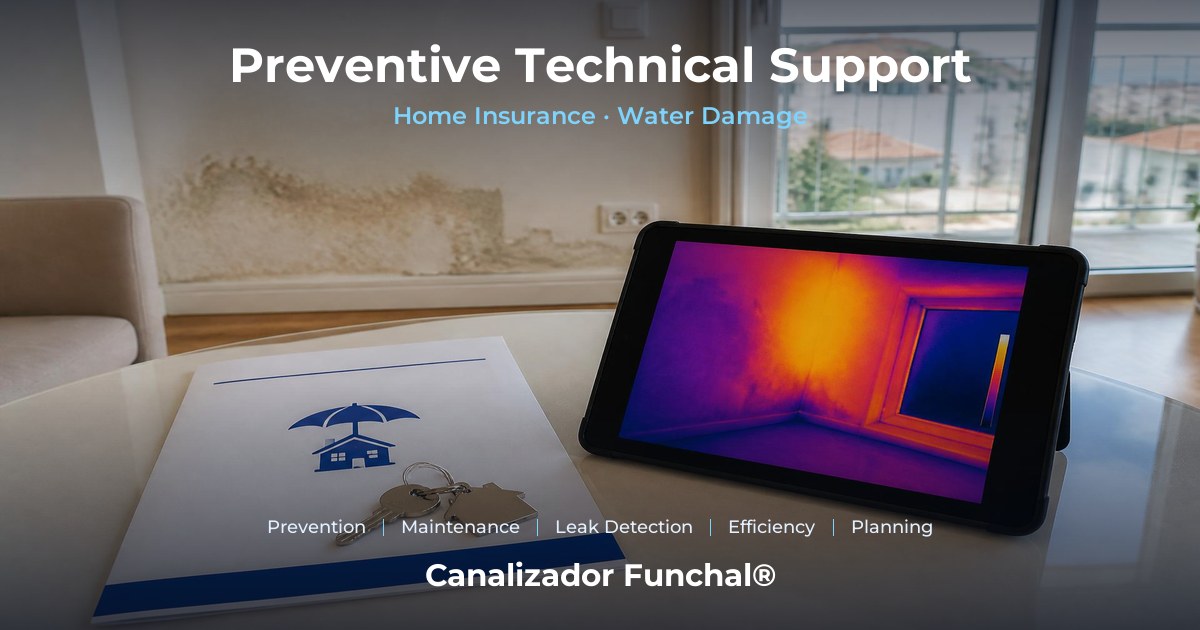
Anyone buying a home in Funchal, Caniço, Santa Cruz, Câmara de Lobos or any other municipality in Madeira has already invested a significant amount before even holding the keys: deposit, deed, taxes, registration and moving costs. When home insurance comes up, the natural instinct is to look for the cheapest option outside the bank, or to accept an initial proposal without assessing the technical details of the property. That is precisely where the risk lies. In many cases, when leaks occur — the neighbour's ceiling dripping or a soaked wall — the owner assumes that “insurance covers everything”, only to discover later that the policy does not include the appropriate cover, or carries an insufficient limit. This article explains, in plain language, what your home insurance policy in Madeira must never be missing.
🏠 The Dilemma of Buying a Home in Madeira
1) Property acquisition costs in Madeira have risen in recent years, stretching many family budgets to the limit by the time insurance is arranged. 2) Multi-risk home insurance is mandatory for properties with a mortgage. However, it does not have to be bought through the lending bank: external insurers are an option and are often more economical, provided the choice is made with due care. 3) The problem is not contracting outside the bank, but choosing a policy on price alone, without technical advice on the property's real needs. 4) Some base products carry only the minimum contents limit and keep the optional covers switched off, so the annual premium looks more attractive. 5) In apartments in Funchal, Santa Cruz and other municipalities the most frequent risk is not fire or theft, but water damage — burst embedded pipes, a leaking concealed cistern, a water heater with a leak, or damaged appliance connections. 6) A marginal difference in the annual premium can decide whether the insurer takes on a repair worth thousands of euros or the owner bears the full cost. 7) The technical recommendation is always the same: read the Particular Conditions and check, cover by cover, which limits are active and which excesses apply.
⚠️ The Wording Difference: “Flood” Is Not “Water Damage”
1) This is one of the most frequent ambiguities in the field: the client spots the word “flood” in the policy and assumes protection against any water-related problem. 2) In insurance policies, “Flood” typically refers to natural, external events: storms, torrential rain, flash floods or overflowing streams — relevant occurrences in the Autonomous Region of Madeira, but they do not cover failures in the internal plumbing system. 3) “Water Damage” is the specific cover that responds to burst pipes, blockages with overflow, accidental discharges and leaks originating in the property's own water and waste system. 4) These are distinct covers, with their own limits and excesses, often contracted independently. 5) The absence of the appropriate cover frequently results in the claim being declined: once the survey confirms that the origin is an internal pipe and that cover is not in the policy, the file is closed without compensation. 6) It is also important to distinguish “sudden and accidental water damage” from slow leaks caused by lack of maintenance — the latter are usually excluded, which is why acting quickly and documenting the event technically matters. 7) Before signing, confirm with the insurer: “What limit applies to Water Damage, what excess applies and what are the policy exclusions?”.
✅ The Three Essential Covers
1) WATER DAMAGE AND ACCIDENTAL DISCHARGE — covers the direct loss caused by water escaping accidentally: burst embedded pipes, appliance connections, concealed cisterns or discharging water heaters. 2) LEAK SEARCH AND DETECTION — funds the work needed to locate the origin of the leak using non-destructive means (thermography, tracer gas, acoustic geophone, pressure testing and video inspection). It avoids unnecessary demolition. Check that the limit assigned to this cover is enough for complex technical work. 3) REPAIR OF THE FAILURE AND THIRD-PARTY DAMAGE — the pipe repair itself (labour plus opening and making good) and civil liability for damage caused to neighbouring flats are frequently separate guarantees. In multi-dwelling buildings, third-party damage cover is essential to safeguard neighbourly relations and avoid heavy costs. 4) Also check: adequacy of the contents limit, excess per claim, cover for debris removal and reinstatement of finishes, and any limits per metre of pipework replaced. 5) For properties intended for letting or holiday rental (common in Funchal, Caniço and Machico), confirm that the policy expressly contemplates that use.
📄 The Role of the Independent Technical Report
1) The insurer's loss adjuster is not a plumber and visits once, often weeks after the incident, when the stain has dried and the evidence is gone. 2) An independent technical report, produced by whoever carried out the detection, turns suspicion into proof: it describes the method used, the exact origin of the leak, the path of the water and the extent of the damage. 3) Our reports include dated photographic records, thermal images, pressure test results, identification of the affected pipe run and a description of the repair carried out or proposed. 4) This document answers the three questions every insurer asks: what is the origin, was it sudden and accidental, and what is a reasonable repair cost. 5) Without a report the process drags through email exchanges and often ends in refusal for “undetermined cause” or “normal wear and tear”. 6) Where a neighbour is involved, the independent report is also what separates liability between flats and stops the building association paying for what belongs to a private unit — or the reverse. 7) Always keep a copy: if you sell the property, it proves the defect was properly treated.
🧭 Recommended Steps in the First 48 Hours of a Claim
1) Close the main stopcock to contain the spread of the damage. 2) Record with photographs and video the state of the rooms, damp stains, affected belongings and water meter readings. 3) Notify the claim to the insurer as soon as possible (within the maximum period set in the policy, usually up to 8 days) and keep the claim number. 4) Request activation of the leak search and detection cover before authorising any demolition work. 5) Use a specialised technical service to locate the leak with non-destructive methods. 6) If neighbouring flats are damaged, inform the building management and the insurer in writing. 7) Avoid concealing or permanently repairing the area before the survey, carrying out only the containment strictly needed to stop the water (properly documented with invoices and photographs).
🎯 Definitive Technical Solution
1) Technical report with a thermal imaging camera: when the insurer refuses the survey or claims there is no proof of the leak's origin, the answer is to formally submit a non-destructive diagnostic report with infrared thermal images. Thermography detects millimetric temperature variations caused by trapped moisture or by the leak under plasterboard, walls and screeds, accurately mapping the origin and the true extent of the failure without breaking anything. 2) Incontestable technical evidence: the report with infrared photographic records, annotated plans and reading dates is the documentary proof that obliges the insurer to cover both the leak search — opening only at the exact point — and the repair of the damage and the restoration of the property to its original condition, including paint and finishes.
🛠️ Technical Intervention Methodology
1) NON-DESTRUCTIVE DETECTION — use of a thermal camera, tracer gas, acoustic geophone and pressure testing to identify the exact point of the leak without damaging structures unnecessarily. 2) DETAILED TECHNICAL REPORT — a conclusive document with photographic and thermographic records, measurements and a reasoned diagnosis to support the claim file with the insurer. 3) REPAIR AND REINSTATEMENT — repair works executed with records of every stage (before, during and after) for the adjuster's validation. 4) GEOGRAPHIC COVERAGE — service across the whole island of Madeira: Funchal, Caniço, Santa Cruz, Machico, Câmara de Lobos, Ribeira Brava, Ponta do Sol, Calheta, Santana, São Vicente and Porto Moniz. 5) MULTI-DWELLING WORK — where claims affect neighbours, the origin and the damage in each flat are documented individually. 6) PREVENTIVE SURVEYS — assessment of the state of the plumbing before buying a property or signing a tenancy agreement. 7) Contact Canalizador Funchal® on WhatsApp or call 962 583 137: with photographs and a description of the situation, we can indicate the most appropriate technical approach straight away.
FAQ
The insurer refuses the survey for lack of evidence. What should I submit?
A non-destructive diagnostic report produced with a thermal imaging camera. The infrared images show the temperature variations caused by moisture under walls, plasterboard and screeds and pinpoint the exact leak, removing the insurer's undetermined-origin argument.
Does a thermographic report force the insurer to pay for the repair and repainting?
It is the technical evidence used to demand both parts: the leak search, opening only at the exact identified spot, and the repair of the damage with restoration of the property's original condition, finishes and paint included, under the policy's water damage cover.
Does home insurance always cover a burst pipe?
No. It only covers it if the policy has active water damage and accidental discharge cover, within the limit and conditions contracted. A base policy chosen purely on price may have that cover switched off or capped very low. In addition, most insurers require the damage to be sudden and accidental: slow leaks with years of visible warning signs are often classified as lack of maintenance and refused.
What is the difference between “flood” and “water damage” cover?
“Flood” covers external events such as storms, torrential rain and flash floods — very real in Madeira, but unrelated to your plumbing. “Water damage” covers water escaping from the home's internal system: burst pipes, appliance discharges, overflows and leaks originating in pipework. They are different covers with their own limits and excesses. Having one does not mean having the other, and this is precisely where most refusals happen.
Does the insurer pay for finding the leak or only for the repair?
It depends on the leak search and detection cover. That cover, not the damage cover, pays for locating the origin with thermography, tracer gas, acoustic equipment or pressure testing. In budget policies it is usually switched off or limited to low amounts that do not stretch to a complex case. Before authorising any demolition, ask your insurer in writing to activate this cover and confirm the available limit.
Why do insurers refuse leak and damp claims?
The most common reasons are: the required cover was not taken out, the origin of the damage was not demonstrated, notification was late, the damage is considered gradual rather than sudden, or there is no evidence of the previous condition. Nearly all of these are beaten with documentation: dated photographs, immediate notification and an independent technical report identifying the exact origin and classifying the event technically.
How much does leak detection and a technical report cost in Funchal?
Technical leak investigation and diagnosis for an insurer start, as a guide, from €250. The method and documentation depend on the area, construction and equipment required. See the full pricing page; any applicable travel fee is shown separately on the map.
My downstairs neighbour suffered damage. Who pays?
If the origin is in your flat, your civil liability cover responds, within the limit contracted; if it is in common parts, such as a building stack, the building association's policy responds. If it is in the flat above, their policy responds. Correctly determining the origin is therefore the decisive part — and that is exactly what an independent technical report, produced by whoever performed the on-site detection, is for.
Water damage at home or doubts about your policy? Message us on WhatsApp for leak detection and a technical report accepted by insurers.
We provide leak detection, insurance technical reports and repairs in Funchal, Caniço, Santa Cruz, Machico, Câmara de Lobos, Ribeira Brava, Ponta do Sol, Calheta, Santana, São Vicente and Porto Moniz, across Madeira Island.