Changed Your Shower Faucet and Lost Hot Water? The Hidden Trap of Old Built-In Plumbing
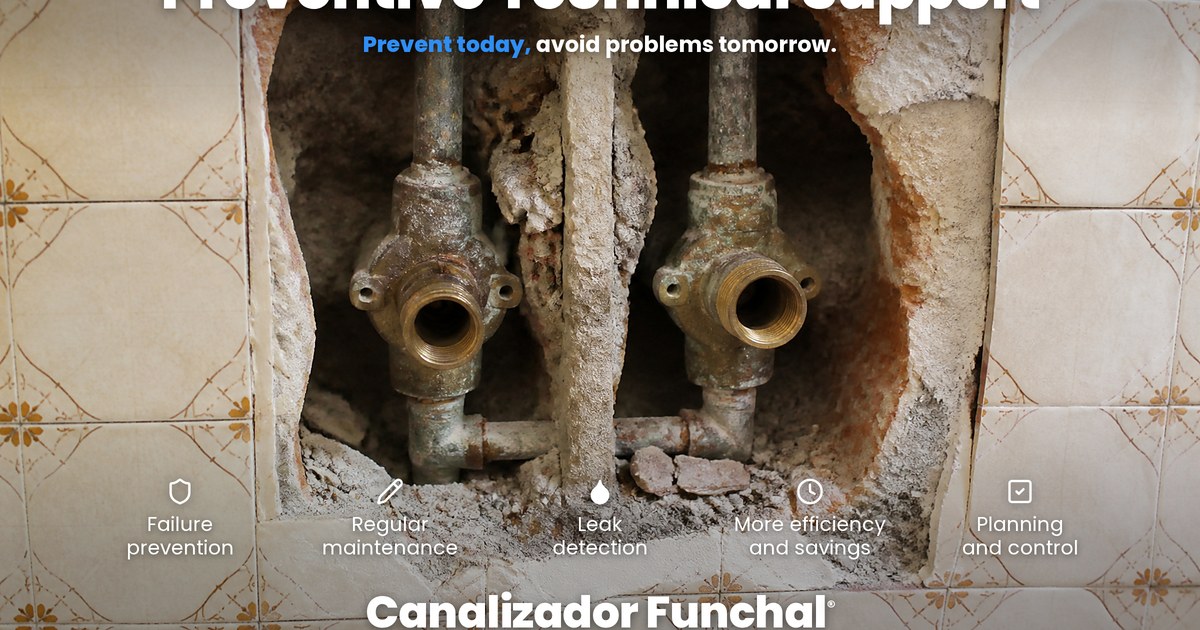
It is one of the most frequent call-outs we get in Funchal, Caniço, Santa Cruz and the other municipalities of Madeira: the customer swaps an old shower tap for a modern exterior mixer, everything looks great — and the hot water is gone. Either it runs warm for thirty seconds and turns cold, or the gas heater simply refuses to ignite. Before buying a new heater or replacing the cylinder, you need to understand a particular feature of Madeiran houses built between the 1960s and the 1980s: in those homes, hot and cold water were mixed inside the wall, not in the tap. When the old headworks are removed without closing those passages (something practically impossible to do without breaking the wall around the taps), an invisible internal hydraulic circuit is created, with constant movement and communication between hot and cold water.
🔎 Symptoms & Initial Diagnosis
1) Hot water disappeared completely at the shower right after the new mixer was fitted, even though the basin and the kitchen still deliver hot water. 2) Water runs hot for a few seconds then cools rapidly, even with a full, powered cylinder — the classic sign of cold water entering the hot circuit. 3) The gas heater tries to fire, clicks and goes out, or never lights at all, because it does not receive enough one-way flow. 4) The cold pipe feels lukewarm at points where it was never warm, indicating crossover between circuits. 5) The cylinder cycles constantly with a visible rise in electricity use, because the heated water is circulating in a loop and losing heat. 6) Closing the cold isolation valve suddenly brings hot water back at the shower — the single most revealing test, and confirmation of the bypass effect. A rigorous diagnosis uses a pressure gauge on both circuits, point-by-point flow testing and a check of what was left open inside the wall.
🧱 How Old Built-In Valves Were Made in Madeira
1) In buildings in Funchal, Câmara de Lobos, Machico, Santa Cruz and Calheta raised between the 1960s and 1980s, the bath or shower was served by two individual headworks screwed onto 1/2" threads and buried in the wall. 2) Each one controlled a single inlet — one cold, one hot — and mixing happened inside a common body, also buried, feeding the shower rose and the spout. 3) There was no exterior mixer tap: the handles were visible, but all the hydraulic work was hidden in the masonry. 4) Connections were run in threaded galvanised pipe, often with bends and tees made up on site. 5) That internal mixing body has no check valves whatsoever: hot and cold communicate freely the moment the headworks stop closing the passages. 6) It is precisely this architecture, invisible to anyone looking at a finished wall, that turns a simple tap swap into a whole-house hot water problem.
⚠️ The Common DIY Mistake and the Bypass Effect
1) The typical mistake: pull out the old headworks, screw two eccentric wall unions into the existing threads and mount a modern exterior mixer on top. 2) Once the headworks are removed, the internal hot and cold passages stay permanently open and interconnected inside the wall, forming a closed loop between both branches. 3) Since cold water normally arrives with higher pressure and direct mains flow, it pushes the hot water backwards — the bypass, or pressure reversal, effect. 4) On a stored hot water system, the heated water circulates continuously through the loop created in the wall: it cools immediately, the cylinder reheats non-stop and electricity consumption soars. 5) On a gas instantaneous heater, the missing pressure differential between inlet and outlet stops the diaphragm from operating and the appliance will not ignite, even in perfect condition. 6) The symptom is misleading: it looks like appliance failure, and it is very common in Madeira to see customers replace heaters or cylinders unnecessarily, only to face exactly the same problem the next day. 7) In apartment blocks, the same bypass can contaminate the shared riser and trigger complaints from neighbours short of hot water.
🧪 Why Hot Water Destroys Galvanised Pipe Faster
1) Galvanised pipe is steel protected by a zinc layer; above 55–60 °C that protection degrades and reverses electrochemically, leaving the steel exposed to corrosion. 2) Thermal shock and constant temperature swings — typical of short, repeated showers — make the metal expand and contract, cracking the inner layer and releasing rust. 3) That is why, in the same house, the hot branch blocks up, loses pressure and runs brownish long before the cold branch, which may still be acceptable. 4) The wall thickness of old pipework is deceptive: from the outside the pipe looks solid, but corrosion grows inwards and the usable bore can shrink to half or less, with no visible leak at all. 5) In Madeira, salty air in Funchal, Caniço and Machico plus permanent humidity accelerate external corrosion in poorly insulated buried sections, attacking the pipe from both sides. 6) Combine a bypass with degraded galvanised pipe and the complaint is no longer only about temperature but also about pressure: poor flow, dirty water and noise in the pipework. 7) Once hot galvanised pipe reaches that state, patching one length only pushes the problem down the line — replacement in multilayer or PEX is the only durable route.
🛠️ The Specialist's Step-by-Step Solution
1) Confirming the diagnosis by selectively closing valves and reading pressure on both circuits, proving internal communication exists before opening any wall. 2) Minimal, surgical opening at the old built-in valve position, preserving existing tiles wherever possible and protecting the shower tray. 3) Permanent isolation of the internal passages: threaded brass plugs with the correct sealant, or cutting and capping the old mixing body, completely eliminating the loop between hot and cold. 4) Creating two independent feeds up to the mixer's eccentric unions, in multilayer or PEX, at standard centres and with no hidden joints inside the wall. 5) Replacing the degraded hot galvanised section whenever inspection shows restriction or rust, taking advantage of the opening already made. 6) A pressure test on the circuit before closing up, followed by temperature and flow testing at every outlet in the house. 7) Tile reinstatement or a discreet inspection panel, plus a final check of the gas heater or cylinder — which in the vast majority of cases never had a fault at all. 8) Handover of a photographic record of what was left inside the wall, an essential document for future work.
🧰 What to AVOID and Preventive Maintenance
1) Avoid mounting an exterior mixer over an old built-in valve without confirming the internal passages are sealed — it is the origin of practically every case we resolve. 2) Avoid replacing a heater or cylinder before ruling out the bypass: on most call-outs in Funchal and Caniço the appliance is fine. 3) Avoid covering the old recess with filler or silicone hoping it will seal: the communication is internal, not superficial. 4) Avoid mixing old galvanised pipe with fittings in other metals without a dielectric union, or galvanic corrosion will accelerate. 5) Maintenance: check working pressure yearly, keeping it between 3 and 4 bar with a reducing valve at the inlet, which protects mixers and appliances. 6) Fit a sediment filter at the main inlet, especially in Santana, São Vicente and higher areas where water carries particles after heavy rain. 7) Operate the isolation valves once a year and clean the filters in the eccentric unions and shower head to prevent blockages from galvanised debris.
FAQ
Why did I lose hot water only after changing the shower tap?
Because in old built-in installations hot and cold were mixed inside the wall, through two headworks on 1/2" threads. Removing those headworks to fit an exterior mixer leaves the internal passages open and connected to each other. Cold water, arriving at higher pressure, enters the hot circuit and pushes the heated water backwards. The result is lukewarm water that cools immediately, or a heater that never ignites. The appliance is fine: the problem is in the wall.
Will you need to break a lot of tiles to fix this?
On most jobs we do in Funchal, Caniço and Câmara de Lobos the opening is small and confined to the old valve recess, often hidden afterwards by the mixer itself or by a discreet inspection panel. Only when the hot galvanised pipe is severely restricted does it pay to widen the opening and replace that section. We always assess the least destructive option first and explain the alternatives before starting.
How long does the repair take?
A straightforward case of isolating the internal passages and connecting the mixer correctly is usually resolved in a two to three hour visit. If the hot galvanised section has to be replaced with multilayer pipe, expect half a day to a full day of work, plus tiling reinstatement time. We confirm the timeframe on site after diagnosis, and we never close a wall without a pressure test.
How much does it typically cost to fix in Funchal and across Madeira?
The figure depends on whether only the internal passages need isolating or degraded pipework must also be replaced, on the finish to be reinstated and on access to the technical area. We never quote blind: we assess, explain the options and confirm the price before starting. Send photos of the tap and the wall on WhatsApp to 962 583 137 and you get a same-day estimate with no obligation.
Is it worth replacing the gas heater or the cylinder?
Almost never. On a large share of the no-hot-water call-outs we attend after a tap change, the heater or cylinder is perfectly functional — what is missing is pressure differential, because of the bypass created in the wall. Before buying anything, run the simple test of closing the shower's cold isolation valve: if hot water reappears elsewhere, the appliance is not to blame.
Which materials do you recommend to last in Madeira's sea air and humidity?
In coastal areas of Funchal, Caniço, Santa Cruz and Machico we use multilayer or PEX pipework with press fittings, low-zinc brass fittings and quality eccentric unions, avoiding cheap chrome parts that degrade quickly in salt. In higher, damper areas such as Santana or Câmara de Lobos we reinforce insulation on the hot branch to reduce thermal shock and condensation. Call 962 583 137 and we will advise the longest-lasting solution for your home.
Lost hot water after changing your tap? Message us on WhatsApp before replacing any appliance.
We diagnose and fix loss of hot water after tap replacement in Funchal, Caniço, Santa Cruz, Machico, Câmara de Lobos, Ribeira Brava, Ponta do Sol, Calheta, Santana, São Vicente and Porto Moniz, across Madeira Island.