Wireless Motorised Actuators for Ball Valves: Remote Water Shut-Off
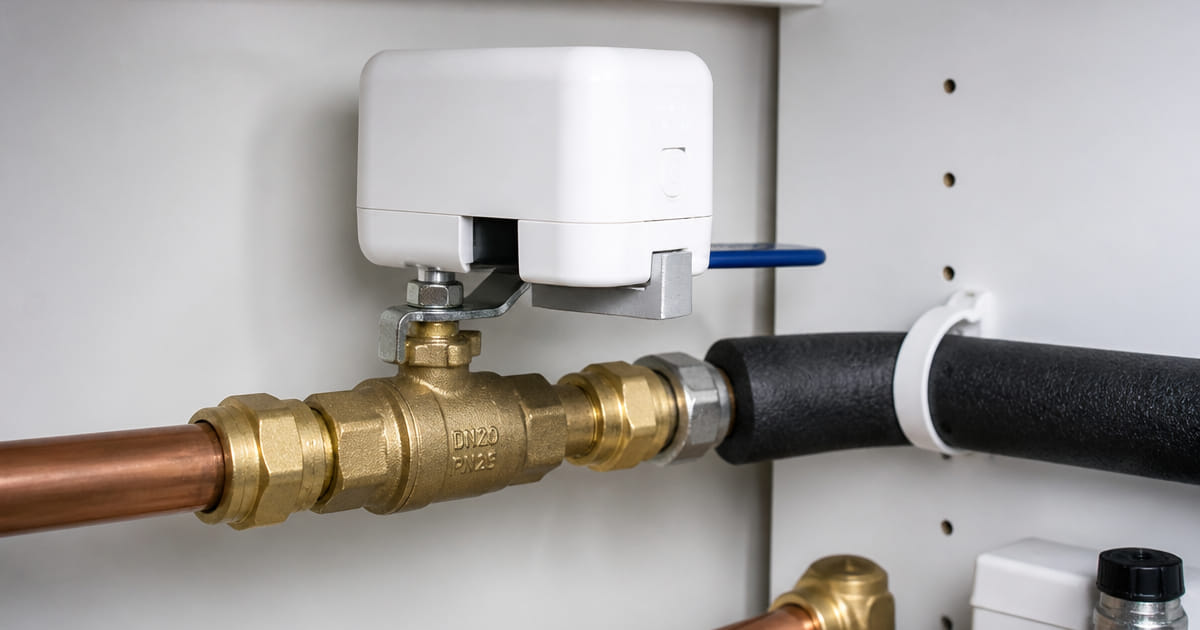
One practical obstacle makes many people give up on automatic water shut-off: the idea of cutting pipework, working inside the meter cabinet and taking on the risk of a new joint leaking. The wireless motorised actuator solves that elegantly — it replaces nothing. It clamps onto the lever of the ball valve you already have and turns it electrically, leaving the plumbing exactly as it is. For anyone who rents out a property, travels, or simply wants to sleep soundly, it is the simplest and most reversible step available.
🔧 What a Wireless Actuator Is and How It Mounts
1) It is a small motor with a mechanical arm that grips the lever of the existing ball valve. 2) Fixing uses an adjustable clamp or metal bracket — no soldering, no glue, no pipe cutting. 3) The motor turns the lever 90° in a few seconds and reports position back. 4) It does not touch the hydraulic circuit: no new joints means no new leak points. 5) Power can be long-life batteries or, preferably, a permanent 5 V supply. 6) It is fully reversible: removed in minutes, leaving the valve as it was — important in rented property.
🆚 Actuator on an Existing Valve or a New Motorised Valve
1) The actuator wins where you do not want to touch pipework or are not allowed to modify the meter cabinet. 2) A dedicated motorised valve wins on long-term robustness and consistently fast closure. 3) Cost: the actuator is clearly cheaper and needs no plumbing labour. 4) Critical requirement: the existing valve must turn smoothly by hand — if limescale has seized it, replace it first. 5) In buildings with a communal meter cupboard, the actuator avoids approvals that would delay the work. 6) In practice we fit actuators in rented properties and motorised valves in owner-occupied homes or refurbishments.
📶 Zigbee, Wi-Fi or Bluetooth: Choosing the Protocol
1) Zigbee runs on a low-power mesh and is the most stable option in cabinets and plant areas far from the router. 2) Wi-Fi needs no hub and allows direct internet control, but draws more power and is sensitive to signal quality. 3) Bluetooth only makes sense for local operation, without true remote control. 4) Thread and Matter are becoming the interoperability standard — that is what we recommend for new installations. 5) Check that the device keeps working locally when the internet fails. 6) In external cabinets in Funchal, metal and concrete attenuate signal: plan a repeater or place the hub nearby.
🏠 Integration with Sensors and Automations
1) The essential automation is simple: leak sensor triggers, actuator closes the valve, notification is sent. 2) A second useful one: close the water automatically when 'away' mode is set, and reopen on arrival. 3) A third: alert if the meter records continuous consumption above a threshold for hours. 4) Typical compatibility with Home Assistant, Google Home, Apple Home and Alexa, depending on model. 5) Always keep a physical button on the actuator for operation without a phone. 6) Document the automations on a card inside the cabinet — cleaners and maintenance staff need to know.
⚠️ Technical Limits to Respect
1) Motor torque is limited: stiff, old or limescaled valves may not reach full closure. 2) The valve must be a ball valve with a lever handle — plug or globe valves are not compatible. 3) Leave physical clearance around the lever: a cramped cabinet blocks the arm's travel. 4) On batteries, standby draw is low but actuation is demanding — prefer a permanent supply where one exists. 5) Cycle the valve periodically: a valve that never closes eventually seizes. 6) If the valve is over 10 years old, replace it before motorising — cheaper than discovering the problem mid-leak.
🛠️ Assisted Installation and Acceptance Tests
1) We first check the valve type and condition, the torque needed and the space available. 2) We test full manual rotation and replace the valve when effort is excessive. 3) We fit the actuator, calibrate open and closed positions and confirm repeatability. 4) We simulate a real leak with a floor sensor and time the total closure. 5) We test network and power loss, plus manual emergency operation. 6) Want to know if your valve is compatible? Send us a photo on WhatsApp and we will tell you straight away.
FAQ
Does installation require cutting the water or the pipe?
No. The actuator clamps to the existing valve lever and never touches the hydraulic circuit. It is installed with the water in service, in around 30 minutes.
Does it fit any meter valve?
It fits ball valves with lever handles that turn smoothly by hand. Plug valves, globe valves or limescale-seized valves must be replaced first.
What if the phone or the internet fails?
The actuator keeps a local physical button and the valve can always be turned by hand after removing the bracket. No automation blocks manual control.
Does it use much power or drain batteries quickly?
Standby draw is minimal; actuation is the demanding moment. With normal use batteries last around a year, but we recommend a permanent supply whenever a socket exists.
Want to shut off your property's water remotely, with no building work? Message us on WhatsApp.
We work in Funchal, Câmara de Lobos, Caniço, Santa Cruz, Machico, Ribeira Brava, Ponta do Sol, Calheta, Santana, São Vicente and across the whole island of Madeira.