Wi-Fi and Bluetooth Water Leak Sensors for Holiday Rentals in Madeira
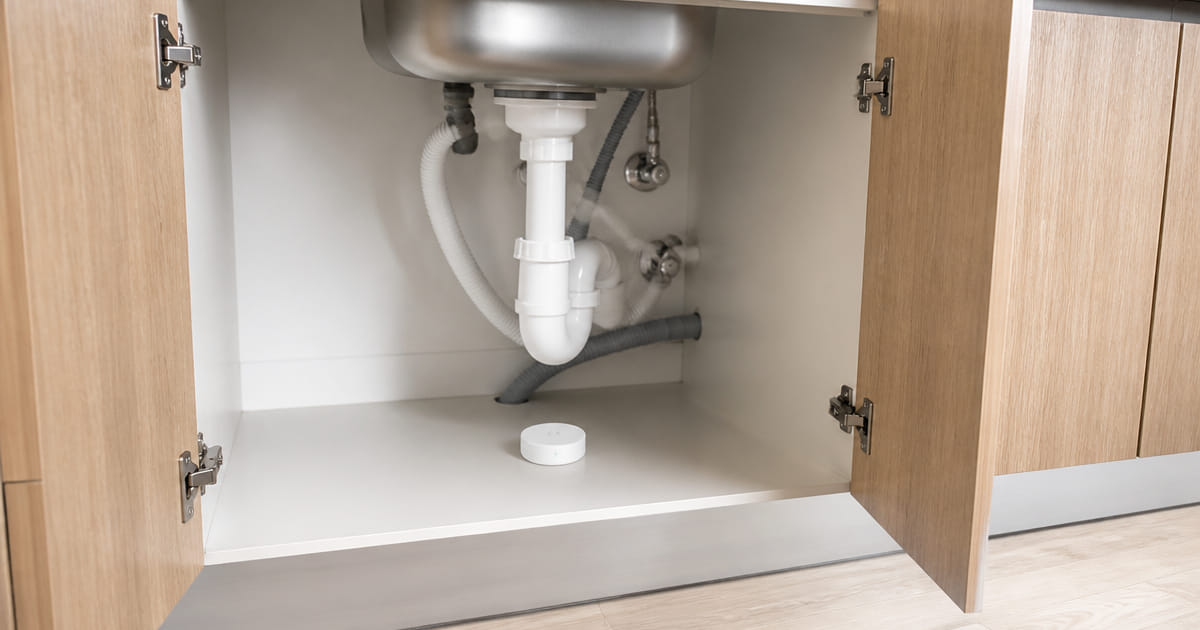
In a holiday rental, a leak found late does not only cost the repair: it costs cancelled bookings, poor reviews and damage to the flat below. And the pattern repeats — leaks almost always happen while the property is empty, between guests or out of season. Wireless sensors solve that blind spot: they are placed in minutes, with no building work, and turn a silent flood into an immediate notification on the owner's or manager's phone.
🏠 Why Holiday Rentals Are the Most Critical Case
1) The property stands empty for long stretches: a leak runs freely for weeks. 2) Guest turnover accelerates wear on hoses, taps and appliance connections. 3) Many owners live on another island or abroad and cannot inspect regularly. 4) Damage to the flat below involves third parties, the building management and insurers, with long timescales. 5) The booking calendar is unforgiving: two days of works can trigger a chain of cancellations. 6) Remote monitoring is the only realistic way to shorten the time between leak and response.
📡 Wi-Fi or Bluetooth: Which to Choose
1) Wi-Fi sensors connect straight to the router and send alerts anywhere in the world — the right choice for absent owners. 2) They need stable coverage at the installation point, which must be verified in concrete and stone-walled buildings. 3) Bluetooth sensors work over short range and suit local checks, or pair with a hub that bridges to the internet. 4) The most robust setup is a local mesh with a hub (Zigbee, Thread or proprietary) and a single internet-connected point: lower power, better range. 5) Check whether alerts still work when the internet drops — the best systems keep a local siren. 6) Choose devices with a declared 2-year battery life or more, plus low-battery warnings.
🧭 Where to Place Them in Each Room
1) Kitchen: at the back of the sink cabinet, next to the trap and the dishwasher isolating valves. 2) Bathroom: behind the toilet base and at the lowest point next to the shower tray or bath. 3) Laundry: under the washing machine and next to the floor drain. 4) Water heater: directly under the cylinder and the safety valve. 5) Plant or meter area, if it is inside the property. 6) Rule of thumb: one sensor per relevant water point, always on the floor and where water pools first.
📱 Useful Alerts Versus Ignored Alerts
1) Give each sensor a clear per-room name — 'Kitchen sink', 'Suite shower' — so you can act without hesitating. 2) Configure critical notifications that bypass phone silent mode. 3) Add a second recipient: property manager, cleaning company or trusted neighbour. 4) Enable low-battery and sensor-offline warnings, because a silent sensor is worse than none. 5) Leave written instructions in the property showing where the main stopcock is. 6) Test the alerts once a quarter with a damp cloth — two minutes per sensor.
🔗 Combining Sensors with Automatic Shut-Off
1) A sensor warns but does not close the water — if nobody can attend quickly, damage keeps growing. 2) Linking sensors to a motorised valve at the inlet gives automatic closure in seconds. 3) In holiday lets we also recommend isolating appliances while the property is empty. 4) A pressure-reducing valve stabilises the system and lowers the chance of burst hoses. 5) A particle filter at the inlet protects taps and valves from grit, common in spring-fed areas. 6) That combination — sensors, automatic shut-off, controlled pressure — is what we consider the standard for tourist rentals.
🌊 Local Realities That Change the Choice
1) Many Madeira apartments have external plant areas and exposed balconies — use equipment rated for humidity and salt. 2) In properties on spring or borehole water, grit demands filtration and sensors at lower points. 3) In older Funchal centre buildings, wall thickness calls for Wi-Fi repeaters or a nearby hub. 4) Heavy rain and balcony ingress can cause false positives: keep sensors away from external doors. 5) Long empty periods dry out traps and bring odours — worth combining with scheduled flushing. 6) We can supply, install, configure and test the whole system — message us on WhatsApp.
FAQ
Do I need building work or an electrician?
No. Wireless sensors are battery powered and simply sit on the floor. Only the hub needs a socket, and a typical apartment is done within an hour.
What if the apartment internet is down?
The sensor still sounds locally and logs the event, but the remote alert only arrives once the connection returns. That is why we recommend automatic shut-off for long empty periods.
How many sensors does a one-bedroom rental need?
Usually three to four: kitchen sink, bathroom, washing machine and water heater. Fewer than that almost always leaves the point that fails first uncovered.
Can guests unplug or move the sensors?
We place them discreetly, inside cabinets and behind appliances. With sensor-offline alerts enabled, any removal is detected immediately.
Own a holiday rental in Madeira? Message us on WhatsApp and we will protect the property without building work.
We work in Funchal, Câmara de Lobos, Caniço, Santa Cruz, Machico, Ribeira Brava, Ponta do Sol, Calheta, Santana, São Vicente and across the whole island of Madeira.