Water Seeping Through Bathroom Floor Grout: How to Diagnose It
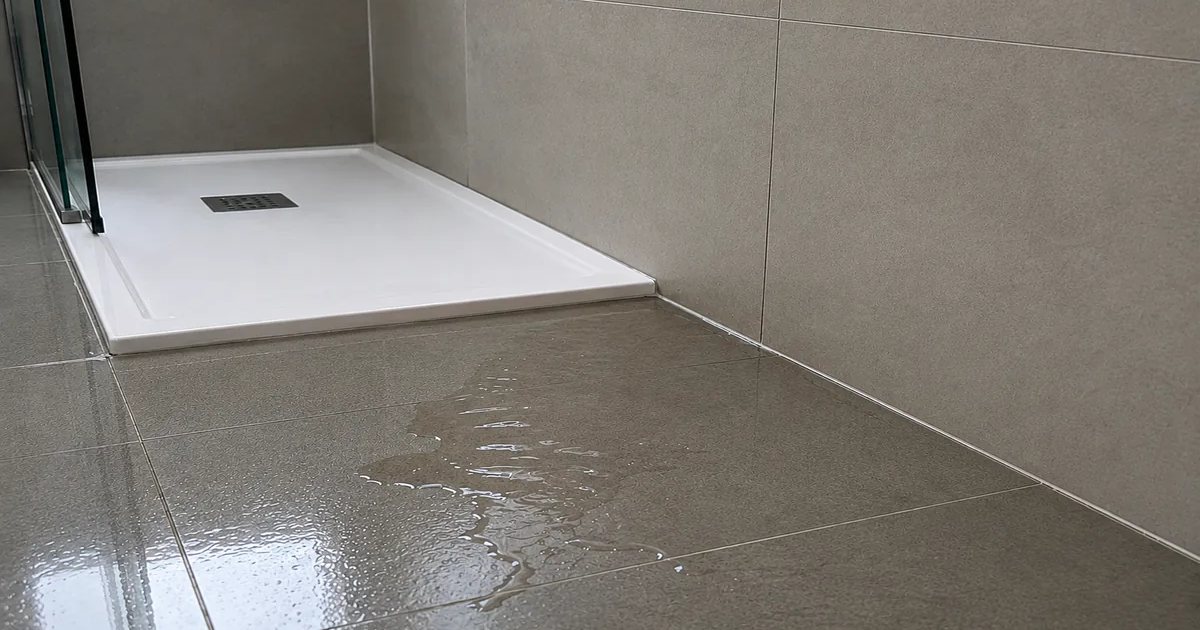
Water appearing between the tiles after a shower means moisture is trapped under the floor. The tile itself is rarely the source — the real question is where water gets into the screed.
🔎 Symptoms & Initial Diagnosis
Before breaking any tile, check three things: 1) when the water appears — only after long showers, always near the drain, or even with no shower use; 2) whether the floor stays permanently damp to the touch days later; 3) whether there are stains on the ceiling below (slab leak) or just a musty smell (badly sealed floor drain). Shut off the water supply and read the meter: if it keeps turning with everything closed, the source is a leak in embedded pipework, not a simple sealing failure.
🧪 Main Causes
The three most common technical causes in bathrooms across Funchal and Câmara de Lobos are: 1) a failed silicone bead at the shower tray or bath, letting water seep behind the tiling; 2) a floor gully or linear drain poorly bonded to the waterproofing membrane, creating a path around it; 3) a rupture in the toilet supply or waste pipework embedded in the slab, worsened by thermal expansion of the pipes and, in older buildings, by corrosion accelerated by sea air (maresia). High mains pressure, common in elevated areas like Santa Cruz, also speeds up wear on joints and connections.
🛠️ Ideal Step-by-Step / Immediate Action
1) Close the bathroom's isolation valve and minimise use of the affected shower. 2) Dry the floor thoroughly after each use, so the exact infiltration point is not masked. 3) Photograph, with dates, how the grout and ceiling stains progress. 4) If there is a neighbour below, notify them immediately in writing — this record matters for insurance. 5) Book thermal imaging and tracer-gas detection before any intervention, so only the exact spot is opened.
🚫 What to AVOID
Avoid: 1) randomly breaking tiles looking for the leak, which multiplies repair costs without guaranteeing you find the source; 2) applying silicone or sealant over an area that is still damp, since trapped moisture rots the screed underneath and the sealant fails within weeks; 3) closing an insurance claim without a technical report identifying the cause — many insurers reject claims of 'undetermined cause'; 4) ignoring a persistent smell near the drain, assuming it is just poor cleaning.
🧰 Preventive Maintenance
Inspect shower tray silicone yearly and replace it preventively every 3-5 years, especially in homes near the sea in Machico or Caniço, where salty air degrades sealants faster. Check that the floor drain runs freely without odour or standing water around it. In buildings over 15 years old, consider a preventive thermal-imaging inspection of embedded pipework, especially where mains pressure is high — a correctly sized pressure reducer significantly extends the life of joints and connections.
FAQ
Could it just be the silicone?
Yes, and it is the most common case. A degraded silicone bead lets through enough water to soak the entire screed.
Do I have to lift the floor?
Only if we confirm a leak in embedded pipework — and even then, prior detection lets us open just the exact area.
Is the leak mine or from the flat above?
If the floor is wet on top and the ceiling dry, the source is yours. Ceiling stains point to the flat above.
Can this damage the structure?
Prolonged moisture degrades mortar, loosens tiles and can corrode reinforcement. It should be fixed quickly.
Need help now? Fast response on WhatsApp.
We work in Funchal, Câmara de Lobos, Caniço, Santa Cruz, Machico, Ribeira Brava, Ponta do Sol, Calheta, Santana, São Vicente and across Madeira Island.