Water Pressure Reducer: When to Install One in Madeira
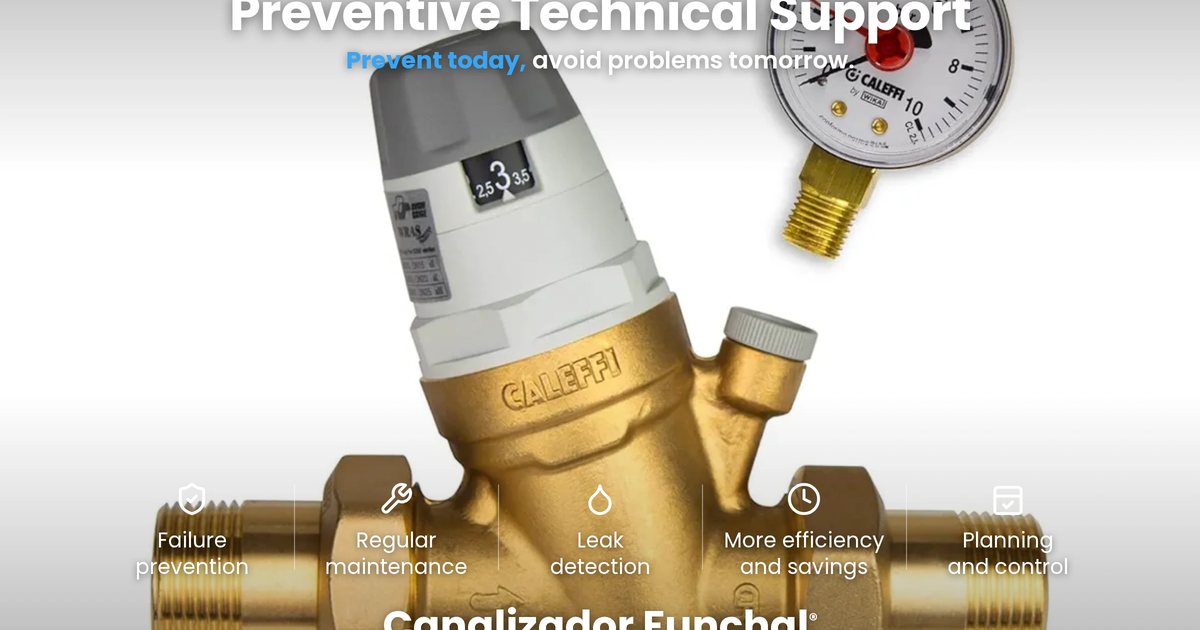
Madeira's terrain creates huge height differences between reservoirs and homes. In several parts of Funchal and the lower parishes, the pressure reaching the tap far exceeds what domestic equipment was designed to handle, with night-time spikes that burst pipes, hoses and cisterns without warning.
🔎 Symptoms & Initial Diagnosis
Before deciding on a reducer, check: 1) taps that splash or make a metallic noise when opened, a clear sign of excessive mains pressure; 2) repeated failures of washing machine or cistern hoses within a short time, often at night when overall demand drops and public pressure peaks; 3) the water heater safety valve dripping constantly, indicating upstream pressure above the factory limit. Measure with a simple gauge on the outdoor tap or washing machine, preferably between 2am and 6am, to capture the real night-time mains peak.
🧪 Main Causes
1) Night-time pressure spikes in the public mains, more pronounced in higher areas of Funchal, Câmara de Lobos and Santa Cruz, where the height difference between the municipal reservoir and the home is greatest. 2) Corrosion from sea air in old metal fittings, common in homes along the coast in Caniço and Machico, weakening the points of least resistance under high pressure. 3) Natural wear of seals in taps, cisterns and hoses, accelerated by the combination of high pressure and Madeira's relatively soft water, which does not protect rubber the way harder water does. 4) Flow and mains pressure differences compared with mainland Portugal, since Madeira's network often runs close to the recommended upper limit. 5) Mechanical expansion of pipework and fittings, worsened by water hammer when taps close abruptly under high pressure.
🛠️ Ideal Step-by-Step / Immediate Action
1) Confirm the static pressure with a gauge, preferably at night, to capture the real peak. 2) If it exceeds 5 bar, plan to install a reducer right after the meter, before the first branch into the home. 3) Always fit a filter upstream of the reducer, to trap sediment and extend the mechanism's life. 4) Add a reading gauge next to the reducer, for a quick visual check whenever needed. 5) Set the reducer between 3 and 4 bar, the ideal comfort value with no noticeable loss of shower flow. 6) Test behaviour both under flow (shower, washing machine running) and at rest, confirming the set value stays stable.
🚫 What to AVOID
1) Delaying replacement of old hoses already showing signs of wear, even after installing the reducer — already compromised parts stay at risk. 2) Using unsuitable tools on brass or copper fittings when installing the reducer or filter, which scratches threads and creates leak points. 3) Over-tightening the reducer's or filter's joints hoping to eliminate any drip — this cracks seals and worsens the problem. 4) Installing the reducer far from the meter, at an interior point of the home, leaving sections of pipework exposed to full mains pressure without protection. 5) Setting the reducer below 2.5 bar, which reduces shower and appliance comfort with no additional benefit.
🧰 Preventive Maintenance
Clean the reducer's filter every 6 to 12 months, especially in areas where the water carries more sediment after public network works. Check the outlet reading on the gauge every 2 years and readjust if needed. Replace connection hoses preventively every 5 years, even without visible wear, especially in coastal homes in Caniço, Machico and Santa Cruz where sea air speeds up corrosion. In homes at higher elevations in Funchal and Câmara de Lobos, consider an annual mains pressure check, since peaks can vary through the year with public network works and changes.
FAQ
How do I know my pressure is too high?
Splashing taps, noisy pipes, a dripping heater safety valve and repeated hose failures are clear signs. Confirm with a gauge, preferably at night.
Where should the reducer be installed?
Immediately after the meter, with a filter upstream and a reading gauge, before any internal branch of the home.
What pressure should I set it to?
Between 3 and 4 bar. That value guarantees shower comfort while protecting pipework, hoses and cisterns from premature wear.
Need help now? Fast response on WhatsApp.
We work in Funchal, Câmara de Lobos, Caniço, Santa Cruz, Machico, Ribeira Brava, Ponta do Sol, Calheta, Santana, São Vicente and across Madeira Island.