Which Toilet Brands to Choose in Portugal? Spare Parts, Durability and Installation Types
Someone who repairs toilets every day looks at sanitary ware very differently from someone buying it in a showroom. The customer sees the shape, the height and the price. We see something else: which internal mechanism it uses, whether a compatible fill valve exists on the Portuguese market, whether the flush valve is a standard part or proprietary, and whether in eight years it will still be repairable instead of requiring broken tiles. This guide gathers what we have learned across hundreds of jobs in Funchal and around Madeira, with no advertising and no brand promises. A good toilet is a repairable toilet.
🚽 What Really Separates a Good Toilet From a Bad One
Quality is not in the catalogue, it is in five technical details. 1) The quality of the internal glaze: well-vitrified ceramic has smooth walls that hold no dirt or odour and stays that way for years. 2) The geometry of the internal trap, which decides whether one flush clears the bowl or two are needed. 3) The type of flush mechanism and whether it is a common standard or a brand-exclusive part. 4) The quality of the supplied fixings: stainless steel bolts and bushes last, cheap zinc-plated ones rust in a marine environment. 5) The service network and how easy it is to find parts in Portugal — the most important criterion and the one most often ignored at purchase.
🔧 Spare Parts: The Decisive Criterion
In a toilet, ceramic rarely fails. Mechanisms do. 1) The fill valve is the part that fails most: it loses its seal, lets water run and inflates the bill. 2) The flush valve wears its bottom seal and causes the classic continuous trickle inside the bowl. 3) Brands using European-standard parts — universal-type mechanisms available in any plumbing supplier — allow fast, cheap repairs. 4) Brands with proprietary mechanisms force special orders, waiting times and sometimes full cistern replacement. 5) With concealed cisterns, the frame brand matters even more than the ceramic brand, because parts must pass through the flush plate without opening the wall. 6) Before buying, ask the seller one simple question: what are the spare parts for this reference and are they held in national stock?
🏗️ Wall-Hung or Floor-Standing: How to Decide
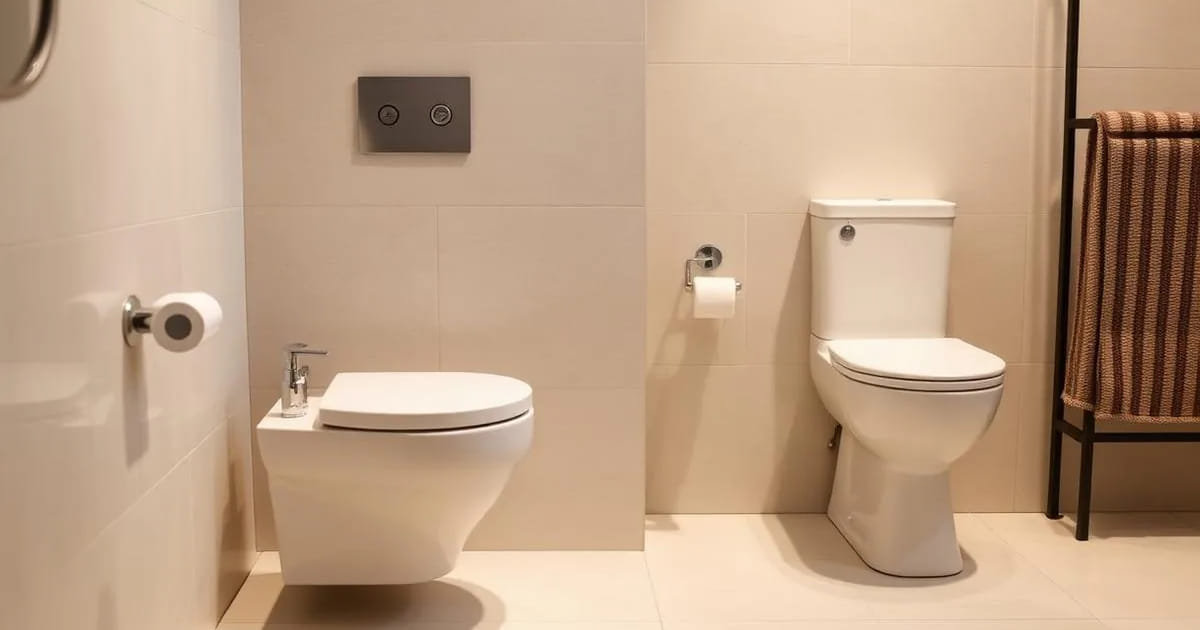
Both are valid, but they solve different problems. 1) A wall-hung toilet frees the floor, makes cleaning easier and lets you set seat height during the works. 2) It needs a properly anchored metal frame and a wall able to take the load — in old stone walls in Funchal that means careful structural preparation. 3) The concealed cistern must always stay accessible through the flush plate, with real working space behind it. 4) A floor-standing toilet is simpler, cheaper to install and lets you replace the cistern without touching walls. 5) In partial renovations, without moving risers or drains, floor-standing is almost always the rational choice. 6) In rentals and holiday lets, ease of fast repair matters more than aesthetics.
🌊 Durability in Madeira: Sea Air, Limescale and Heavy Use
The island environment accelerates wear on components that last longer on the mainland. 1) Salty air attacks cheap chrome, flush plates and zinc-plated fixings — in coastal areas we always use stainless steel and quality brass. 2) Harder water in some areas leaves scale on the flush valve and its seat, causing silent leaks. 3) In holiday lets, daily flush counts can be five to ten times those of a family home, sharply reducing mechanism life. 4) Seats with plain plastic hinges break early under heavy use: we recommend metal soft-close hinges. 5) An annual preventive check of the mechanism costs far less than a water bill inflated by a continuous flush.
⚠️ Installation Mistakes That Ruin Good Toilets
We frequently see excellent ceramics failing because of assembly errors. 1) Sealing the toilet base with silicone all around, leaving no vent, traps moisture and odour underneath. 2) Connecting the outlet to the drain with a misaligned pipe or an unsupported flexible connector causes smells and slow leaks. 3) Over-tightening the fixing bolts cracks the ceramic — the crack only shows months later. 4) Using the wrong sealant on the connector instead of the correct rubber ring. 5) Installing a concealed cistern without full access to the mechanism. 6) Not fitting an isolating valve at each toilet, forcing a whole-house shut-off for any repair. 7) Ignoring height alignment on wall-hung units, leaving the seat permanently uncomfortable.
✅ Practical Advice From Daily Repair Work
Our recommendation never depends on a logo. 1) Prefer common, well-established models on the Portuguese market over short-lived exclusive ranges. 2) Choose universal-standard mechanisms even when the ceramic is premium. 3) For concealed frames, pick systems with a strong national presence and easily sourced parts. 4) Keep the model and mechanism reference in a simple home record — it saves hours in any future repair. 5) Fit an isolating valve at every water point. 6) If you are torn between two models, send us photos on WhatsApp and we will tell you which is easier to maintain in Madeira.
FAQ
Is it worth paying more for a well-known toilet brand?
It is, but not for the name: it is for parts availability and glaze quality. A cheaper toilet with a universal-standard mechanism is often a better choice than a very expensive one with exclusive parts that are hard to source.
Can only the cistern mechanism be replaced?
In most cases yes, and it is the job we do most often. We replace fill valve, flush valve and seal while keeping the ceramic, which fixes continuous flushing and high water bills.
Do wall-hung toilets cause more problems than floor-standing ones?
They do not cause more problems, but they demand correct installation. The risk lies in a poorly fixed frame and insufficient access to the mechanism. Properly done, a wall-hung toilet is fully repairable through the flush plate.
How long does a cistern mechanism last in Madeira?
In a family home, typically five to ten years. In holiday lets or with harder water it may need servicing within two to three years. An annual preventive check avoids surprises on the water bill.
Want to choose the right toilet or repair a cistern? Contact us on WhatsApp.
We work in Funchal, Câmara de Lobos, Caniço, Santa Cruz, Machico, Ribeira Brava, Ponta do Sol, Calheta, Santana, São Vicente and across Madeira Island.