How to Double Your Water Heater's Hot Water in Madeira with a Thermostatic Mixing Valve
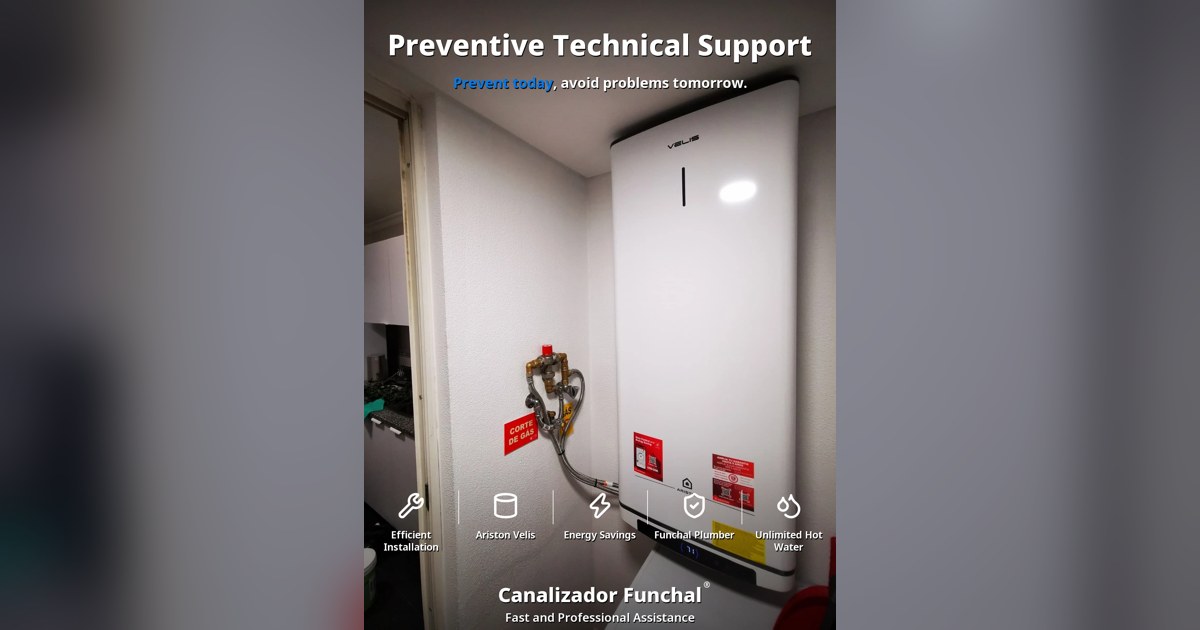
In many apartments in Funchal, Caniço and Santa Cruz there is simply no room for a 200L or 300L cylinder, and solar panels are not viable in a multi-storey building. The good news: an 80L or 100L unit can deliver almost twice the usable hot water. You store the water at around 70 °C and temper it at the outlet with a 3-way thermostatic mixing valve, delivering a constant 38 °C to 40 °C at every tap.
🔎 Symptoms & Initial Diagnosis
1) Hot water runs out halfway through a shower even though the heater works perfectly and shows no fault. 2) A large family — 5 or 6 people in the same apartment — showering back to back: the tank cannot recover between uses. 3) No space in the laundry room, kitchen or balcony for a bulky 200L or 300L appliance, the typical situation in Funchal and Caniço apartments. 4) Solar panels are technically impossible in apartment buildings: no private roof access in a shared condominium and no way to run pipework through the upper floors without works in neighbouring flats. 5) In holiday rentals, guests complaining of cold water after the second shower. If this sounds familiar, the appliance is not the problem — the way hot water is distributed is.
🧪 Main Causes in Madeira
1) Cold mains water at low winter temperatures: at higher altitudes in Funchal, such as Santo António, Monte or Camacha, incoming water is much colder, sharply reducing tank autonomy. 2) Severe space restrictions in Funchal and Caniço apartments: service niches were designed for 50L to 100L units and will not take anything bigger. 3) Poor heating efficiency when the thermostat is set very low out of fear of energy bills: at 45 °C the tank stores little useful energy and the water is gone in minutes, so the heater simply runs more often. 4) Simultaneous demand (shower, sink, washing machine) on a single circuit with no controlled mixing at the outlet. 5) Long pipe runs to the furthest bathroom, with heat losses and water wasted waiting for it to warm up.
🛠️ Ideal Step-by-Step Solution
The technical principle is simple: store the water hot and deliver it tempered. Heating the cylinder to around 70 °C means every stored litre holds far more energy; blending it with cold water at the outlet down to 38 °C to 40 °C roughly doubles the usable litres from an 80L or 100L tank. Technical solution: a professional-grade chrome 3-way thermostatic mixing valve with built-in check valves and filters in the connectors, adjustable from 38 °C to 60 °C, rated up to 100 °C and 16 bar. Rigid “U” assembly: a brass tee is fitted on the cold water inlet, feeding both the water heater and the valve's cold port; the tank's 70 °C outlet connects to the valve's hot port; using sockets, adaptors and rigid elbows, the whole assembly becomes completely solid, with no movement and no strain on the appliance connections. The lower tempered outlet is connected with a high-flow flexible hose to the manifold or distribution board, guaranteeing flow to two outlets at once. Energy optimisation: combine it with a smart water heater (Wi-Fi, scheduling, ECO and BOOST modes) and a programmable timer socket set around the family's actual shower times.
🎯 Definitive Technical Solution
1) Store hot, deliver tempered: raise the cylinder thermostat to 65 °C–70 °C — a temperature that also kills Legionella bacteria — and fit a 3-way thermostatic mixing valve on the tank outlet, set to deliver 38 °C–40 °C at taps and showers. Every stored litre then yields far more usable water, substantially increasing the available hot water volume with no risk of scalding. 2) Dedicated potable expansion vessel: install a sanitary expansion vessel with a food-grade EPDM membrane on the cold water inlet of the water heater, sized at roughly 8%–10% of the tank capacity and pre-charged to 3.5 bar. It absorbs the thermal expansion of the water while heating, completely eliminating the constant dripping of the safety valve and protecting pipework, flexible hoses and taps from pressure spikes.
🚫 What to AVOID
1) Leaving the valve hanging from flexible hoses alone, with no rigid support: weight and vibration eventually crack the connections and cause leaks inside the cabinet or wall. 2) Skipping the brass tee on the cold inlet and picking up cold water somewhere else on the system: pressure balance is lost and the outlet temperature swings every time a toilet is flushed. 3) Setting outlet temperatures above 45 °C: this creates a real scalding risk, especially with children or elderly people at home, and cancels the gain in usable litres. 4) Ignoring the valve's internal filters: they clog with grit and debris and mixing stops being stable. 5) Using cheap mixing valves without built-in check valves: hot water backfeeds into the cold circuit and cold taps start running lukewarm.
🧰 Preventive Maintenance
1) Check the mixing valve setting yearly, measuring the temperature at the tap with a thermometer and readjusting the knob if needed. 2) Clean the filters and the built-in check valves in the connectors once a year, or whenever flow drops. 3) Inspect and replace the water heater's magnesium anode — running at 70 °C accelerates anode wear, so check it every 2 years. 4) Flush sediment from the tank and confirm the safety valve operates correctly. 5) For holiday rentals in Funchal, Caniço and Santa Cruz, include this check in the property's annual maintenance, before high season.
FAQ
Why does the water heater safety valve keep dripping?
Because water expands when heated and has nowhere to go. The correct fix is not tightening or replacing the valve: it is fitting a sanitary expansion vessel with a food-grade EPDM membrane on the cold inlet, sized at 8%–10% of the tank capacity and pre-charged to 3.5 bar. The vessel absorbs the expansion and the dripping stops.
What size expansion vessel do I need for a 100-litre water heater?
Around 8 to 10 litres, always with a food-grade EPDM membrane and pre-charge verified at 3.5 bar, fitted on the cold water inlet downstream of the safety valve. The pre-charge should be checked with a gauge at installation and reviewed every 2 years.
Does a thermostatic mixing valve use more electricity?
Not by itself — it simply makes better use of the energy already stored. The tank heats to a higher temperature, but since every litre yields more tempered water, the heater cycles less often through the day. Combined with scheduling or a timer, the bill usually stays the same or drops.
Is it safe to set the water heater to 70 °C?
Yes, as long as mixing happens at the outlet. The thermostatic valve delivers 38 °C to 40 °C at taps and showers and shuts down quickly if the cold supply fails. Storing at 70 °C also has the sanitary benefit of inhibiting Legionella growth in the tank. Never feed taps directly with 70 °C water.
Does this solution work in any apartment in Madeira?
It works in the vast majority of apartments in Funchal, Caniço, Santa Cruz and across Madeira Island, holiday rentals included, provided there is room for the rigid “U” assembly next to the heater and access to the cold inlet for the brass tee. A site visit confirms pressure, flow and available space.
Need help now? Fast response on WhatsApp.
We install thermostatic mixing valves in Funchal, Caniço, Santa Cruz, Câmara de Lobos, Machico, Ribeira Brava and across Madeira Island, in private homes and holiday rental apartments.