Guide to Tap and Mixer Brands: Ceramic Cartridges, Pressure and Seals
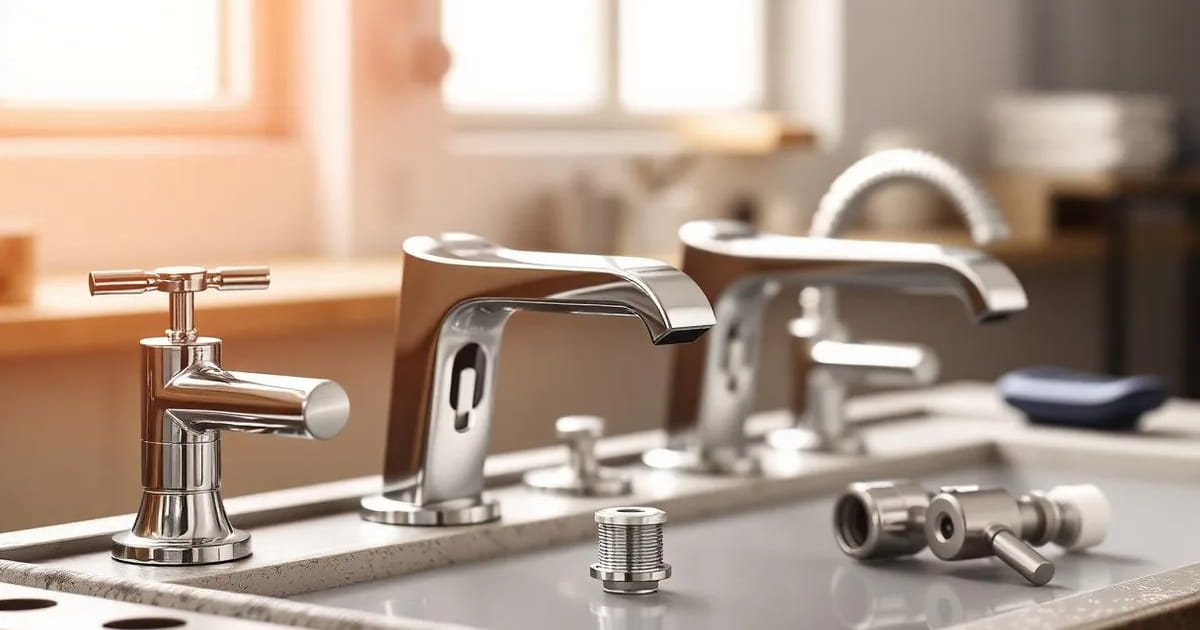
Every tap looks excellent on the display stand. The real difference only shows two or three years later: one still runs smooth and drip-free, the other drips, grinds and loses flow. As plumbers we do not judge taps by design but by three concrete things — the ceramic cartridge that controls flow, the metal alloy of the body and the quality of the seals. This guide explains how to recognise a good mixer before buying it, and what changes when the installation is in Funchal, with salty air and mains pressure swinging through the day.
💧 The Ceramic Cartridge: Heart of the Mixer
In a single-lever mixer, almost everything depends on the cartridge. 1) Two polished ceramic discs slide over each other to control flow and temperature — if well made, they stay watertight for thousands of cycles. 2) Cartridge size is decisive for repairs: 35 mm and 40 mm are the common sizes and are easily found in Portugal. 3) Exclusive sizes force brand orders, with lead times that sometimes make the repair dearer than the tap. 4) A well-made cartridge has a brass or rigid technical-polymer body, not brittle plastic. 5) Signs of an end-of-life cartridge: a stiff or loose lever, constant dripping, noise at mid-travel and unstable temperature mixing. 6) The good news is that replacing the cartridge is quick and cheap when the size is standard.
🔩 Body, Alloy and Finish
The body determines mechanical strength and resistance to local water. 1) Solid brass bodies with good wall thickness withstand pressure and do not crack when connections are tightened. 2) Low-zinc brass alloys resist dezincification better, a real issue with more aggressive water. 3) Taps that feel very light in the hand are usually thin-walled or zamak, with a higher risk of body cracking. 4) A quality chrome finish has well-applied nickel and chromium layers — in coastal Funchal and Caniço that decides whether the shine lasts two years or ten. 5) Brushed and matt finishes tolerate limescale marks better but need non-abrasive cleaners. 6) Supplied flexible hoses matter too: a cheap hose is the single part that most often causes floods.
📊 Working Pressure: The Most Ignored Factor
Many taps do not fail from poor quality, they fail from wrong pressure. 1) Most mixers are designed for 1 to 5 bar, with an optimum near 3 bar. 2) In Funchal and higher areas such as Monte, Santo António or São Gonçalo, mains pressure can rise significantly at night and punish cartridges and seals. 3) Excess pressure causes persistent dripping, noise, vibration and accelerated wear of the ceramic discs. 4) Insufficient pressure, common on upper floors, gives weak flow and poor hot water mixing. 5) A calibrated pressure-reducing valve at the property inlet protects every tap in the house and is one of the best-value investments. 6) Before blaming the tap, we always measure static and dynamic pressure with a gauge.
🚿 Seals, Limescale and Concealed Mixers
Limescale is the silent enemy of mixers in Madeira. 1) Deposits form first in the aerator at the spout, reducing flow — cleaning or replacing it solves many so-called pressure problems. 2) On rubber seals and valve seats, scale causes tiny continuous leaks. 3) In concealed shower mixers the same process is far worse, because the valve sits inside the wall with limited access. 4) For concealed work, choosing a brand with commonly available parts matters even more than for a basin tap. 5) Thermostatic mixers give comfort and safety, but need reasonably clean water and an inlet filter in well or spring-fed areas. 6) A yearly preventive clean of aerators and filters greatly extends the life of the whole set.
⚠️ Common Buying and Installation Mistakes
We see the same mistakes repeated in new builds and renovations. 1) Buying very cheap taps for heavily used bathrooms and then paying repeated labour on repairs. 2) Fitting a mixer without its own isolating valves, forcing a whole-house shut-off. 3) Reusing old flexible hoses on a new tap — minimal saving, high risk. 4) Over-tightening connections, deforming seals and creating a leak that did not exist. 5) Installing concealed mixers without keeping the trim kit accessible for future maintenance. 6) Ignoring the match between mains pressure and shower flow, ending up with a weak shower despite expensive hardware. 7) Skipping a particle filter in well-fed properties, which ruins cartridges quickly.
✅ How We Choose in Practice
Our criterion is always long-term maintenance. 1) We prefer mixers with a standard-size ceramic cartridge and parts available in Portugal. 2) We prefer a brass body with noticeable weight in the hand. 3) We check that a seal kit and replacement aerator exist for the model. 4) For showers we prioritise concealed bodies from established ranges, even with a simpler visible finish. 5) We always set the working pressure before signing off an installation. 6) For advice on your own case, send us photos of your current taps on WhatsApp and we will tell you what is worth repairing and what is worth replacing.
FAQ
Is it worth repairing a mixer tap or better to replace it?
If the body is in good condition and the cartridge is a standard size, repairing is almost always cheaper and faster. If the body is corroded or the cartridge is exclusive and unavailable, replacement makes more sense.
My tap still drips after new seals. Why?
In single-lever mixers, dripping rarely comes from external seals: it comes from a worn ceramic cartridge or excessive mains pressure. We measure pressure and replace the cartridge to fix it for good.
Are thermostatic taps a good choice in Madeira?
They are excellent for comfort and safety, especially with children, but they need clean water and stable pressure. In areas with well or very hard water we recommend an inlet filter to protect the mechanism.
How do I know if my pressure is damaging my taps?
Typical signs are frequent drips on several taps, noise when opening and a bang on closing. A gauge measurement confirms it, and a calibrated reducing valve protects the whole installation.
Dripping tap or weak flow? Contact us on WhatsApp.
We work in Funchal, Câmara de Lobos, Caniço, Santa Cruz, Machico, Ribeira Brava, Ponta do Sol, Calheta, Santana, São Vicente and across Madeira Island.