Water Infiltration Through Stone Window and Door Surrounds in Madeira
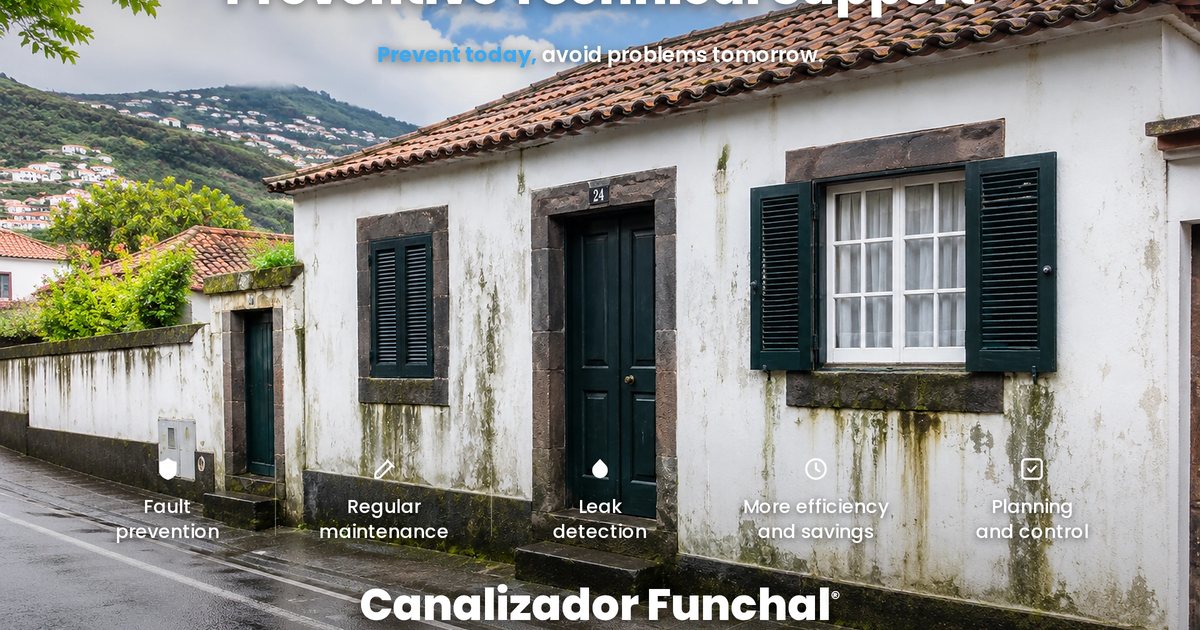
Damp patches that always appear around windows and doors, paint peeling inside the reveal and a musty smell after days of wind-driven rain: in many Madeira homes the cause is not a plumbing leak but the stone surround. Local stone is porous and behaves like a sponge when it is neither sealed nor properly detailed.
🔎 Symptoms & Initial Diagnosis
You can often find the source without breaking any wall. 1) Watch the pattern: does the stain always appear around the same window or door, and nowhere else on the wall? 2) Check timing: does the damp worsen 24 to 48 hours after wind-driven rain, especially southerly or easterly wind common in Funchal, Caniço and Machico? 3) Check the water meter with everything closed — if it does not move, an internal leak is ruled out. 4) Touch the outdoor stone: if it feels cold and dark after rain, it is soaked. 5) Look for hairline cracks in the frame sealant and open stone joints. This simple check almost always points to porous stone rather than plumbing.
🧪 Main Causes
1) Porosity of the regional volcanic stone: basalt and soft dressed stone absorb water like a sponge, especially in older houses in Santa Cruz, Câmara de Lobos and Ribeira Brava with no water-repellent treatment. 2) Wind-driven rain and sea spray: Atlantic wind pushes rain against the façade under pressure, and salt accelerates joint deterioration. 3) Thermal movement: daily expansion and contraction of stone and frame fatigues the sealant. 4) Failed sealant or silicone at the frame-to-stone joint, dried out or detached. 5) Missing drip groove under the sill and no outward fall, common defects in traditional buildings that were never corrected.
🛠️ Ideal Step-by-Step / Immediate Action
1) Photograph the stain together with the date of the associated rain, so the technician can see the pattern. 2) Dry the indoor surface with a cloth and ventilate the room to reduce mould risk. 3) Move furniture or electrical sockets away from the area for safety. 4) Do not cover the stain with furniture or paintings, so its progress can be monitored. 5) If possible, apply temporary waterproof tape only over visible cracks on the outside of the stone as a stopgap until the visit. 6) Contact a technician specialised in sealing stone surrounds, serving Funchal, Caniço, Santa Cruz, Machico, Câmara de Lobos and Ribeira Brava, for a full moisture-meter diagnosis.
🎯 The Definitive Technical Solution
1) Deep-crystallisation waterproofing: forget paints and surface repellents that peel within two seasons. We apply a penetrating deep-crystallisation waterproofer that enters the pores of the volcanic stone or granite and reacts inside, sealing the microstructure from within without forming a surface film and without stopping the stone from breathing. 2) Metal drip flashing with a minimum 15° fall: fitted at the base of the outer frames to create a pressure-equalisation chamber. This is what stops strong storm wind from driving water by capillarity and under pressure towards the frame base — without this detail any sealant will fail again. 3) Polyurethane (PU) mastic instead of ordinary silicone: at the frame-to-stone joints we use high-modulus, UV-resistant elastic PU, able to follow the daily thermal movement without cracking or peeling off.
🚫 What to AVOID
1) Do not break open the interior wall looking for a leak before confirming it is not the stone — in most cases that work is unnecessary and costly. 2) Do not apply sealing paints, film-forming waterproofers or varnish directly on stone that is still damp: they trap moisture inside the wall and cause spalling and faster stone decay. 3) Never use epoxy resin over stone with active dampness, as it creates a watertight barrier that pushes water to another point on the façade. 4) Do not close an insurance claim or sign a settlement without a technical report that clearly identifies the stone surround as the source, or the insurer may reject cover by wrongly classifying the leak as plumbing damage.
🧰 Preventive Maintenance
1) Inspect the frame sealant on every exterior window and door yearly, replacing it before it fully cracks. 2) Reapply breathable silane/siloxane water repellent to the stone every 5 to 8 years, more often on homes near the sea in Funchal, Caniço or Machico due to salt spray. 3) Periodically clear sill drip grooves to ensure rainwater drains correctly. 4) After heavy storms, visually check stone joints and frame seals. 5) Avoid high-pressure façade washing, which degrades sealant and opens up stone pores.
FAQ
Why did the water repellents and paints I applied fail again?
Because they only work at the surface: they form a film that UV radiation and stone movement eventually lift, while water keeps entering through pores and joints. The lasting fix is a penetrating deep-crystallisation waterproofer that reacts inside the pores and seals the microstructure from within, combined with correcting the detail at the base of the frame.
Is the metal drip flashing really needed if the stone is sealed?
Yes. In a storm the wind pressurises the façade and drives water by capillarity to the base of the frame. A drip flashing with at least a 15° fall creates a pressure-equalisation chamber that cuts off that path. Without it, even with treated stone and new mastic, the leak returns during wind-driven rain.
How do I know the leak is from the stone surround and not a pipe?
If the stain always appears around the same window or door, worsens 24 to 48 hours after wind-driven rain, and the water meter does not move with everything closed, the source is almost always the porous stone and a poorly sealed frame joint.
Does a breathable water repellent stop water fully?
It drastically reduces capillary absorption without sealing the pores, letting residual moisture escape. It does not replace fixing cracks and open joints, which must be treated first.
How long does the wall take to dry after the repair?
It depends on thickness and how soaked it was, but it usually takes several weeks. Painting before that will make the paint peel again.
Need help now? Fast response on WhatsApp.
We work in Funchal, Câmara de Lobos, Caniço, Santa Cruz, Machico, Ribeira Brava, Ponta do Sol, Calheta, Santana, São Vicente and across Madeira Island.