Stainless Steel Linear Channel Drain for Walk-In Showers: How to Avoid Blockages and Odours
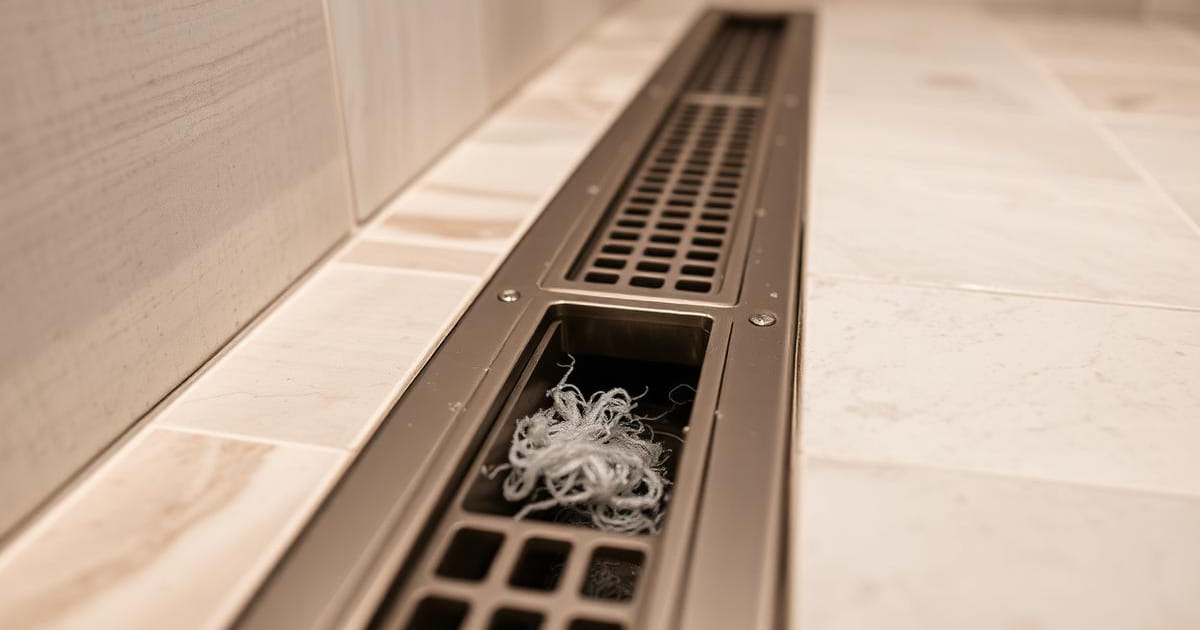
The level-access walk-in shower has become the standard in Funchal refurbishments and short-term rental apartments. A stainless channel drain looks great and works well, but it carries a technical detail nobody explains in the showroom: to fit within a shallow slab, the trap has an ultra-low profile. That means less water-seal volume, less room for debris and far greater sensitivity to hair, soap and creams. This guide shows how to keep a channel draining well, how to restore the water seal and how to confirm real flow rate in litres per minute.
🚿 How a Low-Profile Channel Drain Works
1) Water enters through the grate and falls into a stainless or plastic body with an internal fall to the outlet. 2) Inside the body a siphon cup (or a membrane) creates the water seal against sewer gases. 3) In ultra-low models the water seal may be just 20 to 30 mm — against 50 mm in a conventional trap. 4) Grate and cup are usually extractable, precisely because maintenance is mandatory. 5) The outlet is horizontal, which demands correct fall on the branch to avoid backflow. 6) Dry-membrane models partly replace water as the odour barrier.
🧴 Why It Clogs So Fast
1) Hair: it balls up inside the siphon cup and traps everything behind it. 2) Soap, gel and shampoo form a greasy emulsion that hardens with Madeira's hard-water lime. 3) Body creams and bath oils stick to the internal walls of the stainless body. 4) Grit and outdoor dust, very common in homes near the sea and unpaved lanes. 5) Reduced internal volume: 2 mm of crust in a shallow trap matters far more than in a 50 mm trap. 6) Closed designer grates hide the problem until the shower is already pooling.
👃 Lost Water Seal and Odours
1) In lightly used showers — guest rooms, rentals in low season — the trap water evaporates in 2 to 3 weeks. 2) With the seal gone, sewer odour enters the room directly. 3) Poor stack venting causes siphoning: another appliance's discharge sucks the cup dry. 4) A powerful extractor in a bathroom with no air inlet worsens the negative pressure and pulls air from the drain. 5) Odour only after showering points to biofilm on the grate and body, not an empty trap. 6) Permanent odour points to a lost water seal or a damaged membrane.
🛠️ Correct Cleaning of the Extractable Siphon Cup
1) Remove the grate and hair filter without forcing the clip tabs. 2) Extract the siphon cup (twist or lift, depending on the maker) and wash it in hot water with a degreasing detergent. 3) Clean the internal walls with a soft brush — never steel wool, which scratches stainless and creates corrosion points. 4) Descale with citric acid or a dedicated product, 15 to 20 minutes contact, avoiding caustics on plastic bodies. 5) Refit the cup fully home and refill the water seal with 1 to 2 litres of water. 6) Frequency: monthly in family use, weekly or between stays in rentals.
📏 Flow-Rate Check in l/min and Levelling
1) A shower channel must drain at least the installed shower flow: typically 9 to 12 l/min, up to 20 l/min for ceiling heads. 2) Simple test: fill a 10-litre container and time the discharge — 10 litres in under 60 seconds is a good sign. 3) If water pools during the shower, real flow capacity is below consumption. 4) Check levelling: the grate should sit 2 to 3 mm below the tile plane, with a floor fall of 1% to 2%. 5) Confirm a minimum 1% to 2% fall on the horizontal branch to the stack. 6) Long branches with 90° bends cut flow drastically — replace them with two 45° bends.
🛡️ Filter Grates, Dry Membranes and Prevention
1) Fit a removable basket hair filter: it captures 90% of the problem at the surface. 2) In intermittently used showers, fit a dry-membrane trap or anti-odour valve that seals even without water. 3) Check stack ventilation before blaming the drain. 4) Pour 2 litres of water into every unused shower once a week to keep the seal. 5) Avoid caustic products: they attack seals, stainless and the membrane itself. 6) Want technical servicing or a flow correction on your channel drain? Message us on WhatsApp.
FAQ
Do stainless channel drains clog more than normal drains?
It is not the stainless: it is the low profile. With less internal volume and a shallower seal, the same hair and soap load causes trouble far sooner.
Can I use chemical drain cleaner in a channel drain?
We do not recommend it. Caustics degrade seals and membranes and can stain stainless steel. Correct cleaning is mechanical, extracting the siphon cup.
Why does it only smell when I have been away a few days?
Because the water seal evaporated. In a low-profile trap that happens in 2 to 3 weeks. The permanent fix is a dry anti-odour membrane.
Can flow be improved without lifting the floor?
Often yes: full technical cleaning, a larger-section cup and correction of the accessible branch usually solve it without building work.
Channel drain running slow or smelling? Message us on WhatsApp.
We work in Funchal, Câmara de Lobos, Caniço, Santa Cruz, Machico, Ribeira Brava, Ponta do Sol, Calheta, Santana, São Vicente and across Madeira Island.