Soundproofing Waste Pipes: How to Eliminate Flush Noise at Home
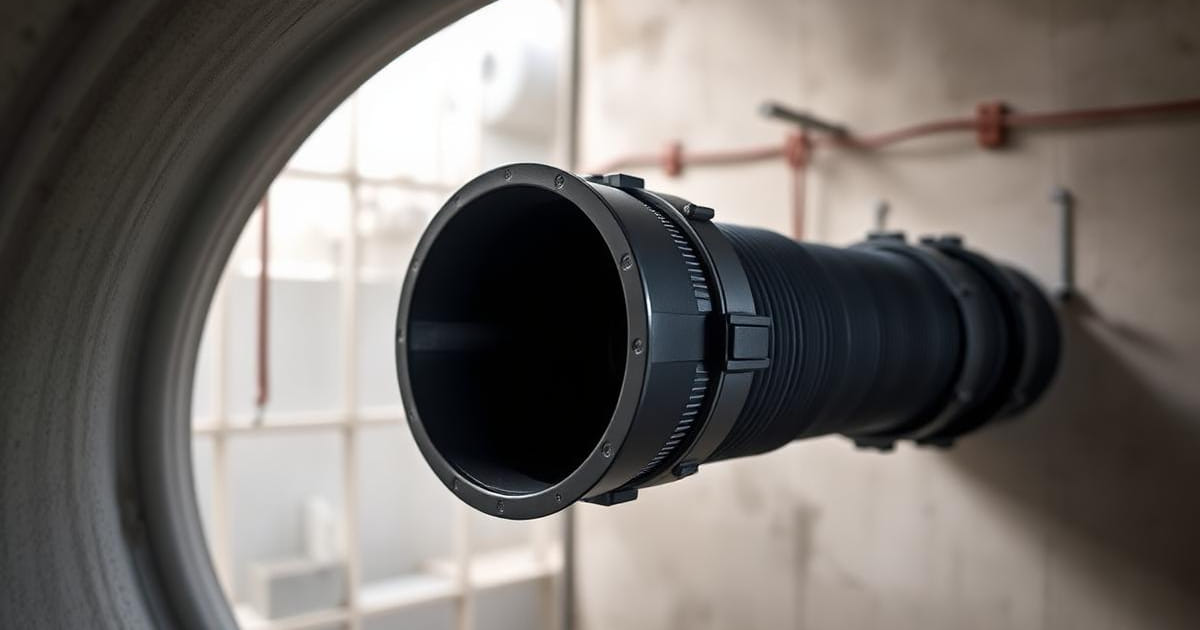
Hearing the upstairs neighbour's flush through your bedroom wall is not bad luck: it is an installation that transmits structural noise. In many Funchal buildings the soil stack was built in plain PVC, clamped straight onto masonry, with no decoupling at any penetration. The falling column of water vibrates the pipe, the pipe vibrates the clamp and the clamp vibrates the wall. This article explains where the noise starts, which materials fix it and what can be corrected without demolishing the whole flat.
🔇 Where the Noise Actually Comes From
1) Flush noise has two components: airborne, travelling through the duct air, and structural, travelling through the building itself. 2) Airborne noise is fixed with mass and absorption; structural noise is fixed with decoupling — different problems, different solutions. 3) Water falling down a vertical stack hits direction changes and creates pressure pulses that make the pipe vibrate. 4) That vibration enters the structure at every rigid contact: clamps, slab penetrations and plastered chases. 5) Thin-walled pipe amplifies: low mass means low inertia and more radiated sound. 6) A 90° bend concentrates impact; two 45° bends reduce turbulence and noise. 7) In Funchal buildings with lightweight walls between bedrooms and bathrooms, the same pipe that goes unnoticed in an older block becomes unbearable.
🧱 Triple-Layer Soundproof Pipe
1) Modern soundproof pipe is three-layer polypropylene, with a mineral-filled middle layer that adds mass and damping. 2) The difference against plain PVC is not marketing: it is density and the ability to dissipate vibration energy. 3) Thicker walls and denser material measurably lower noise under comparable conditions. 4) These systems use dedicated clamps with built-in isolation, designed together with the pipe. 5) Sizing does not change: DN110 for WCs, DN75 for sinks and DN50 for basins, with correct falls. 6) You do not need to soundproof the whole network: absolute priority is the stack and any branch crossing bedrooms and living rooms. 7) In refurbishments, replacing only the section crossing a sensitive room solves most complaints at controlled cost.
🔧 Clamps with EPDM Isolation
1) The clamp is where most structural noise enters the wall — and it is the cheapest correction available. 2) A bare metal clamp tightened onto pipe is a perfect acoustic bridge: noise goes straight into the structure. 3) The right clamp has a continuous EPDM rubber liner that damps vibration before it reaches the support. 4) Tighten to hold, not to strangle: a compressed pipe loses expansion clearance and transmits more. 5) Support spacing must follow the manufacturer — excess supports multiply transmission points. 6) On stacks, alternate fixed and guide clamps to accommodate thermal movement without ticking noises. 7) EPDM copes well with Madeira's humidity and salt air, unlike common foams that degrade within a few years.
🚧 Correct Detailing at Chases and Slabs
1) A pipe mortared directly into a chase becomes one with the wall: any vibration transfers in full. 2) Correct practice wraps the pipe in acoustic membrane or mineral wool before closing the chase. 3) At slab penetrations, use a sleeve or resilient band to avoid direct pipe-to-concrete contact. 4) The chase fill must never bear rigidly on the pipe around its whole perimeter, or all decoupling is lost. 5) In service ducts, double plasterboard with mineral wool inside cuts a significant part of the airborne noise. 6) Penetration seals must stay watertight without creating rigid bridges — elastic sealant, not cement. 7) This is the detail that most often fails on site and the most expensive one to correct once everything is closed up.
🛠️ What to Do When the Work Is Already Done
1) First identify whether the noise is airborne or structural: a hand on the pipe and on the wall during a flush already tells you a lot. 2) If the clamps are reachable inside a duct, swapping them for EPDM-lined models is the best value intervention. 3) Wrapping the accessible section in a high-mass acoustic membrane cuts the airborne component immediately. 4) Replacing accessible 90° bends with two 45° bends reduces the impact of falling water. 5) Check that secondary venting is adequate: a gurgling system is also a noisier system. 6) Close ducts with double board and mineral wool, keeping an access hatch for maintenance. 7) Only after these measures do you consider replacing the stack, which is the definitive fix but means working on the building.
✅ Good Practice for New Installations
1) Specify soundproof pipe from design stage on stacks and on every branch crossing sleeping areas. 2) Never place a soil stack in a wall shared with a bedroom if a technical alternative exists. 3) Use only the system's EPDM-lined clamps, respecting spacing and the fixed/guide logic. 4) Prefer two 45° bends over any abrupt direction change, especially at the base of the stack. 5) Ensure correct primary and secondary venting to avoid negative pressure and suction noise. 6) Decouple every slab and chase penetration and photograph the work before closing up. 7) These decisions cost little in new work and pay back every day in comfort. Refurbishing and want to avoid flush noise? Message us on WhatsApp.
FAQ
Is it worth soundproofing only the soil stack?
In most cases yes. The vertical stack is where water reaches the highest velocity and generates most vibration, so treating that section plus the penetrations resolves the majority of noise complaints.
Is soundproof pipe much more expensive than standard PVC?
The material costs more per metre, but total project cost rises little because it is used only in sensitive areas. Compared with opening walls years later, specifying it correctly first time is always cheaper.
Can noise be reduced without opening walls?
Yes, where there is a service duct. Swapping clamps for EPDM-lined models, wrapping the pipe in acoustic membrane and closing the duct with double board and mineral wool already gives a clear improvement.
Why do I hear drainage more in newer homes?
Lighter construction, plasterboard partitions and thin-walled pipe fixed straight to the structure. Less mass means more noise transmission, even when the plumbing itself is technically correct.
Flush noise bothering you? Message us on WhatsApp.
We work in Funchal, Câmara de Lobos, Caniço, Santa Cruz, Machico, Ribeira Brava, Ponta do Sol, Calheta, Santana, São Vicente and across Madeira Island.