Sewer Backwater Valves: How to Stop Wastewater Backflow on Ground Floors
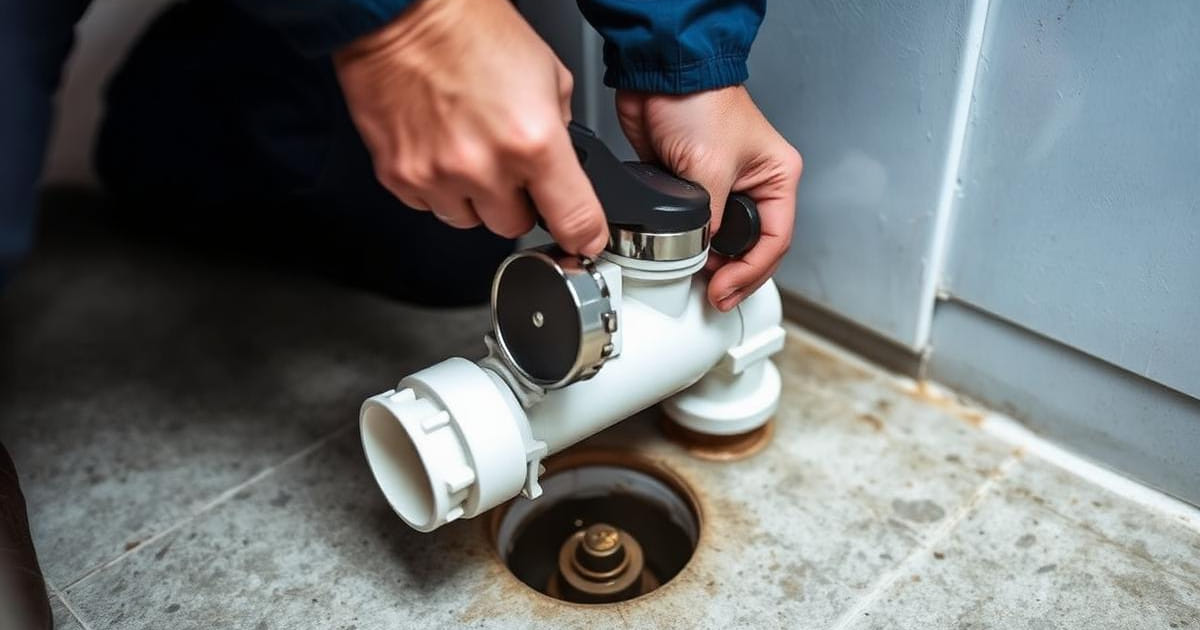
Few incidents are as destructive — and as preventable — as sewage backflow. A heavy downpour in Funchal, a blockage in the public sewer or an abnormal discharge upstream is enough for wastewater to find the easiest path: the lowest discharge point on the system, which is almost always a ground-floor gully, a basement shower tray or the toilet in an annex. The damage rarely stops at cleaning: floors, skirting, furniture and appliances are all contaminated. The good news is that protection is simple, mechanical and permanent when correctly installed.
🌊 Why Sewage Comes Up Through the Drains
Backflow follows simple physics, not bad luck. 1) The building drainage discharges by gravity into a public sewer with finite capacity. 2) When that sewer fills — heavy rain, stormwater wrongly connected, a downstream blockage — the level rises and pressurises the connected branches. 3) Water seeks the lowest outlet: the lowest fixture in your home. 4) In Funchal, Câmara de Lobos or Machico the steep terrain makes it worse, because flow reaches the sewer with high energy and speed. 5) Ground floors, basements, garages and annexes below street level are the critical areas. 6) Warning signs before the serious event: gurgling gullies when it rains, strong sewer smell on stormy days and a toilet with a fluctuating water level. 7) If it happened once it will happen again — the cause is structural and does not go away on its own.
⚙️ How a Backwater Valve Works
The principle is mechanical and needs no electricity. 1) The valve body is fitted in the branch drain, downstream of the fixtures you want to protect. 2) In the normal direction, flow pushes the flap open and drains freely. 3) When flow reverses, that same flap is pushed against its seat and seals the pipe. 4) Quality models use a stainless steel flap, which also acts as a rodent barrier — a real problem in older urban areas. 5) Double versions (two flaps in series) are used where risk is high, providing redundancy. 6) A manual emergency shut-off lets you fully close the pipe ahead of a forecast storm or during works on the public sewer. 7) There are also gully-mounted valves, useful when the main branch cannot be altered.
📍 Where to Install: the Decision That Really Matters
The installation point matters more than the brand. 1) The valve must sit downstream of every fixture below the risk level, but never upstream of fixtures on upper floors — otherwise it blocks their discharge too when it closes. 2) In houses the typical location is the last inspection chamber before the connection to the public sewer. 3) In ground-floor flats we protect the individual branch, never the shared stack without a building-management agreement. 4) Access is mandatory: a valve with no inspection chamber is a doomed valve. 5) Allow working room to remove the flap and clean the seat. 6) Keep upstream venting intact, so that valve closure does not create negative pressure and empty the traps. 7) On new builds, plan the opening during the drainage stage — retrofitting costs three times as much.
🧰 Quick Inspection Chambers and Maintenance
Maintenance is what separates a working valve from a buried ornament. 1) The inspection chamber needs a sealed lid, reachable without breaking up flooring. 2) Recommended inspection twice a year, and always before the autumn rains. 3) What to check: clean flap, seat free of wet wipes and fibres, no hardened grease on the seal face, free hinge. 4) Wet wipes and kitchen grease are the number-one cause of valves jammed open. 5) Test the manual emergency shut-off to confirm it has not seized. 6) Keep a record of interventions — in an insurance claim that history helps. 7) Repeated metallic noise during discharges may mean a worn flap that is chattering; replace it before it fails.
🚫 Mistakes That Turn Protection Into a Problem
We see these regularly on third-party installations. 1) Fitting the valve on the building's main stack, blocking neighbours' discharge and causing backflow on intermediate floors. 2) Choosing thin plastic flaps on systems carrying grit and debris — they wear and stop sealing. 3) Burying the valve with no inspection chamber to 'save' on flooring. 4) Fitting it the wrong way round: more common than you would think, and the system simply stops draining. 5) Ignoring system venting, causing dry traps and permanent odour. 6) Relying on the valve alone without fixing stormwater wrongly connected to the foul drain. 7) Skipping the tightness and closure tests after installation — the final check is not optional.
✅ A Six-Step Protection Plan
1) Survey the system: identify levels, branches and the lowest fixture. 2) CCTV inspection where there is a history of blockages, to rule out roots or collapses. 3) Select the valve type: single, double or with manual shut-off, according to risk. 4) Define the installation point and build an accessible inspection chamber. 5) Final tests: normal drainage, closure under reverse flow and chamber tightness. 6) A six-monthly maintenance plan with records. If your property has already had sewage coming up the drains, send us photos of the area and the chamber on WhatsApp: we will advise the right solution and the cost before travelling out.
FAQ
Does a backwater valve really stop backflow during heavy rain?
Yes, when it is correctly sized and installed at the right point on the branch. The flap closes under reverse flow and stops wastewater entering from the sewer. What it does not do is fix internal blockages or wrongly connected stormwater — those must be dealt with in parallel.
Can I fit the valve on the building's shared stack?
Not without a building-management decision and a technical study. A valve on the shared stack blocks every flat's discharge when it closes, potentially causing backflow on intermediate floors. In ground-floor flats we protect the individual branch instead.
What maintenance does a sewer backwater valve need?
Inspection and cleaning twice a year, always before autumn. The flap is removed, the seat cleaned of grease and fibres, and the manual emergency shut-off tested. A valve jammed by wet wipes is a valve that offers no protection.
Is a stainless steel flap genuinely useful against rodents?
It is, and that is an important benefit in older urban areas of Funchal. At rest the stainless flap closes by gravity and stops rodents climbing the branch drain, which a thin plastic flap cannot guarantee over time.
Had sewage coming up your drains? Contact us on WhatsApp.
We work in Funchal, Câmara de Lobos, Caniço, Santa Cruz, Machico, Ribeira Brava, Ponta do Sol, Calheta, Santana, São Vicente and across Madeira Island.