Sewer Backflow Valves with Manual Emergency Shut-Off in Low-Lying Areas
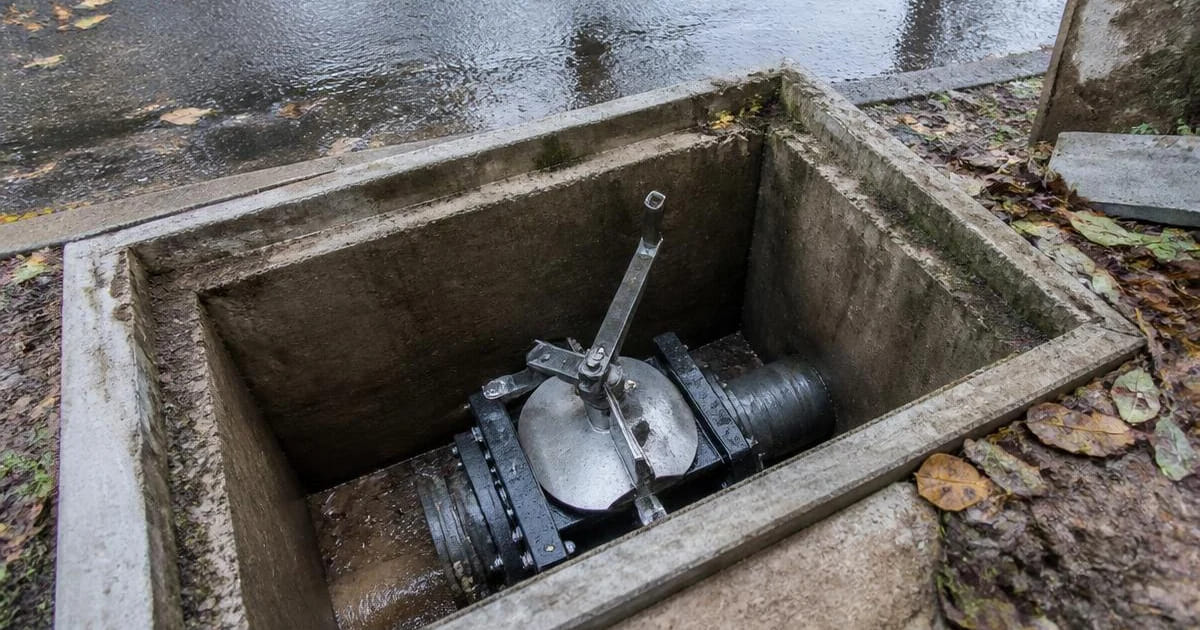
There is a kind of flooding that comes from no fault in the house: it comes from the street. When a storm saturates the sewers, the public network stops receiving and starts giving back. Water climbs the branch and emerges at the lowest point of the property — the yard gully, the ground-floor shower tray, the basement toilet. Anyone living in the low parts of Funchal, near watercourses or below street level, knows the scene. Proper protection is mechanical, installed outside and verifiable.
🌊 How Public Sewer Backflow Happens
1) In an intense downpour, combined sewers take stormwater and foul water at the same time. 2) When flow exceeds capacity, the sewer surcharges and water looks for a side exit. 3) House branches start working in reverse, from the sewer towards the property. 4) The water finds the lowest level: floor gullies, shower trays, WCs and trapped gullies. 5) In buildings with a basement or sunken garage, that point is often below the sewer level. 6) What comes out is not clean water — it is effluent, with hygiene, odour and property damage consequences.
🛡️ Backflow Valve: How It Works
1) A hinged flap opens in the direction of flow and closes when flow reverses. 2) A stainless steel flap resists effluent corrosion far better than simple plastic versions. 3) The body is sized to the branch — typically DN110 to DN160 — with an elastomer seal. 4) Double-flap models provide redundancy in high-risk areas. 5) Access through the cover allows inspection and cleaning without cutting pipework. 6) Correctly installed, it does not interfere with the property's normal discharge.
🔒 Why the Manual Emergency Shut-Off Matters
1) Paper, wet wipes and grease can stop the flap from seating fully. 2) The manual lever locks the flap closed, creating a positive mechanical barrier. 3) It is used before or during a severe weather alert, when no household discharge is expected. 4) With the lever closed the house is isolated from the sewer — but it also cannot discharge. 5) So it must be reopened as soon as the event passes, which means the procedure has to be written down and known. 6) In holiday rentals, that instruction belongs in the property's emergency manual.
🧱 Correct Installation in an Outdoor Chamber
1) The valve is installed outside, on the branch, downstream of everything to be protected. 2) It must sit in an accessible inspection chamber with a cover that opens without special tools. 3) It should never be buried without access or hidden under permanent paving. 4) Level and fall must be maintained: a badly bedded valve collects debris. 5) Adequate venting downstream must be provided to avoid siphonage. 6) Before installing, a camera survey confirms the branch is sound — you do not protect a pipe that is already broken.
🚿 Complementary Measures in At-Risk Areas
1) Floor gullies with dry membrane anti-backflow traps in the basement and yard. 2) A pumping station with a macerator pump where fixtures sit below sewer level. 3) Real separation of storm and foul water inside the property, where the network allows it. 4) Floor water sensors with alarms next to historically affected areas. 5) Raised thresholds at garage doors and basement accesses. 6) Photograph and log every event: it is the basis of any claim or insurance case.
🔧 Maintenance and Periodic Checks
1) Inspect the valve twice a year and always after a backflow event. 2) Clean the flap and the sealing seat: a single wipe thread is enough to hold it open. 3) Check clearance and the state of the elastomer, which hardens over time. 4) Test the locking lever to make sure it has not seized. 5) Record the checks — in shared buildings and rentals, that is evidence of diligence. 6) Live in a low-lying area and had sewer backflow? Message us on WhatsApp and we will assess the installation.
FAQ
Does a backflow valve harm normal drainage?
No, when correctly sized and maintained. The flap opens with the flow itself. What harms drainage is lack of maintenance: accumulated debris reduces the section and holds the flap open.
Can I leave the locking lever permanently closed?
No. With the lever closed, the house cannot discharge to the sewer either. It is closed during the risk event and reopened straight afterwards, following a defined procedure.
Where should the valve be installed?
In an accessible outdoor inspection chamber, on the branch, downstream of every fixture to be protected. Never buried without access, since it needs periodic inspection and cleaning.
Does it help with street stormwater flooding?
It protects against backflow through the foul or storm branch. It does not stop water entering through doors and gates, which needs thresholds, channels and drainage gratings.
Low-lying property with sewer backflow? Message us on WhatsApp.
We work in Funchal, Câmara de Lobos, Caniço, Santa Cruz, Machico, Ribeira Brava, Ponta do Sol, Calheta, Santana, São Vicente and across the whole island of Madeira.