Septic Tanks in Madeira: The Complete Technical Guide to Construction and Operation
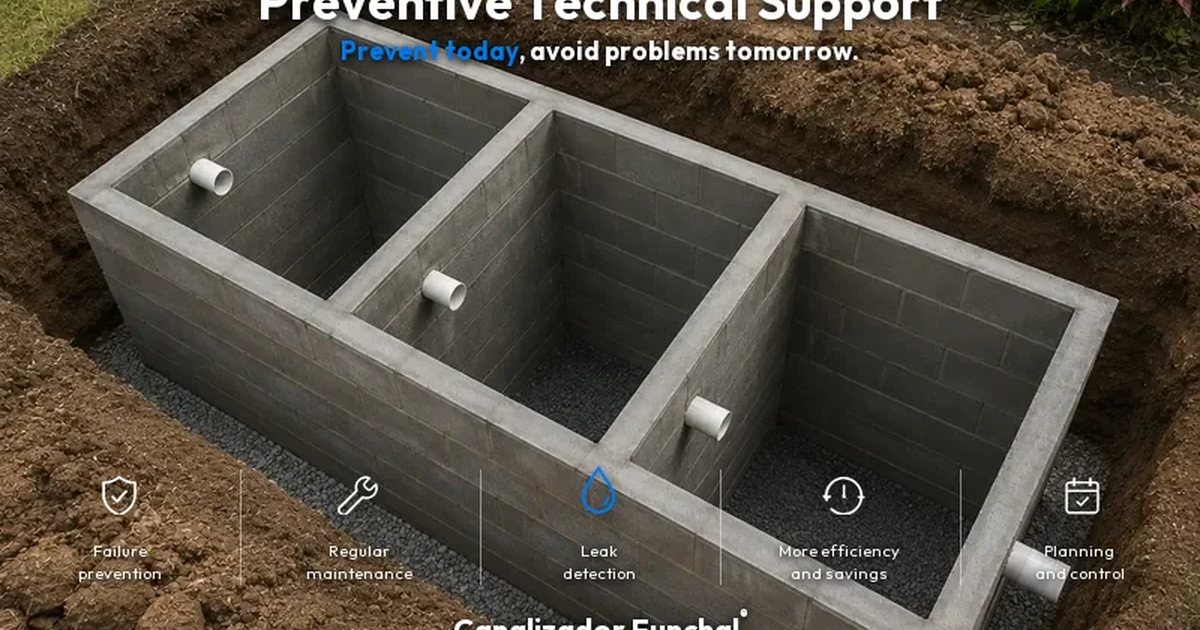
In the areas of Madeira island with no access to the public sewer network, building and correctly sizing a septic tank is essential to guarantee hygiene, avoid bad odours and prevent soil contamination. However, there are serious execution mistakes that make many tanks fill up quickly or fail biologically.
🔎 Symptoms & Initial Diagnosis
1) Slow drainage throughout the house and rising toilet levels: the tank is full or the soakaway has stopped infiltrating. 2) Bad smells in the yard or near the covers: missing ventilation or no trapped chamber before the tank. 3) Waterlogged ground or unusually green vegetation over the infiltration area: a clogged soakaway. 4) Needing to empty the tank every few months instead of every few years: an almost certain sign that soapy water is mixing into the sewage chamber. 5) A macerator pump running continuously or tripping the breaker: the impeller is jammed with wipes or rags. 6) Practical check: carefully open the covers and look at the level in each chamber — the third chamber (soakaway) should be virtually empty; if it is full, the problem is in the final infiltration.
🧪 Main Causes and Sizing on the Island
1) Undersizing: as a practical reference, allow around 1.5 to 2 m³ of useful volume for a family of 4 to 5 people, with a minimum retention time of 24 hours. For holiday rentals in Funchal, Caniço or Santa Cruz with rotating occupancy, always size generously. 2) The 3-chamber cascade system (set at different levels, like steps): the first sewage chamber receives only toilet water and must be fully sealed, with an isolated concrete floor, to prevent infiltration and protect the bacteria that break down organic matter; the second chamber takes greywater from the shower, sinks, kitchen and appliances; the third acts as soakaway and final safety overflow, staying almost always empty. 3) Mixing greywater into the sewage chamber: detergents kill the bacteria and the tank fills far faster. 4) Basalt rock and steep slopes: in areas of Câmara de Lobos, São Vicente or Santana infiltration capacity is limited and the soakaway must be properly sized. 5) Incorrect inlet pipe fall: less than 1.5% to 2% leaves solids stranded halfway. 6) No upward ventilation and no trapped chamber before the inlet. 7) Homes below street level: these require a pumping station with a macerator/extraction pump.
🛠️ Ideal Step-by-Step Use and Checks
1) From the design stage, separate two distinct networks: blackwater (toilet) and greywater (showers, kitchen, appliances). 2) Install a trapped inspection chamber on the drain line before the tank inlet and a vent stack above roof level. 3) Provide accessible, sealed and safe inspection covers on every chamber. 4) Twice a year, open the covers and record the sludge level: when sludge and crust take up more than a third of the useful depth of the first chamber, schedule emptying. 5) Use a licensed tanker, but always ask them to leave a few centimetres of sludge at the bottom — it is the bacterial seed that restarts the biological process. 6) After each emptying, dose bacteria and enzymes formulated for septic tanks. 7) If you have a macerator pump, test the float switch and listen to the motor monthly. 8) Keep a simple log of emptying and inspection dates.
🚫 What to AVOID
1) Wet wipes, sanitary pads, nappies, rags and cotton buds: they wrap around the macerator impeller, block it and burn out the motor. 2) Cooking oils and fats: they form a surface crust and prevent anaerobic digestion. 3) Bleach, acids, caustic soda and disinfectants in large quantities: they sterilise the tank and stop the biological process. 4) Connecting washing machine waste directly to the sewage chamber. 5) Emptying the tank until it is 100% clean and dry with a high-pressure jet. 6) Discharging roof or yard rainwater into the tank: it saturates the soakaway. 7) Sealing covers with cement, making inspection impossible. 8) Building the sewage chamber without a sealed floor, contaminating soil and groundwater.
🧰 Preventive Maintenance
1) Dose bacteria and enzymes monthly (or as per the manufacturer), always at night so they are not flushed straight through. 2) Sludge emptying frequency: as a rule every 2 to 3 years in a family home with properly separated networks; yearly or every 18 months in holiday rentals and heavily occupied houses. 3) Visual inspection of the chambers twice a year. 4) Check ventilation and the trapped chamber annually — they are the main causes of bad odours. 5) Clean the macerator pump's retention basket, where fitted, every 6 months. 6) Keep the infiltration area free of trees, vehicles and impermeable paving. 7) Spread laundry loads across the week rather than all on one day — excess flow washes solids through to the soakaway.
FAQ
How often should a septic tank be emptied in Madeira?
In a family home with correct separation of blackwater and greywater, every 2 to 3 years. In holiday rentals or heavily occupied houses, yearly or every 18 months. The best indicator is inspection: when sludge and crust fill more than a third of the useful depth of the first chamber, it is time to empty.
Why does my septic tank fill up so fast?
The most common cause is mixing soapy water and detergents into the sewage chamber. The chemicals kill the bacteria that decompose organic matter, solids build up undigested and the tank fills quickly. The second most frequent cause is undersizing relative to the real number of users.
Do bacteria and enzyme treatments actually work?
Yes, as preventive maintenance. They speed up digestion of organic matter, reduce crust formation and help control odours, especially after an emptying. They do not replace periodic sludge removal, nor do they fix construction faults such as a missing sealed floor or ventilation.
Need help now? Fast response on WhatsApp.
We build, assess and unblock septic tanks, soakaways and pumping stations in Funchal, Câmara de Lobos, Caniço, Santa Cruz, Machico and across the island of Madeira.