Sensor and Timed Taps: Installation, Maintenance and Water Savings
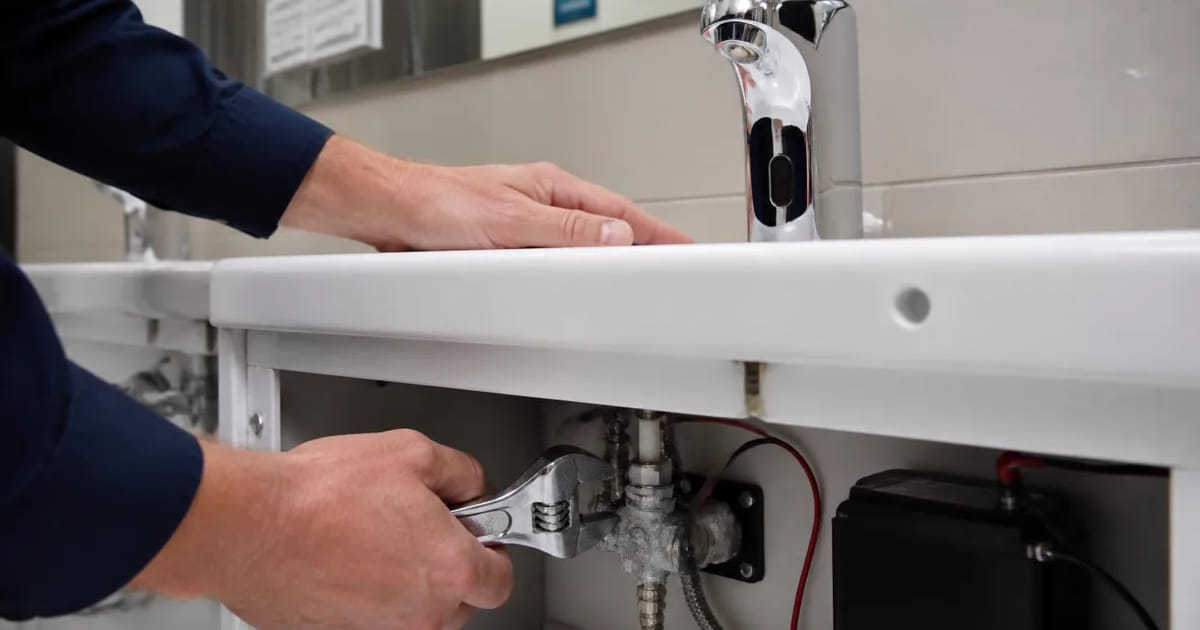
Infrared sensor taps and self-closing timed taps are no longer exclusive to airports and shopping centres. They are now installed in holiday rentals, gyms, restaurants, clinics, schools and increasingly in private homes across Madeira. The reason is twofold: they cut water use automatically and remove hand contact. The problem is that when they fail, almost nobody knows where to look — the fault gets blamed on the sensor when, in nine out of ten cases, it lies in the solenoid valve, the power supply or the inlet filter.
⚡ How a Sensor Tap Actually Works
1) The infrared sensor emits a beam and detects its reflection off your hands, sending a signal to the electronic module. 2) The module opens a solenoid valve fitted under the basin, and that valve is what really controls the water. 3) Power comes from batteries (typically 4×AA or a lithium pack) or from a 6 to 12 V mains transformer. 4) Water reaches the solenoid through flexible hoses and a small mesh filter that traps particles. 5) Many models include a flow limiter and a pre-mixed temperature setting. 6) Maximum continuous run time is defined in firmware or by DIP switches on the module. 7) Understanding this chain is what allows a diagnosis in minutes instead of needlessly replacing the whole tap.
🧱 Solenoid Valve Blocked by Limescale
1) The most common fault in Madeira is a solenoid valve with a limescaled plunger and diaphragm. 2) The classic symptom is the sensor lighting up and the coil clicking, but no water flowing or only a trickle. 3) A second variant is the tap dripping after shut-off, because the diaphragm no longer seats properly. 4) The correct fix is to isolate the water, strip the solenoid body and mechanically clean the plunger, spring and diaphragm. 5) Hardened or torn diaphragms must be replaced: cleaning will not restore them. 6) The inlet mesh filter should always be cleaned in the same visit, since it feeds the blockage. 7) In hard water, a particle filter at the property inlet drastically reduces how often this happens.
🔋 Batteries, Transformers and Power Faults
1) A tap that responds intermittently, with delay, or opens only for an instant is nearly always a power supply at end of life. 2) Alkaline batteries typically last one to two years in domestic use and far less under heavy commercial use. 3) Always replace the full battery set and never mix new cells with used ones. 4) On transformer models, check output voltage and connector condition: humidity and sea air oxidise the contacts. 5) In coastal salt-spray areas (Caniço, Santa Cruz, Machico, Porto Moniz) the power box must sit away from water splashes. 6) Modules with a diagnostic LED signal battery status by flash pattern — the manufacturer's manual is worth reading. 7) On new installations, prefer a transformer in commercial spaces and batteries only where maintenance is easy and regular.
🎯 Misaligned Sensors, False Triggers and Dirt
1) A tap that opens by itself almost always has a reflective surface too close: a very white basin, a mirror, paper or an object left in place. 2) A lens fouled by limescale, toothpaste or soap loses range and stops detecting dark or wet hands. 3) Clean the lens with a soft damp cloth, without abrasives or concentrated alcohol. 4) Most models allow detection distance to be adjusted via a potentiometer, DIP switch or calibration sequence. 5) Excessive range triggers the tap as someone simply walks past; short range forces hands uncomfortably close. 6) Very strong direct sunlight on the lens can interfere with older models. 7) After any cleaning or battery change, let the tap self-calibrate without hands in the sensor field.
⏱️ Setting Timed Taps in Rentals and Commercial Use
1) Self-closing timed taps shut by spring and hydraulic cartridge, with no electronics, and the run time is set by screw or by changing the cartridge. 2) On public basins, seven to fifteen seconds per press is the most widely accepted practical range. 3) Times that are too short make users press repeatedly, which wastes more water than one properly sized cycle. 4) On timed gym or pool showers the typical cycle is much longer, twenty to forty seconds. 5) The cartridge is the wear part: when shut-off becomes abrupt, noisy or too slow, replace it. 6) Abrupt closing causes water hammer and should be corrected rather than tolerated, to protect the pipework. 7) In holiday rentals, record the cartridge brand and model: it speeds up future repairs enormously.
💧 Real Savings and Planned Maintenance
1) Savings come from eliminating tap-open time with no actual use, not from degrading the jet. 2) Combining a sensor or timer with a low-flow aerator produces the best result per water point. 3) Set a six-monthly routine: lens cleaning, inlet filter cleaning and run-time testing. 4) Replace batteries preventively at the start of each season in holiday rentals instead of waiting for failure. 5) Inspect the solenoid valve yearly in hard-water areas and keep a spare diaphragm in stock. 6) Log the work: in commercial spaces, that record is evidence of diligent maintenance. 7) Want sensor or timed taps installed or repaired at your property? Message us on WhatsApp.
FAQ
My sensor tap clicks but no water comes out. Why?
The click means the electronics and coil are working, so the problem is downstream. In most cases it is a solenoid valve with limescale on the plunger and diaphragm, or a blocked inlet filter — both fixed by cleaning or replacing parts.
How long do sensor tap batteries last?
One to two years in domestic use and often under a year in heavy commercial use. In holiday rentals it pays to replace them preventively at the start of each season.
Why does the tap open on its own with nobody there?
There is a reflective surface inside the sensor field — a mirror, a very pale basin, paper or an object left there — or the detection distance is set too far. Reducing the range and clearing the field solves it almost every time.
Which is better for a holiday rental: sensor or timed?
Timed taps are more robust, with no electronics or batteries, ideal where maintenance is infrequent. Sensor taps give a better user experience and hygiene, but need a maintenance routine and a reliable power supply.
Faulty sensor tap or badly set timer? Message us on WhatsApp.
We work in Funchal, Câmara de Lobos, Caniço, Santa Cruz, Machico, Ribeira Brava, Ponta do Sol, Calheta, Santana, São Vicente and across Madeira Island.