Rising Damp and Salt Efflorescence on Walls in Madeira: Causes and Permanent Fixes
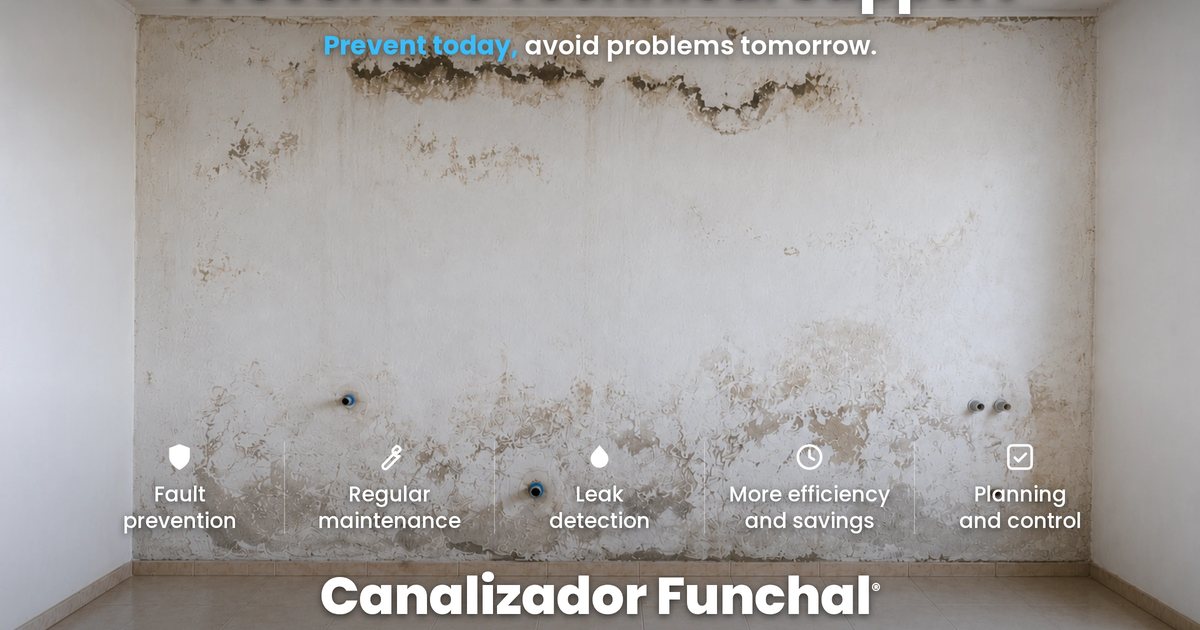
Paint blistering along the skirting, plaster crumbling at a touch and a white crystalline powder on the wall: the classic picture of rising damp with salt efflorescence. In Madeira the problem is made worse by two very local factors — the historic use of unwashed sea sand in mortars, and the absence of waterproofing beneath slabs and footings in direct contact with the ground.
🔎 Symptoms & Initial Diagnosis
Without hacking off any plaster, check: 1) the shape of the damage — a continuous horizontal band at the base points to rising damp, an isolated patch mid-wall or on the ceiling points to a leak; 2) whether it clearly worsens in winter and improves in summer, typical of capillarity; 3) whether there is white crystallised powder (efflorescence) on the plaster surface. Always confirm with a moisture meter at several points and, above all, a water meter test with everything closed — many cases labelled 'rising damp' turn out to be a nearby plumbing or drain leak.
🧪 Main Causes
In many older homes in Funchal and Câmara de Lobos, two local factors combine: 1) the historic use of unwashed sea sand in mortars, whose salt stays trapped, dissolves with rising water and crystallises at the surface as it evaporates, blowing plaster and paint apart from within; 2) missing membrane or chemical barrier between footings/ground slabs and walls, worsened by the island's typical sloping terrain, adding lateral water pressure from the hillside after heavy rain, especially in Ribeira Brava and Santa Cruz.
🛠️ Ideal Step-by-Step / Immediate Action
1) Shut off the water and read the meter over 2 hours with no use, ruling out a hidden leak first. 2) Photograph the damage band and measure its height above the skirting. 3) Do not paint or seal the affected area with plastic paint — let the wall breathe until the technical visit. 4) Check whether the damp coincides with a wall against a bank or sloping ground. 5) Book an assessment with a moisture meter and, if needed, a thermal camera before any permanent works.
🚫 What to AVOID
Avoid: 1) hacking off and re-rendering with ordinary mortar without treating the cause — the salt migrates through the new layer within months; 2) applying plastic or waterproof paint internally, which seals the pores and makes the paint peel off in even bigger sheets; 3) closing the diagnosis as 'rising damp' without ruling out a nearby plumbing or drain leak, which is mandatory before any waterproofing work; 4) waiting years without acting, since prolonged moisture weakens the masonry's strength.
🧰 Preventive Maintenance
In new construction, always invest in a bituminous membrane under footings and ground slabs, a perimeter drain with gravel and geotextile, and certified washed sand in mortars — a fraction of the cost of repairing later. In existing buildings, inspect the skirting band on ground floors yearly, especially in villas built against banks in Machico or Caniço. After treating with an anti-capillary barrier and renovation render, always finish with breathable mineral paint so residual evaporation from the wall is not blocked.
FAQ
Is it rising damp or a water leak?
Rising damp forms a continuous band at the wall base and worsens in winter. A leak creates a localised patch, often mid-wall or on the ceiling, and persists all year. A meter test and moisture readings confirm it.
Will painting over it work?
No. Plastic or waterproof paint applied internally seals the pores, moisture builds up behind and the paint eventually peels off in sheets, often worse than before.
How long does the wall take to dry?
Once the barrier is in place, a thick wall can take 3 to 12 months to dry. Renovation render lets you use the room meanwhile.
Can sea-sand salt be removed?
Not entirely. The contaminated render is removed and renovation mortar is used, hosting the crystals in its pores without breaking the finish.
Need help now? Fast response on WhatsApp.
We work in Funchal, Câmara de Lobos, Caniço, Santa Cruz, Machico, Ribeira Brava, Ponta do Sol, Calheta, Santana, São Vicente and across Madeira Island.