How to Remove Mould Behind Fitted Wardrobes and Bed Headboards
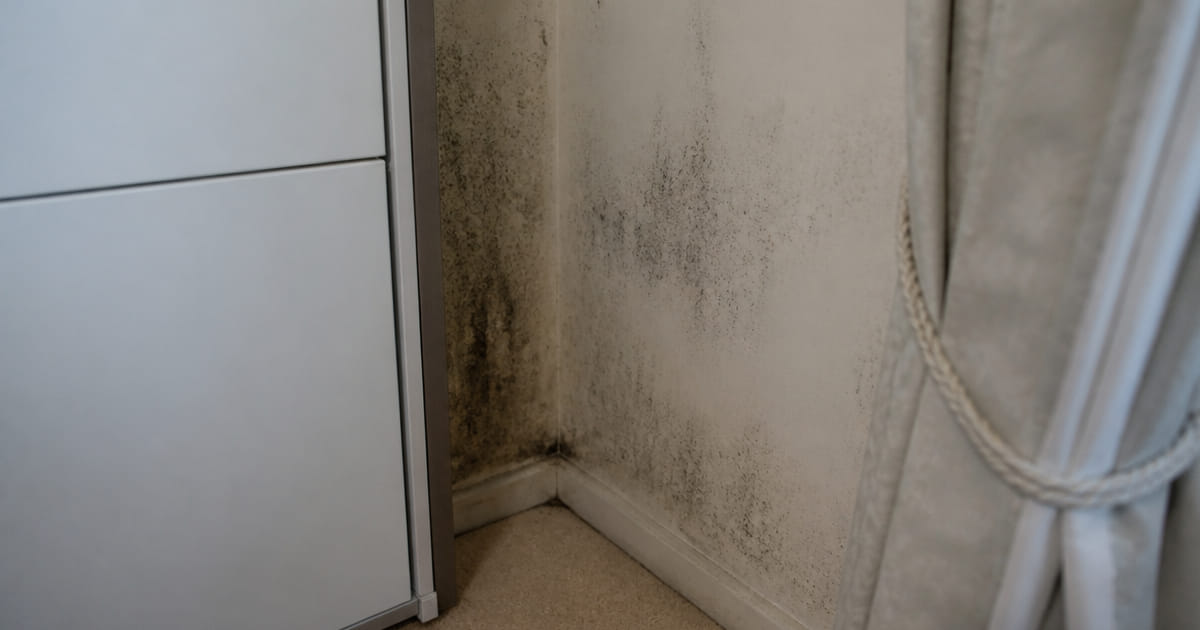
The pattern repeats in hundreds of Madeira bedrooms: the wall is spotless across the room, yet behind the fitted wardrobe or the bed headboard there is mould, a musty smell and damp clothing. It is neither coincidence nor poor cleaning. That spot combines the three conditions mould needs: a surface colder than the rest of the wall, virtually still air and high relative humidity. Fixing it requires thermal diagnosis first and intervention second — painting over with anti-fungal paint spends money only to watch the problem return next winter.
🔎 Why Always There: The Physics of the Cold Spot
1) Furniture pushed against an external wall insulates on the wrong side: it stops room heat reaching the wall. 2) The surface behind the unit ends up 2 to 4 °C colder than the rest of the wall. 3) If that temperature drops below the indoor air dew point, invisible condensation forms. 4) With no air movement, that moisture never evaporates and lingers for hours or days. 5) Just 65% to 70% RH at the surface and a few days are enough for spores to germinate. 6) Upholstered headboards make it worse, adding night-time breath vapour right against the cold wall.
🌡️ Thermal Diagnosis: Measuring the Thermal Bridges
1) A thermal camera identifies the cold zones: columns, beams, shutter boxes, corners and slab-to-wall junctions. 2) The survey needs a temperature difference between inside and outside, ideally early morning. 3) An infrared thermometer gives spot surface temperature at very low cost. 4) In parallel, air RH and temperature are measured to calculate the dew point. 5) If the surface sits below that value, condensation is confirmed; if above, look for a leak or ingress. 6) A depth moisture meter separates surface damp from moisture coming from inside the wall.
🚱 First Rule Out Leaks and Water Ingress
1) Condensation mould is diffuse, superficial and concentrated in corners and cold zones. 2) Leak mould is localised, often with a dark halo, lifting paint and damp spreading up or down. 3) Check whether pipework is buried in the wardrobe wall: hot water risers and branches from an adjoining bathroom. 4) A pressure test with a gauge confirms or clears the pipework in minutes. 5) On facades exposed to driving rain, assess cracks, stonework and joints before any internal insulation. 6) Insulating internally over an active leak only hides the problem and accelerates decay.
🧱 Correcting the Cold Spot: Internal Insulation
1) The technical fix is raising the internal surface temperature above the dew point. 2) A thin insulation board behind the wardrobe — XPS or calcium silicate — resolves most cases. 3) Calcium silicate is preferable when a capillary-active, mould-resistant material is wanted. 4) Elastomeric foam and insulating sleeves treat buried cold pipes that are chilling the wall. 5) Bonding must be continuous, with no air pockets that would create new condensation points. 6) A levelling render and a breathable finish — mineral or silicate paint — complete the work.
🌀 Forced Air Circulation in Enclosed Spaces
1) Space the unit 3 to 5 cm off the external wall with spacers, creating a vertical air channel. 2) Add ventilation grilles at the skirting and the top of the wardrobe for a chimney effect. 3) Replace solid backs pressed to the wall with grilled or slatted ventilated panels. 4) In very sealed wardrobes, a small low-power fan with an RH sensor keeps air moving. 5) Never store damp clothes or towels inside: every damp item is a vapour source. 6) Continuous bathroom and kitchen extraction lowers overall apartment RH and supports this strategy.
🧽 Correct Cleaning and Lasting Prevention
1) Clean with a proper fungicidal product, gloves and mask, room ventilated — bleach decolours but does not treat the root. 2) Vacuum the dry surface with a HEPA filter machine before applying product, to avoid spreading spores. 3) Let it dry fully before painting; painting over a damp wall guarantees the mould returns. 4) Keep bedroom RH between 40% and 60% with mechanical ventilation or dehumidification. 5) Log RH with a hygrometer through one winter: the data shows whether the fix worked. 6) Mould that keeps returning to the same spot? Message us on WhatsApp for a thermal and moisture survey.
FAQ
Does anti-fungal paint solve it?
It does not address the cause. It delays reappearance for some months, but while the surface stays below dew point with no air movement, the mould always comes back.
How do I tell condensation from a water leak?
Condensation is diffuse, superficial and seasonal, worse in winter. A leak is localised, permanent and often blisters the paint. A depth moisture meter plus a pressure test settles it.
Is it worth insulating only behind the furniture?
Yes, in many cases it is the best value intervention. What matters is overlapping the insulation beyond the cold area with margin, so no new cold spot forms at the edge.
Should I move the bed?
Pulling the headboard a few centimetres off the external wall and allowing air circulation is often enough, especially combined with insulation correction and room ventilation.
Mould behind the wardrobe or headboard? Message us on WhatsApp for a thermal and moisture survey.
We work in Funchal, Câmara de Lobos, Caniço, Santa Cruz, Machico, Ribeira Brava, Ponta do Sol, Calheta, Santana, São Vicente and across the whole island of Madeira.