Rainwater Drainage on Ramps and Retaining Walls: How to Prevent Flooding
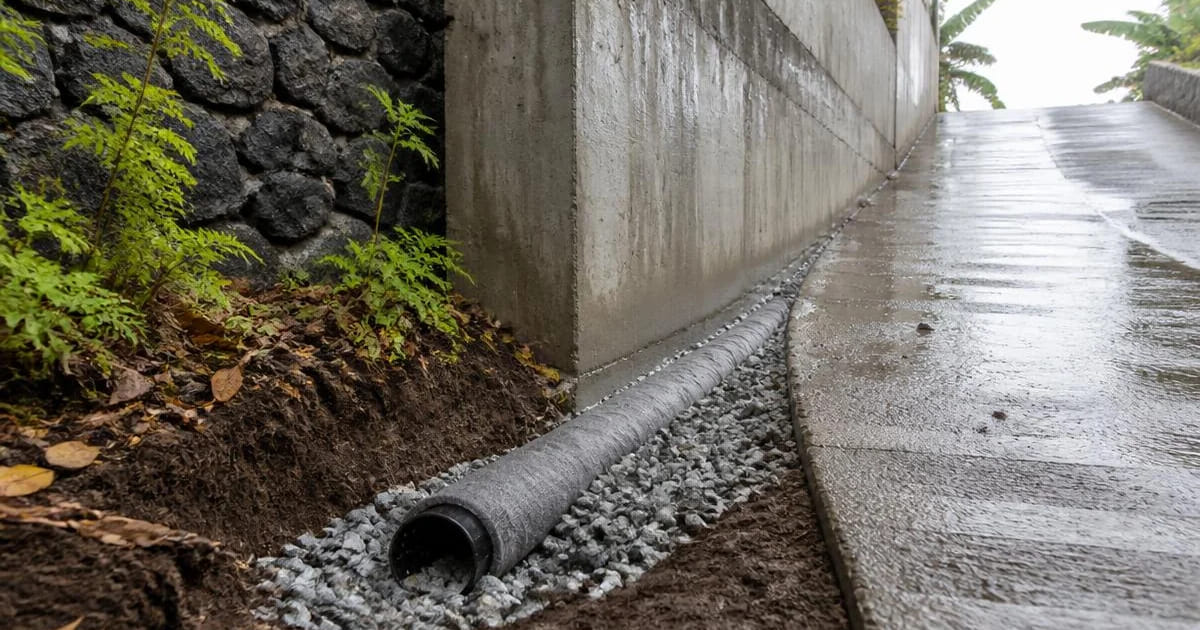
In Madeira the topography rules: almost every house has a retaining wall behind it and a ramp running down to the garage. When it rains hard, the water does not disappear — it finds the lowest point. If that point is the bottom of the ramp or the base of the wall, the garage becomes the reservoir. This guide explains why it happens and how it is solved permanently, with proper drainage instead of sandbags and towels at the door.
🌧️ Why Water Builds Up at the Base of the Wall
1) The ground uphill of the wall behaves like a sponge: it absorbs rain and releases it slowly against the back face. 2) With no drain, that water applies permanent hydrostatic pressure to the structure. 3) Concrete is not waterproof: water crosses it by capillarity and emerges on the inside. 4) Casting joints and pipe penetrations are preferential infiltration paths. 5) On basalt slopes water runs between soil and rock layers and reappears metres away from its origin. 6) The typical result is efflorescence, a rising damp patch and paint peeling off the garage wall.
🚗 Why the Garage Ramp Floods
1) The ramp is a sloped channel: it collects water from every impermeable surface uphill. 2) Many ramps only have one narrow, undersized grating at the bottom. 3) Leaves, soil and hillside sand blind that grating in the first minute of rain. 4) With no raised threshold at the entrance, the gate is no obstacle at all. 5) If the grating connects to a branch that also carries foul water, backflow is guaranteed in a storm. 6) Short, intense downpours — Madeira's pattern — produce peak flows that undersized systems never absorb.
🪨 The French Drain: How It Is Built Correctly
1) A longitudinal trench is opened at the base of the wall, below the level of the floor to be protected. 2) A perforated corrugated pipe is laid (typically DN110 to DN160), perforations facing down. 3) The pipe is wrapped in a geotextile sleeve, which lets water through and holds back fine particles. 4) It is backfilled with washed, uniformly graded gravel — never with all-in aggregate or soil. 5) A second geotextile layer separates gravel from soil so the drain does not silt up over the years. 6) A minimum 0.5% to 1% fall takes the water to a collection chamber, soakaway or licensed storm sewer — the drain has to end somewhere.
🛡️ Waterproofing and Drainage Board on the Back Face
1) The drain deals with accumulated water; waterproofing stops passage through the concrete. 2) A bituminous or cementitious membrane is applied to the back of the wall before backfilling. 3) A dimpled drainage board creates an air gap that leads water straight to the drain. 4) It also protects the membrane while the backfill is compacted. 5) The first half metre of backfill should be granular material, not clay. 6) Combining all three — membrane, board and drain — is what separates a repair from a solution.
⚙️ Channels and C250/D400 Load-Class Gratings
1) Polymer concrete channels are stronger and less porous than traditional concrete, with smooth high-flow walls. 2) Load class follows the traffic: C250 for areas with cars and occasional heavy vehicles, D400 for accesses used by trucks. 3) An under-rated grating cracks, sinks and becomes a physical hazard. 4) The channel goes across the bottom of the ramp and, ideally, across the top too, to intercept water before it runs down. 5) It must be bedded in reinforced concrete, precisely levelled and set slightly below the paving. 6) The outlet needs pipework to match: an excellent channel connected to a DN75 still floods.
🧰 Prevention and Maintenance Before the Rains
1) Clean gratings, channels and silt traps before autumn, while it is still convenient. 2) Check that storm chambers really do receive and discharge. 3) Never connect rainwater to the foul drain: in a storm, backflow comes up through the grating. 4) Fit a concrete threshold or hump at the garage entrance as a second line of defence. 5) Document the network: where it enters, runs and discharges avoids blind excavation later. 6) Water getting into your garage or efflorescence on the wall? Message us on WhatsApp and we will assess the drainage on site.
FAQ
Does a French drain need maintenance?
Properly built with washed gravel and geotextile, it lasts many years untouched. What needs periodic cleaning are the collection chambers and gratings the drain discharges into.
Is one more grating at the bottom of the ramp enough?
Rarely. The problem is usually total flow and outlet diameter. A continuous cross channel with the right load-class grating and a correctly sized branch solves it; an extra grating on a thin pipe does not.
What is the difference between C250 and D400 gratings?
The load they carry. C250 suits accesses with cars and occasional heavy vehicles; D400 is for roads and accesses with regular heavy vehicle traffic.
Can I discharge drainage onto my neighbour's land?
No. Discharge must go to a storm sewer, soakaway or authorised point within your own property. Discharging onto someone else's land creates liability for damage.
Water in the garage or damp on the retaining wall? Message us on WhatsApp.
We work in Funchal, Câmara de Lobos, Caniço, Santa Cruz, Machico, Ribeira Brava, Ponta do Sol, Calheta, Santana, São Vicente and across the whole island of Madeira.