Rainwater Downpipe Leaking Inside the False Ceiling
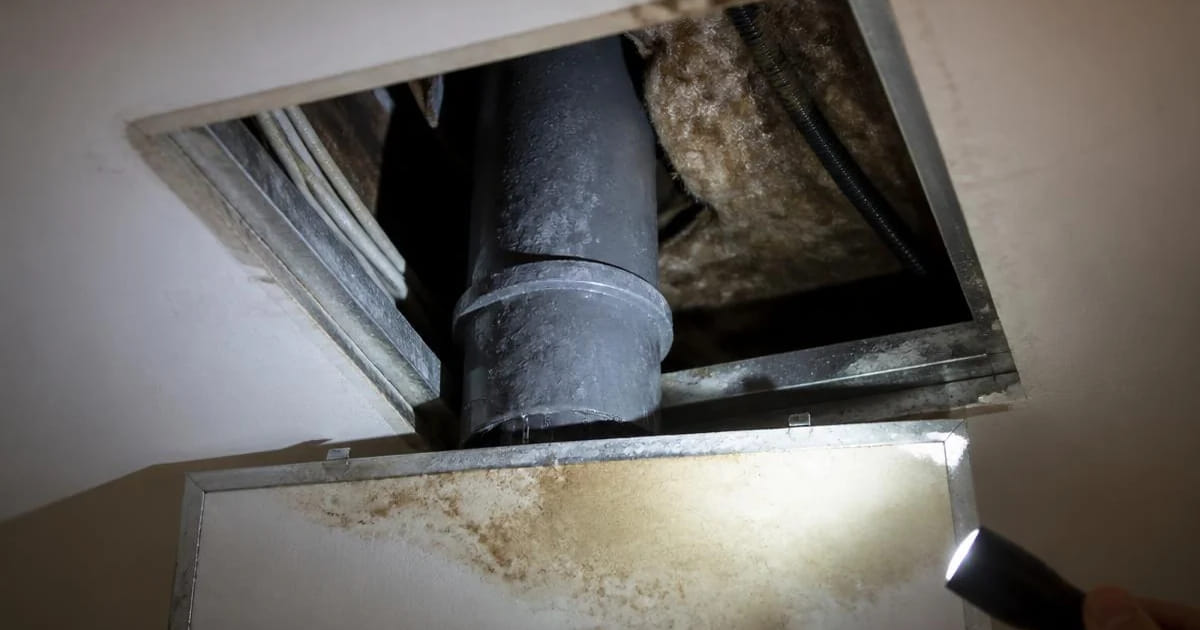
It is one of the most frustrating diagnoses: the false ceiling drips, but only when it rains hard. On dry days there is nothing to see, no pressure to test, no obvious wet spot. The cause is almost always the vertical rainwater stack crossing the building — a failed joint, a crack from thermal movement, or an old fracture. This guide explains how it is located without demolition and repaired from the inside.
🌧️ Why It Only Drips in Heavy Rain
1) The rainwater stack only carries meaningful flow while it rains: the rest of the time it is dry and gives nothing away. 2) In an intense downpour the pipe part-fills and water finally touches the defect. 3) If the top inlet is blinded by leaves, pressure builds and water escapes at the weakest joint. 4) Fine cracks only discharge when there is a column of water above them. 5) Water runs down the outside of the pipe for metres before appearing, so the stain is never under the defect. 6) Between downpours the plasterboard partly dries, giving the false impression it fixed itself.
🔍 Telling Rainwater, Foul Drain and Condensation Apart
1) Rainwater: drips at the same time as the rain, clean water, no smell. 2) Foul drain: appears when someone flushes or showers, with odour and sometimes colour. 3) Condensation: droplets across the whole cold pipe surface, no concentrated source, worse in humid summers. 4) Pressurised water leak: constant, weather-independent, with loss showing at the meter. 5) Façade or terrace infiltration: follows wind-driven rain direction, not usage times. 6) Confirm with a controlled simulation test — pouring water on the roof or into the pipe — before opening any ceiling.
📹 Video Inspection with a Flexible 360° Camera
1) The camera cable is fed in through the roof outlet, a rodding eye or a minimal opening at the access panel. 2) The articulated head rotates and inspects the entire internal circumference, not just straight ahead. 3) It identifies open joints, failed solvent welds, longitudinal cracks, crushed pipe, roots and settlement. 4) The metre counter on the reel gives the exact distance from the defect to the entry point. 5) With a sonde locator, the point is marked on the slab or wall to within centimetres. 6) The video stays as a technical record — essential in shared buildings and insurance claims.
🧵 Repair with a Resin Liner and Packer
1) The liner is a fabric sleeve impregnated with epoxy resin, sized to the pipe diameter. 2) It is fitted over an inflatable packer and positioned exactly over the defective zone. 3) The packer is inflated, pressing the liner against the internal pipe wall. 4) The resin cures and forms a new structural pipe inside the old one, watertight and smooth. 5) The packer is withdrawn and the result is confirmed with a second camera run. 6) Section loss is minimal and there is no need to cut into ceilings, walls or finishes.
🧱 When a Liner Will Not Do, and What Then
1) A collapsed or misaligned pipe will not take a liner: that stretch must be replaced. 2) A fully separated joint with a step needs a localised mechanical repair. 3) Very small diameters or double 90° bends limit packer access. 4) In those cases a single localised opening is made, not the whole false ceiling. 5) In renovations it always pays to replace old PVC with a stack that has expansion joints and rubber-lined clips. 6) Providing an inspection panel at each change of direction saves a lot of money later.
🛡️ Preventive Care of the Rainwater Stack
1) Clean outlets, gutters and stack heads twice a year, before and after autumn. 2) Fit leaf guards or baskets on roof inlets. 3) Check clips: a poorly fixed pipe expands, vibrates and opens joints. 4) Ensure expansion joints on long stacks, especially on sun-exposed façades. 5) In shared buildings, log the inspections: the stack is common property and so is the liability. 6) Ceiling dripping when it rains? Message us on WhatsApp and we will locate it without breaking everything.
FAQ
Does the false ceiling have to be opened to find the leak?
Usually a minimal access or the existing hatch is enough. Video inspection travels the stack internally and the locator marks the exact point, avoiding exploratory demolition.
Is a resin liner a permanent solution?
Yes, where the pipe keeps its geometry. The cured liner forms a structural pipe inside the old one, with a service life of decades and an internal surface smoother than the original.
Is the rainwater stack my responsibility or the building's?
Stacks serving several units are normally common property of the building. The private branch inside your unit is yours. The inspection report is what settles the boundary.
Can I wait until the end of winter to repair it?
Not advisable. Water sitting in the false ceiling degrades plasterboard, insulation and electrical wiring, turning a local defect into a full ceiling replacement.
Ceiling dripping when it rains? Message us on WhatsApp.
We work in Funchal, Câmara de Lobos, Caniço, Santa Cruz, Machico, Ribeira Brava, Ponta do Sol, Calheta, Santana, São Vicente and across the whole island of Madeira.