Pressure Vessels and Pressure Switches: Setting Pressure and Stopping Frequent Pump Starts
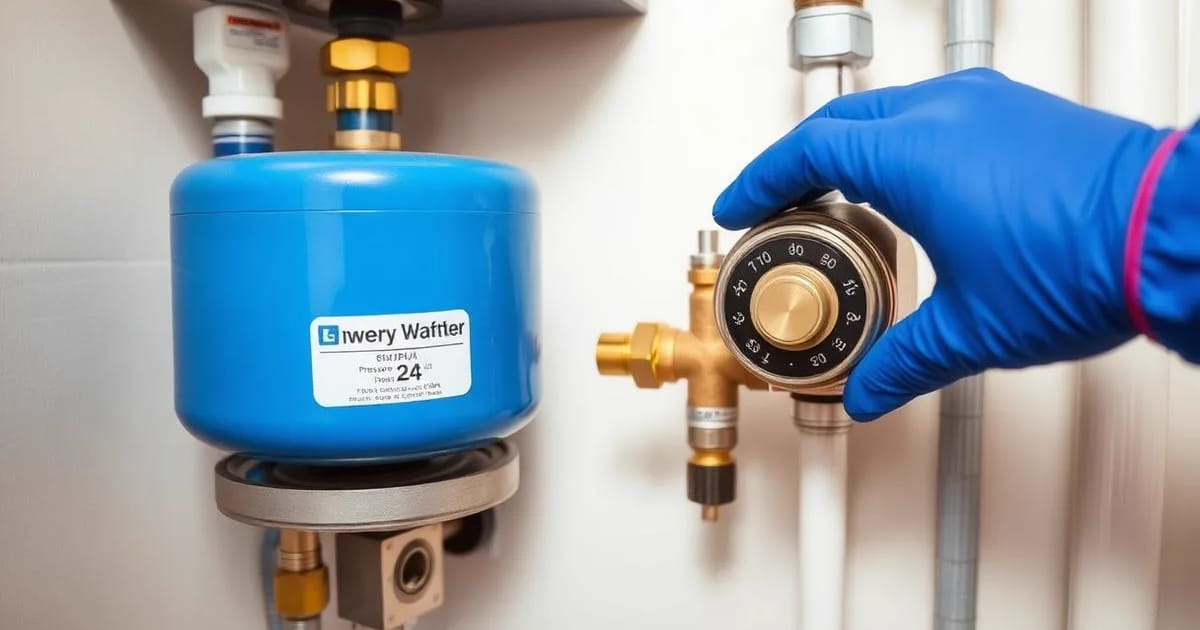
In Madeira many houses rely on booster sets: borehole water, spring water, storage tanks, or simply pressure support in high areas where the mains arrives weak. When the pump starts and stops every few seconds — short cycling — the cause is almost always the same: the vessel has lost its pre-charge, or the pressure switch is badly set. This guide explains step by step how the system works and how to tune it without wrecking the motor.
⚙️ How a Booster Set Works
1) The set has three inseparable parts: pump, diaphragm pressure vessel and pressure switch. 2) The pump creates flow and pressure; the vessel stores water under the pressure of compressed air in its upper chamber; the pressure switch starts and stops the motor according to network pressure. 3) Inside the vessel an EPDM diaphragm separates water from air — it is what lets you draw a glass of water without starting the pump. 4) When you open a tap, pressure drops; at the cut-in value the switch closes and the pump runs. 5) When pressure reaches the cut-out value the contact opens and the pump stops. 6) The gap between those values is the differential. 7) With no usable vessel, every litre drawn forces a start: capacitor, bearings and the switch itself wear out fast.
📊 Reference Values: Cut-in, Cut-out and Pre-charge
1) In a typical house, cut-in at 2.0 bar and cut-out at 3.5 bar gives comfortable pressure without stressing the installation. 2) Vessel air pre-charge should sit about 0.2 to 0.3 bar below cut-in — in this example, 1.7 to 1.8 bar. 3) Always measure pre-charge with the vessel drained of water and the system depressurised, at the Schrader valve on top. 4) Very tight differentials (say 0.5 bar) cause constant starts; wide differentials feel like pressure swings in the shower. 5) In buildings over two floors, remember every 10 m of height costs roughly 1 bar. 6) Cut-out pressure must stay clear of domestic fitting limits: above 4 bar, fit a pressure reducer downstream. 7) Write the values on a label beside the set — it makes future diagnosis far quicker.
🔁 Short Cycling: Diagnosis in Seven Steps
1) Close every tap and watch the gauge: if pressure falls on its own, there is a leak or a passing check valve. 2) Tap the vessel by hand: a solid «full» sound all the way up means a ruptured diaphragm and a flooded air chamber. 3) Press the Schrader valve: water instead of air confirms a punctured diaphragm and the vessel must be replaced. 4) Measure pre-charge with a tyre gauge after draining; zero explains short cycling immediately. 5) Check the switch for burnt contacts or a capillary blocked by limescale. 6) Confirm the check valve at the pump outlet is not letting water return to the well or tank. 7) Only then assess the motor: a pump starting 40 times a minute fails because of the system, not a manufacturing defect.
🔧 The Correct Adjustment Procedure
1) Isolate the electrical supply before opening the switch cover — the contacts are live. 2) Close the outlet valve, open a low tap and drain the vessel completely. 3) Set the air pre-charge to the calculated value and close the valve. 4) Restore power and set the cut-out screw first (usually the central one), watching the gauge. 5) Then set the differential screw, which defines the cut-in point. 6) Test with a real draw-off: open a basin tap and confirm the pump runs steadily, with no relay chatter. 7) Repeat with the shower at half flow — that is where setting errors show up first.
🌊 Madeira Specifics: Boreholes, Springs and High Ground
1) Borehole and spring water carries sand that abrades the impeller and blocks the switch capillary: an inlet particle filter is essential. 2) With levadas and springs, entrained air causes knocking and false pressure readings — an expansion vessel and air vent solve it. 3) In high areas such as Monte, Santo António, Camacha or Santana, mains pressure is irregular and the set works longer hours: plan annual maintenance. 4) The marine environment corrodes metal switch enclosures; we prefer properly protected versions with sealed glands. 5) In holiday rentals simultaneous demand is high: a larger vessel (50 to 100 L) cuts starts dramatically. 6) Sun-exposed tanks heat the water and shift pressure through expansion — shading plus an expansion vessel fixes it. 7) Pumps in damp garages need a dedicated RCD and equipotential bonding.
✅ Preventive Maintenance and When to Call a Technician
1) Check vessel pre-charge once a year: it is the single action that most extends pump life. 2) Clean the inlet filter quarterly on borehole or spring water. 3) Listen to the start: multiple relay clicks mean the switch is near end of life. 4) Confirm there are no visible leaks on the manifold's threaded joints. 5) Log the standing pressure — month-to-month drift predicts failures. 6) Replace vessel and switch together once both pass 8 to 10 years. 7) If the pump trips the breaker, overheats or hums without building pressure, switch it off and get support: persisting burns the motor. Need the set adjusted or replaced? Send WhatsApp photos of the unit and the gauge.
FAQ
What pre-charge should my pressure vessel have?
About 0.2 to 0.3 bar below the pump cut-in pressure. With cut-in at 2.0 bar, pre-charge sits between 1.7 and 1.8 bar, measured with the vessel drained and the system depressurised.
Why does my pump start and stop constantly?
In most cases the vessel has lost pre-charge or its diaphragm is ruptured, so it stores no volume. It also happens with too tight a differential on the switch, a leak in the pipework, or a passing check valve.
Can I raise cut-out pressure for a stronger shower?
Within limits yes, but above 4 bar the risk of leaks in flexible hoses, mixers and water-heater connections rises sharply. Often the real fix is removing pressure losses and limescale, not adding pressure.
Is a bigger vessel worth it?
Yes, especially in houses and short-term rentals with simultaneous demand. A 50 to 100 L vessel greatly reduces the number of starts, saves energy and extends pump and switch life.
Pump starting constantly? Message us on WhatsApp.
We work in Funchal, Câmara de Lobos, Caniço, Santa Cruz, Machico, Ribeira Brava, Ponta do Sol, Calheta, Santana, São Vicente and across Madeira Island.