Potable Expansion Vessel: Absorbing Hot-Water Expansion and Stopping the Drip
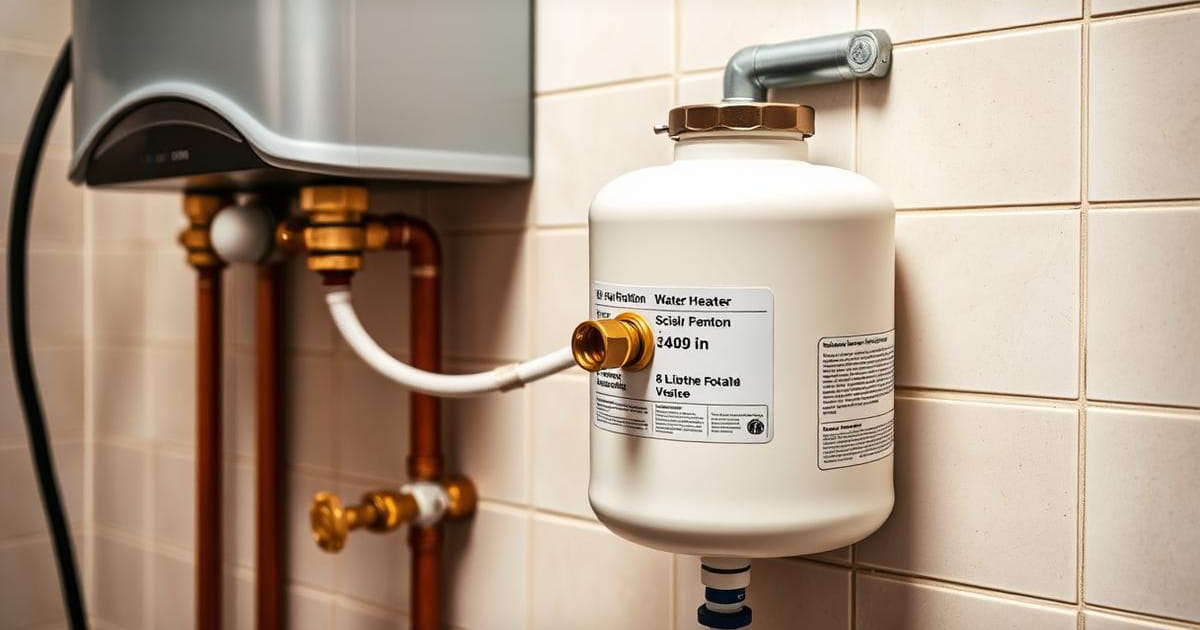
A safety valve that drips every day is not a faulty valve: it is a symptom. In most cases we resolve in Funchal the problem is hydraulic and has a name — there is no potable expansion vessel, or there is one but it is uncalibrated. Water heated inside the cylinder grows in volume, the system has nowhere to absorb the excess, and pressure climbs until the valve opens. The result is continuous waste, limescale on the floor, premature wear of fittings and, very often, noise in the pipework.
🌡️ Why Water Expands and Where It Hurts
The physics is simple and unforgiving. 1) Water grows in volume with temperature: heating from 15 °C to 60 °C produces roughly 2% expansion. 2) In a 100-litre cylinder that is about 2 litres that must go somewhere. 3) In older systems, with elastic pipework and less tight valves, that excess found a natural escape. 4) In modern systems with a check valve, pressure reducer and multilayer pipe, the hot-water circuit is hydraulically closed. 5) Since water is practically incompressible, the extra volume translates directly into rising pressure, which can jump from a working 3 to 4 bar to the 7 bar at which the safety valve opens. 6) The valve opens, relieves and closes again — on every heating cycle. 7) That is why the drip mostly shows up at night or after periods without draw-off.
⚙️ How an EPDM Diaphragm Vessel Works
The vessel is a hydraulic shock absorber. 1) Inside the metal body there is an EPDM diaphragm approved for drinking water, separating two chambers. 2) On one side, mains water; on the other, a pre-compressed cushion of air or nitrogen. 3) When water heats and expands it pushes the diaphragm and compresses the gas — gas is compressible, water is not. 4) When draw-off resumes and pressure falls, the gas returns that water to the circuit. 5) The diaphragm also prevents contact between air and water, avoiding oxygenation and contamination. 6) In potable models the interior is lined and certified for human consumption: never fit a central-heating vessel on a domestic hot-water system. 7) The vessel is best installed on the cold-water inlet to the cylinder, with a tee, isolating valve and the ability to drain for servicing.
📐 Sizing and Setting the Pre-Charge
This is where nearly every installation fails. 1) Practical sizing rule: about 8% to 10% of the stored volume — 8 litres for a 100-litre cylinder is a common figure. 2) The air pre-charge must be set slightly below the system working pressure: with 3.5 bar mains, typically 3 bar of pre-charge. 3) Always check with the water side depressurised: close the isolating valve, drain the water, and only then read the gauge on the Schrader valve. 4) Adjust with a hand pump or compressor, always with a reliable gauge. 5) If the pre-charge is too high, the vessel never takes water and absorbs nothing. 6) If it is too low, it fills with water quickly, saturates and the dripping returns. 7) Losing pre-charge is normal: that is why the check must be annual. 8) If water rather than air comes out when you press the valve, the diaphragm has ruptured and the vessel must be replaced.
🔎 Diagnosis: Vessel, Valve or Mains Pressure?
Before replacing parts, we measure. 1) We fit a gauge and log pressure at rest and through the heating cycle. 2) If static pressure is already above 5 bar, the problem starts at the mains and needs a pressure-reducing valve — common in higher areas of Funchal with a strong water column. 3) If pressure only rises when the cylinder heats, it is thermal expansion: no vessel, or an uncalibrated one. 4) If the safety valve drips with stable, low pressure, the valve is dirty or its seat is damaged. 5) We also check the check valves that close the circuit and prevent return flow. 6) We test the diaphragm's integrity and the condition of the safety group. 7) Only with that data do we decide what to replace — swapping the valve without fixing the cause guarantees a repeat.
🚫 Common Mistakes and What Never to Do
1) Plugging or over-tightening the safety valve outlet to 'stop the drip' — dangerous, and it removes the only overpressure protection the cylinder has. 2) Fitting a central-heating vessel (non-potable diaphragm) on the domestic hot-water system. 3) Installing the vessel with no isolating valve, making it impossible to check the pre-charge without draining the installation. 4) Not setting the pre-charge to the real mains pressure and leaving the factory value. 5) Fitting the vessel on the hot outlet, permanently exposed to high temperature, which degrades the diaphragm. 6) Ignoring static mains pressure and simply fitting a larger vessel. 7) Leaving the vessel hanging on the pipework alone: above 8 litres it needs its own bracket, or the connection suffers fatigue.
✅ Annual Check Routine
1) Read mains pressure at rest and during heating. 2) Check and correct the expansion vessel pre-charge. 3) Operate and test the safety valve, confirming it closes without dripping. 4) Visually inspect the safety group and the discharge pipe, which must stay visible and never obstructed. 5) Check the pressure reducer, where fitted, and the check valve. 6) Confirm storage temperature at 60 °C: less expansion, less limescale, less risk. 7) Log the readings for comparison next year. Safety valve dripping? Send photos of the installation and the gauge on WhatsApp and, based on the readings, we will tell you what actually needs correcting.
FAQ
The safety valve only drips when the cylinder heats. Is that normal?
It is not normal, it is thermal expansion with nowhere to go. If pressure only rises during the heating cycle, either the potable expansion vessel is missing or its pre-charge is wrong. Replacing the valve without fixing the cause only delays the problem.
What size expansion vessel do I need?
As a practical rule, 8% to 10% of stored volume: a 100-litre cylinder typically calls for an 8-litre vessel. On systems with high pressure or higher temperatures we size above that figure after measuring real pressure.
How do you check the vessel's air pre-charge?
Close the isolating valve, drain the water side and read the pressure at the Schrader valve with a gauge. The value should sit slightly below the system working pressure. If water comes out of the valve, the diaphragm has ruptured and the vessel needs replacing.
Can I use a central-heating expansion vessel on hot water?
No. Central-heating vessels have neither a diaphragm nor a lining certified for drinking water. Domestic hot-water systems always require a vessel with an EPDM diaphragm approved for potable use.
Safety valve dripping? Contact us on WhatsApp.
We work in Funchal, Câmara de Lobos, Caniço, Santa Cruz, Machico, Ribeira Brava, Ponta do Sol, Calheta, Santana, São Vicente and across Madeira Island.