Pipe Inspection with a Video Camera: Diagnosis Without Building Work
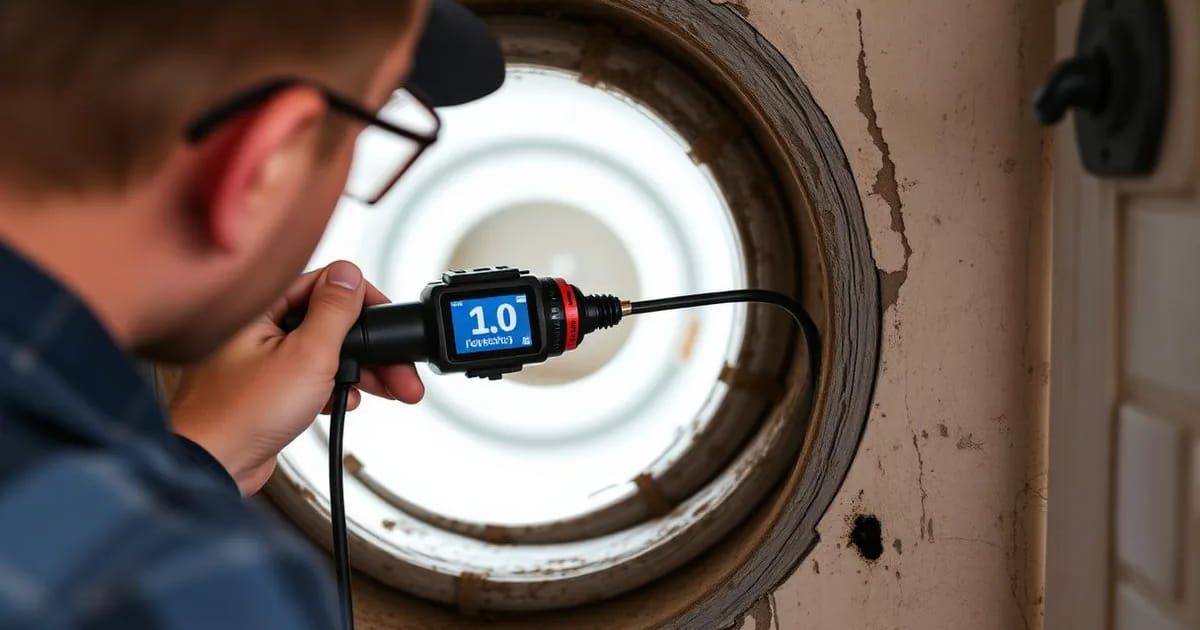
The worst decision in plumbing is opening a wall on a hunch. In an older Funchal house or an apartment with concealed pipework, the cost of a wrong diagnosis is not just the pipe: it is the tile that is no longer made, the screed, the paint and the days without a bathroom. Borescope inspection — a high-resolution articulated endoscopic camera — solves precisely that. It enters through access points that already exist, travels along branches and stacks, and shows on screen what is really inside: a crack, heavy scale, a step at a badly made joint, or simply debris that a clean-out will remove. You look first, open only where needed, and the quotation is finally based on facts.
🔍 What a Borescope Is and How It Differs
1) A borescope is a flexible probe with a camera and LED lighting at the tip, connected to a monitor or phone. 2) On articulated models the tip is steered remotely, letting you look at the pipe wall and into branch connections. 3) Slim 4 to 8 mm probes reach small-bore pipes, traps and the threads of concealed shower mixers. 4) Larger probes with a stiffer cable handle waste branches and stacks several metres long. 5) Wheeled drain CCTV cameras are the rugged version used for buried sewers. 6) A metre counter on the probe records the exact distance from the defect to the entry point. 7) Models with a sonde transmitter let the point be marked on the floor or wall to within centimetres.
🚪 Access Points Without Destruction
1) The rule is to always enter through an existing access before considering opening any structure. 2) Floor gullies, trapped gullies and inspection chambers are the usual routes on the waste side. 3) At a WC, inspection is done through the trap itself or the pan connector after simple removal. 4) On supply pipes, taps, shower heads or concealed mixer escutcheons come off and the probe enters the thread. 5) Rodding eyes, access bends and plugged tees reach long runs with no building work at all. 6) In stacks the survey can run top down, using the vent as the entry point. 7) Only where no access exists at all do we open a small technical hatch, left with a cover for future use.
🧾 What the Image Reveals: Blockages, Cracks and Scale
1) Soft blockages of grease, hair and soap residue appear as sticky mass reducing the useful bore. 2) Limescale and oxide encrustation shows as a hard irregular crust, typical of old iron and copper pipes. 3) Longitudinal and circumferential cracks are told apart by geometry and by how water tracks through them. 4) Misaligned joints create steps where debris catches and the blockage always returns to the same place. 5) Fine roots in buried sewers appear as white filaments at the joints. 6) Back-falls and standing water point to a gradient error, not simple dirt. 7) Burrs and leftover solvent or sealant from the original install explain many recurring blockages in new builds.
🛠️ Method Behind a Rigorous Survey
1) It starts with mapping the likely route and reviewing the problem history, with dates and symptoms. 2) A minimal pre-clean is done where needed, so the lens is not blinded by debris. 3) The probe advances slowly, with continuous video recording and the travelled distance noted. 4) At every anomaly we stop, articulate the tip and document it with a still image and a measurement. 5) The sonde locator marks the exact position at surface level, allowing surgical intervention. 6) It ends with a flow or pressure test, confirming the link between the defect and the symptom. 7) The report delivers images, distances and a technical recommendation — also useful for insurers and building management.
💡 When Inspecting Beats Opening
1) Blockages that always return to the same point, even after effective clearing. 2) Persistent smells with no visible cause in accessible traps and gullies. 3) Suspected leaks in concealed pipework, before any demolition decision is made. 4) Buying an older property: a survey shows the true condition of the internal network. 5) Renovation planning, to decide whether existing pipework stays or is replaced. 6) Damp disputes between apartments, where photographic evidence prevents long arguments. 7) Holiday rentals, where a repeat failure between stays costs far more than the survey.
📋 Limits of the Technique and Best Practice
1) A borescope shows what is visible inside: it does not replace acoustic listening, tracer gas or thermography for hidden pressurised leaks. 2) Fully blocked pipes need partial clearing before any useful image can be captured. 3) Tight 90° bends limit probe travel and may require entry from another point. 4) Very cloudy water reduces visibility and may mean draining the section first. 5) Interpretation is technical: the same image can mean a local repair or a full section replacement. 6) Always keep the video and report: they serve as property history and documentary evidence. 7) Want to see inside your pipework without breaking walls? Message us on WhatsApp.
FAQ
Does borescope inspection damage the pipework?
No. The probe is flexible and enters through existing access points such as gullies, inspection chambers or tap threads. The procedure is non-invasive and needs no opening of walls or floors.
Can it find leaks on pressurised water pipes?
It shows the pipe interior and confirms cracks or corrosion reachable by the probe. For hidden pressurised leaks it is combined with acoustic listening, tracer gas or thermography to pinpoint the spot.
Can you tell exactly where to open?
Yes. Using the probe metre counter and a sonde locator, the defect position is marked at surface level, allowing a surgical opening of just a few centimetres.
Is a survey worth it before buying an older house?
Very much so. It reveals the real condition of stacks and branches, exposes back-falls and scale, and lets you negotiate or budget replacement work with hard evidence.
Want to see inside your pipework without breaking walls? Message us on WhatsApp.
We work in Funchal, Câmara de Lobos, Caniço, Santa Cruz, Machico, Ribeira Brava, Ponta do Sol, Calheta, Santana, São Vicente and across Madeira Island.