Particle Filter at the Water Meter: Essential Protection for Your Plumbing
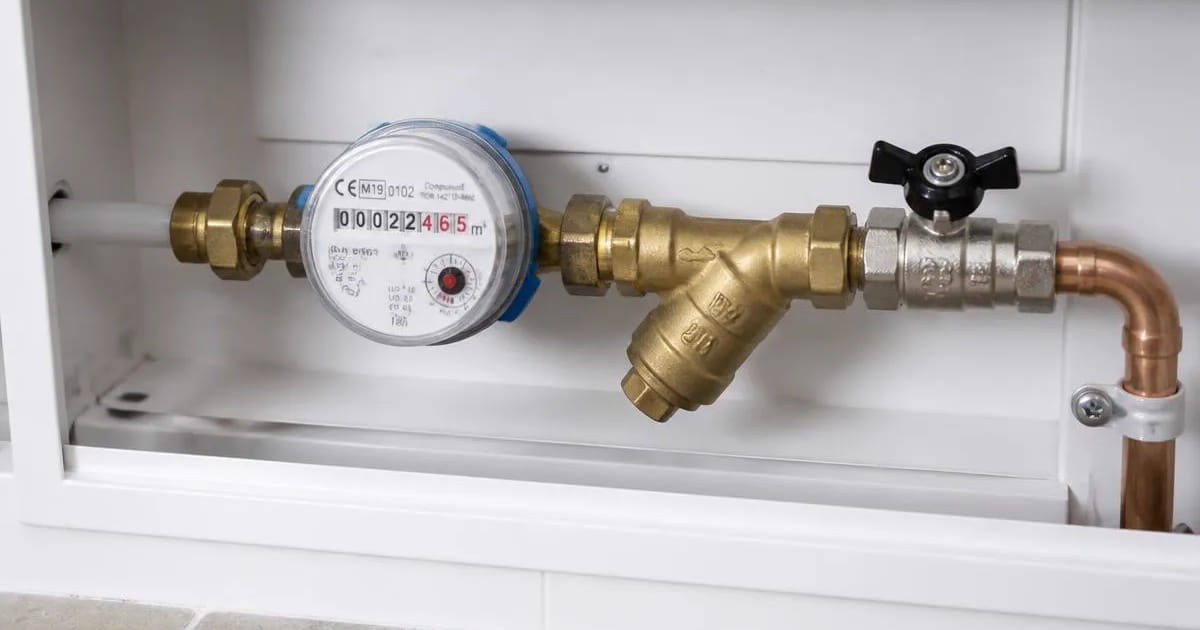
Mains water passes strict quality controls and meets drinking-water standards. However, its journey through kilometres of municipal pipework before reaching your tap involves variables far beyond the consumer's control. Street mains bursts, network maintenance works, sudden pressure surges and ageing service pipes inevitably release solid debris into the flow. Fitting a solid particle filter at the water meter inlet (downstream of the meter) is the first and most effective line of defence for any home's plumbing system.
🔎 What It Is and How It Works
It is a compact mechanical device installed at the start of the property's private network. The most common and affordable model is the brass 'Y' strainer, made of a metal body and an inner cartridge with a fine stainless steel mesh. There are also self-cleaning filters, which include pressure gauges and a bottom valve for quick blow-down.
🪣 Sediment the Filter Traps
1) Sand and silt: released during street pipework repairs. 2) Rust and scale: shed from old cast iron or galvanised pipes in the distribution network. 3) Metal filings and small metallic debris: caused by mechanical wear of the network itself.
🛡️ 4 Reasons to Install One
1) Protecting sensitive appliances: washing machines, dishwashers, water heaters and boilers use solenoid valves with millimetre-sized orifices; sand or particles block the water inlets, accelerate pump wear and cause serious failures in hydraulic blocks. 2) Preserving ceramic tap cartridges: modern mixer and single-lever taps use high-precision ceramic discs to regulate flow and temperature; a single grain of sand trapped between the discs scratches the ceramic irreversibly, causing constant dripping and cartridge replacement. 3) Preventing clogged aerators: when tap aerators fill with sand and silt, the flow becomes irregular, splashes out of the basin and loses volume; the inlet filter traps the debris before it reaches the outlets. 4) Preventing pressure loss in internal pipework: sediment entering the domestic network settles in elbows, reducers and bends; over time these deposits build up scale that narrows the useful pipe diameter, causing a permanent drop in water pressure throughout the house.
🧰 Ideal Installation Point
It must be fitted immediately after the water meter (on the private network), ensuring 100% of the water entering the home is filtered.
🔧 Maintaining a 'Y' Strainer
It needs periodic cleaning of the stainless mesh. Simply shut off the water supply, unscrew the filter cap, remove the steel mesh, rinse it under running water and refit it.
💧 Maintaining a Self-Cleaning Filter
Just open the bottom blow-down valve for a few seconds to flush out accumulated sediment, with no need to dismantle anything.
FAQ
How much does it cost to install a particle filter?
Installing a sediment filter starts, as a guide, from €75. See the full pricing page; any travel fee applicable to the parish is shown separately on the map.
Does the filter reduce water pressure inside the house?
No, provided it is correctly sized for your pipe diameter and cleaned periodically.
Can I install the filter before the meter?
No. Any work upstream (before) the meter belongs to the water utility. The filter must always be installed downstream (after) the meter, on your private network.
Protect your home's plumbing today: a solid particle filter is a low-cost preventive measure that avoids expensive repairs. Get a professional, leak-free installation.
We install particle filters in Funchal, Câmara de Lobos, Caniço, Santa Cruz, Machico, Ribeira Brava, Ponta do Sol, Calheta, Santana, São Vicente and across Madeira Island.