Why Opening Windows Does Not Stop Bedroom Mould: The Mechanical Ventilation (MVHR) Answer
Everyone hears the same advice: “open the windows in the morning and the mould will go”. In Madeira that advice frequently fails, and the reason is measurable. On many days of the year outdoor air in Funchal, Câmara de Lobos or Caniço carries 80% to 90% relative humidity. Opening a window in those conditions does not dry the bedroom: it simply swaps humid indoor air for humid outdoor air. If the problem is the water vapour load in the air and the temperature of the surfaces, the answer is not random passive airing but controlled mechanical ventilation with a known flow rate, filtration and pre-heating of the incoming air.
💧 Outdoor Relative Humidity in Madeira
1) Relative humidity is the percentage of water vapour in the air compared with the maximum it can hold at that temperature. 2) In Madeira's humid subtropical climate, with constant sea breeze, outdoor air often sits above 80% RH. 3) On the mid-slope areas — Monte, Santo António, São Gonçalo — frequent cloud cover pushes that figure higher. 4) When that air enters a cooler bedroom, RH rises further, because cold air holds less vapour. 5) Above 65% RH at the surface, mould spores have everything they need to germinate. 6) That is why a bedroom can grow mould even with the window opened every single day.
🪟 Why Passive Ventilation Fails
1) An open window depends on wind, temperature and timing — it has no guaranteed flow rate. 2) Air change is concentrated into 10 or 20 minutes a day, while vapour production runs 24 hours. 3) Two people sleeping release roughly 1 to 1.5 litres of water per night through breathing and perspiration. 4) With the window shut for the rest of the day, that load accumulates with no renewal at all. 5) In modern homes, airtight frames and insulation removed the air leakage that used to ventilate unnoticed. 6) The result: more energy-efficient houses that are simultaneously more prone to condensation and mould.
🌀 What Breezers and Decentralised Units Are
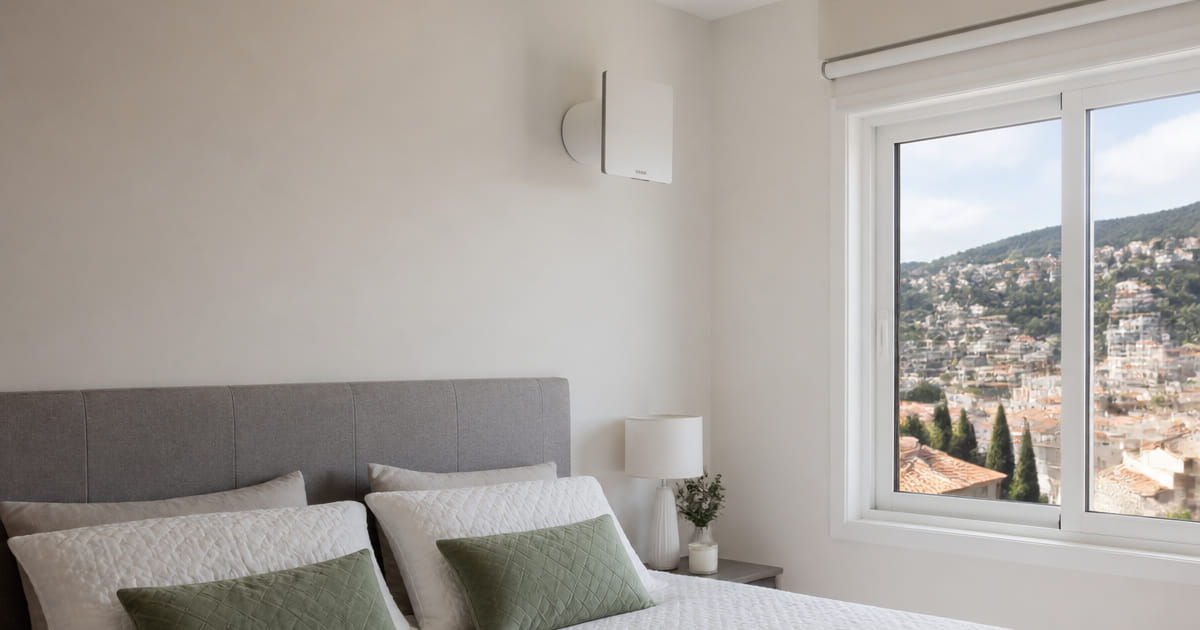
1) They are compact units fitted to an external wall with a single 100 to 160 mm penetration. 2) They need no ductwork or suspended ceilings, which makes them ideal for occupied apartments. 3) A low-consumption fan supplies outdoor air at an adjustable rate, typically 30 to 150 m³/h. 4) The slight positive indoor pressure pushes stale air out through gaps and extract grilles. 5) Electrical consumption is a few watts at night-time speeds. 6) Each bedroom can have its own unit, controlled independently room by room.
🧴 Air Filtration and Pre-Heating: The Decisive Difference
1) The unit filters incoming air with G4 to F7 class filters or better. 2) That captures dust, pollen, airborne salt and fine particles — something an open window never does. 3) Pre-heating raises the incoming air temperature before it reaches the room. 4) Warmer air has lower RH and creates no cold draught over the bed. 5) On models with a ceramic or plate heat exchanger, part of the extracted heat warms the incoming air. 6) It is this combination — controlled flow, filtration and temperature — that lowers indoor RH steadily, not bursts of window opening.
📏 Diagnose Before Installing: Measure, Don't Guess
1) Fit a digital hygrometer in the bedroom and log RH and temperature morning and night for a week. 2) Measure the temperature of the surfaces where mould appears with an infrared thermometer. 3) Compare that with the dew point of the indoor air: if the wall is below it, condensation forms. 4) Check for active leaks or water ingress — in that case ventilation solves nothing. 5) Confirm the bathroom and kitchen have real, working extraction by measuring flow at the grille. 6) Only then size the ventilation unit for the room volume and actual occupancy.
🛠️ Installation and Maintenance in Madeira
1) The wall penetration should slope slightly outwards to keep wind-driven rain out. 2) Choose facades less exposed to prevailing rain and keep the intake away from pollution sources and exhausts. 3) Elastic sealing and an insulating sleeve in the penetration prevent thermal bridges and condensation on the pipe. 4) Near the sea, prefer stainless steel or salt-resistant technical plastic external grilles. 5) Replace filters as the manufacturer specifies, typically every 6 to 12 months, and vacuum the grilles. 6) Want to end bedroom mould for good? Message us on WhatsApp and we will assess the right ventilation solution.
FAQ
Wouldn't a dehumidifier solve the same problem?
It lowers RH but does not renew air or remove CO₂ and indoor pollutants, uses more energy and needs emptying. It is complementary; mechanical ventilation treats the cause — stale humid air with no renewal.
What relative humidity should a bedroom have?
Between 40% and 60% RH is the healthy, safe range. Sustained levels above 65% sharply increase mould risk, especially on colder external walls.
Are decentralised units noisy in a bedroom?
At night-time speeds, quality models typically sit between 19 and 25 dB(A), below a bedroom's background noise. Correct sizing avoids having to run high speeds.
Do I need major building work to install one?
No. A single circular penetration in the external wall and a nearby socket are enough. Installation usually takes a morning, with no ducts or false ceilings.
Bedroom mould that always returns? Message us on WhatsApp and we will assess humidity, ventilation and thermal bridges.
We work in Funchal, Câmara de Lobos, Caniço, Santa Cruz, Machico, Ribeira Brava, Ponta do Sol, Calheta, Santana, São Vicente and across the whole island of Madeira.