Moss, Algae and Leaks on Balconies and Porches: Diagnosis and Slope Mistakes
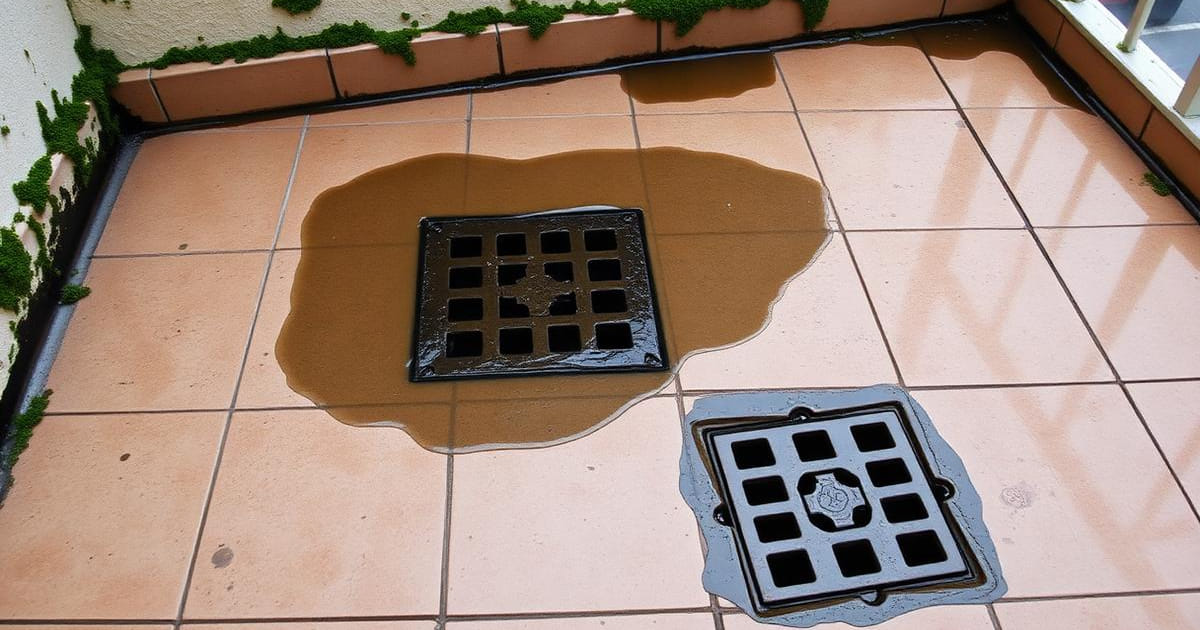
In Madeira, a badly sloped balcony is not a cosmetic detail: it is an open water tank sitting on a concrete slab. With winter rain, permanent humidity and salt-laden wind, trapped water always finds a tired joint, a threshold detail or a poorly reinforced drain. Moss and algae are the free map of that problem — they grow exactly where water does not drain. This guide shows how to diagnose the real slope, tell dirt from an active leak, and restore watertightness without lifting the entire floor.
🌿 What Moss Is Actually Telling You
1) Moss needs persistent water: if it grows in strips, those strips hold water for hours after the rain. 2) Dark algae in the joints means moisture retained inside the grout, not just on the surface. 3) Moss concentrated against the wall reveals reversed slope, carrying water to the most fragile detail of the balcony. 4) Moss around the drain means the drain sits too high, or the grate is clogged with leaves and grit. 5) Green stains on the underside of the slab or the neighbour's ceiling mean water has already crossed. 6) On Funchal's hillsides, north-facing exposure makes everything worse: less sun, slower drying, faster colonisation.
📐 How to Measure the Real Slope (and What Is Acceptable)
1) Correct slope on an external floor is 1% to 2% towards the drain — 1 to 2 cm per metre. 2) Measure with a long spirit level or a laser level, from the wall to the drain, along three different lines. 3) The most honest test is a bucket of water: pour slowly and watch where the sheet stops. 4) Pooling that persists beyond 10 to 15 minutes means insufficient slope or a sunken area. 5) Check the drain grate sits 3 to 5 mm below the floor plane — never level with it or above. 6) On porches with low walls, confirm there is at least one outlet per contained area, not a closed basin.
🕳️ Drains, Grates and Rainwater Discharge
1) A single drain on a long balcony is not enough: the practical rule is one collection point per 30 to 40 m² or per drainage basin. 2) The grate must be removable and the drain body accessible for cleaning without breaking tiles. 3) Drains without a basket trap grit and leaves in the bend, reducing the section and forcing overflow through the joints. 4) Check the rainwater outlet is not connected to foul drainage without a trap — a frequent cause of balcony odour. 5) In Funchal buildings with old risers, backflow during heavy rain pushes water under the floor. 6) Rainwater cleaning twice a year, before and after winter, solves half the leaks we see.
🧱 Waterproofing Membrane Failures: Where It Always Breaks
1) Wall-to-floor perimeter: if the membrane does not rise 15 to 20 cm up the wall, water gets in behind the skirting. 2) Drain flange: with no reinforcing mesh and bonded collar, this is failure point number one. 3) Door thresholds: a missing drip edge and an interrupted membrane let water cross indoors. 4) Movement joints filled with rigid cement crack in the first thermal cycle. 5) Old bituminous membranes turn brittle in the sun and lose elasticity at folds. 6) Repointing the surface grout alone changes nothing when the problem sits under the tile.
🛠️ Watertightness Repair: From Least to Most Invasive
1) Mechanical cleaning plus a specific biocide to remove moss, algae and root growth from joints. 2) Reopening and re-grouting with flexible cementitious or epoxy grout in traffic areas. 3) Elastic polyurethane sealing at perimeters, thresholds and movement joints — never ordinary silicone. 4) Liquid waterproofing over the existing tiles, with reinforcing mesh at perimeters and drains, where the substrate is sound. 5) Replacing the drain with a collared model and rebuilding the fall in screed, where there is a sunken basin. 6) Partial floor removal only where the membrane is compromised — decided by diagnosis, not by default.
🛡️ Preventive Maintenance in Madeira
1) Two annual cleanings of drains, grates and gutters, before and after winter. 2) Visual inspection of perimeters and thresholds looking for hairline cracks. 3) Preventive anti-moss treatment on north-facing balconies and shaded porches. 4) Renewal of elastic sealing every 5 years, even with no visible symptoms. 5) Photographic records of stains to compare between winters — useful evidence for management companies and insurers. 6) Want a slope and watertightness diagnosis on your balcony? Message us on WhatsApp.
FAQ
Does balcony moss damage the floor or is it only cosmetic?
It damages it. Roots open the grout joints, retain even more water and accelerate degradation of the membrane below. It is a symptom of trapped water, not a cleaning issue.
Can the slope be corrected without lifting all the tiles?
Often yes: a local drainage basin is rebuilt around the drain and liquid waterproofing is applied over the rest. Only a saturated substrate requires full removal.
Does a stain on the neighbour's ceiling always come from the balcony?
No. Before any work we test by sector — balcony watertightness, pressurised pipework and drainage — so we do not repair what is not broken.
How long does liquid waterproofing over tiles last?
Properly applied with reinforced perimeters, 8 to 12 years in normal Madeira exposure. On balconies heavily exposed to sun and salt we plan a review at 6 years.
Balcony with moss, pooling water or a stain on the ceiling below? Message us on WhatsApp.
We work in Funchal, Câmara de Lobos, Caniço, Santa Cruz, Machico, Ribeira Brava, Ponta do Sol, Calheta, Santana, São Vicente and across the whole island of Madeira.