Microbiologically Influenced Corrosion (MIC) in Iron Pipes: Brown Water and Hidden Pinholes
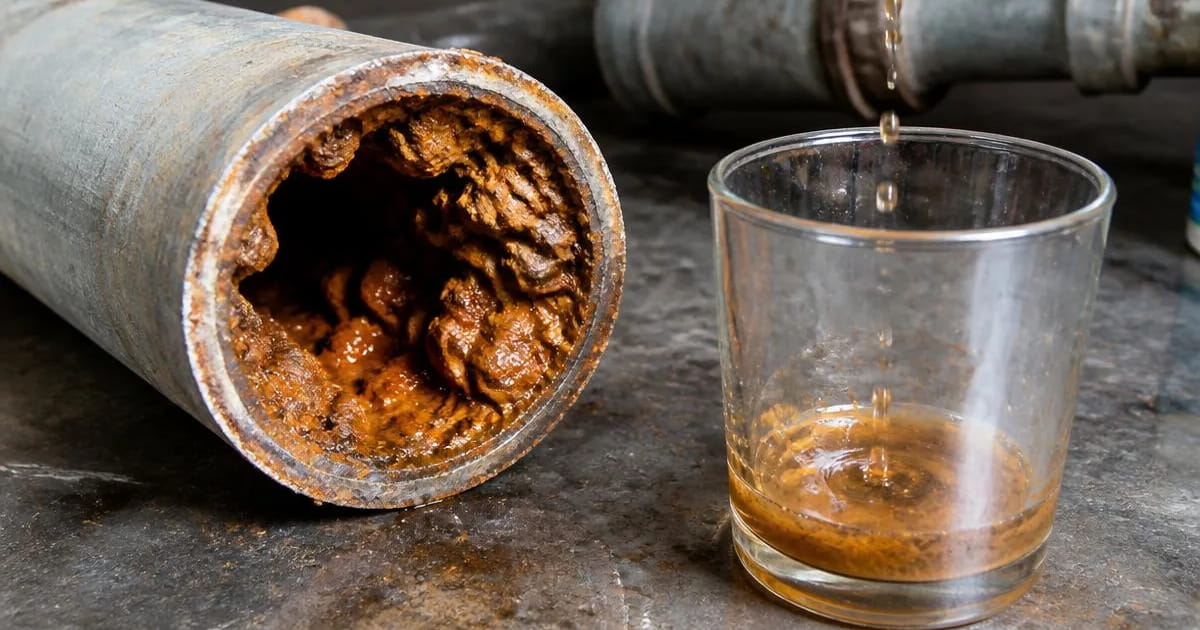
In older Madeira properties the water often runs yellow or brown, especially first thing in the morning, carrying flakes and solid residue that stain sanitaryware and clog tap aerators. In other cases the flow suddenly drops at a single outlet, or a damp patch appears for no obvious reason, and when the wall is opened there is a tiny, almost invisible hole in a metal pipe that looked perfectly sound from the outside. Both symptoms — brown water and localised perforation — frequently share one cause: microbiologically influenced corrosion (MIC). This is not ordinary rust from age: it is an accelerated biochemical process driven by bacterial colonies living inside the pipe, eating the metal beneath their own deposits. At Canalizador Funchal® we diagnose these cases with internal borescope inspection before deciding on any replacement.
🟤 The Symptom: Brown Water, Debris and Flow Loss
The clinical picture of MIC is recognisable and differs from simple surface oxidation. 1) Water runs yellow or brown for the first few seconds after hours of standing, then clears — a sign of deposits accumulated inside the pipe. 2) Solid particles, orange flakes or dark grains appear in tap aerators and appliance filters. 3) Pressure and flow fall gradually on one specific branch while the rest of the property stays normal. 4) A rotten-egg or metallic smell sometimes appears, indicating sulphate-reducing bacterial activity. 5) Sanitaryware develops persistent orange staining that returns days after cleaning. 6) Water heaters and filters clog far more often than they should. 7) Finally, leaks appear at isolated points — holes a few tenths of a millimetre wide — with no visible external damage to the pipe.
🦠 The Biochemical Mechanism: How Bacteria Eat Iron
MIC is a biological process, not merely a chemical one, and that is what makes it so aggressive. 1) Iron-oxidising bacteria (Gallionella and Leptothrix types) oxidise dissolved iron and deposit oxides on the inner pipe wall. 2) Those deposits organise into a biofilm — a viscous layer of microorganisms and organic matter clinging to the metal. 3) Tubercles then form over the biofilm: hard mounds of scale with an outer crust and an active inner core. 4) Inside the tubercle an oxygen-free environment develops, ideal for sulphate-reducing bacteria producing hydrogen sulphide. 5) The sulphide chemically attacks the steel and creates a localised corrosion cell with very low pH, isolated from the bulk water. 6) Metal is consumed from the inside out and beneath the deposit, so the outer surface of the pipe still looks intact. 7) The process is self-accelerating: the bigger the tubercle, the more anaerobic its core and the faster the wall loses thickness.
⚠️ The Hidden Danger: Perforation Without Warning and Choked Bores
MIC is treacherous because it advances silently and then fails suddenly. 1) Perforation happens by localised pitting, without general wall thinning, so it cannot be spotted by eye. 2) The first sign is usually an actual leak in a wall, ceiling or floor, with water damage already done. 3) A single tubercle can cut the usable bore of a 3/4" pipe by more than half, with drastic flow loss. 4) Scale fragments break away and block aerators, thermostatic mixers, solenoid valves and water heater elements. 5) The water carries iron and organic matter, degrading drinking water quality and taste. 6) In apartment blocks the problem spreads through shared risers and affects several floors in sequence. 7) Repairing only the hole is pointless: the colony stays active and new pinholes appear nearby within months.
🔬 Professional Diagnosis: Borescope, Water and Mapping
Before replacing anything, the real internal condition must be seen. 1) We carry out an articulated borescope (endoscope) inspection through strategic cut points, filming the pipe interior. 2) We assess tubercle size and distribution and the percentage of usable bore that remains. 3) We take water samples on first draw and after flushing, comparing colour, turbidity and sediment. 4) We measure static and dynamic pressure per branch to locate the choked sections. 5) We cut a pipe sample in a suspect zone and split it lengthways for direct reading of the wall condition. 6) We record the existing material per section — galvanised iron, steel, copper — and identify mixed joints that worsen corrosion. 7) We produce a risk-classified map of the system defining what is replaced now and what stays under monitoring.
🛠️ Professional Technical Solution: Disinfection and Strategic Replacement
Effective work combines biological elimination with material renewal. 1) We disinfect the system with a suitable product and controlled contact time, followed by a full purge at every outlet. 2) We run sequential high-velocity flushing to carry away loose sediment before service is restored. 3) We replace the critical sections identified by borescope with multilayer pipe (PEX-AL-PEX) or PPR, materials that neither feed MIC nor form tubercles. 4) We eliminate direct joints between dissimilar metals, using dielectric unions where the transition is unavoidable. 5) We fit an inlet particle filter and, where justified, a check valve and an accessible purge point for maintenance. 6) We remove inactive pipework and dead legs, where stagnant water is the main breeding ground for bacterial colonies. 7) We leave a verification plan: visual water checks, filter cleaning and a scheduled repeat internal inspection.
🚫 Mistakes to Avoid
Improvised fixes only postpone the problem and raise the final cost. 1) Do not clamp or resin-patch the hole and consider the case closed — the colony keeps working. 2) Do not replace only the metre of pipe that burst when the whole riser is tuberculated end to end. 3) Do not use aggressive acid descalers on already weakened pipework: they can cause immediate rupture. 4) Do not join new copper directly to old galvanised iron, adding galvanic corrosion to the problem. 5) Do not leave dead legs or decommissioned branches full of standing water inside walls. 6) Do not ignore early signs such as frequently clogged aerators or brownish first-draw water. 7) Do not start a repiping project without prior internal inspection — diagnosis is what prevents over- or under-spending.
🗓️ Prevention in Madeira: Old Systems and Spring Water
Local conditions raise the risk in many buildings on the island. 1) Much of the housing stock in Funchal and neighbouring municipalities still has galvanised iron risers over 30 years old. 2) Many highland homes are supplied from springs or wells, with water rich in dissolved iron and organic matter. 3) Holiday homes and short-term rentals sit unused for long periods, encouraging stagnation and biofilm growth. 4) We recommend periodic water analysis on private sources and appropriate upstream filtration. 5) In closed properties, every outlet should be flushed before use resumes. 6) At the first refurbishment it is always worth renewing old risers rather than reusing metal pipework. 7) Our maintenance plans include periodic internal inspection and filter cleaning, catching MIC long before the first leak.
FAQ
Is brown water dangerous to health?
Iron itself is not toxic at usual concentrations, but water carrying biofilm, sediment and sulphides is no longer of adequate quality for consumption. Avoid drinking or cooking with it until the source is resolved and the system disinfected.
Can it be treated without replacing the pipes?
Disinfection and flushing remove much of the colony and improve the water, but they cannot restore lost metal thickness or clear consolidated tubercles. Where pipework is heavily attacked, replacing the critical sections is unavoidable.
Why does a hole appear when the pipe looks fine outside?
Because MIC corrodes from the inside out, beneath the deposits. Localised pitting punches through the wall at a tiny point while the exterior stays intact — which is why leaks appear with no warning.
Multilayer or PPR: which should I choose?
Both are immune to MIC. Multilayer is faster to install on embedded routes with bends; heat-fused PPR is extremely robust on risers and columns. We choose based on the routing, pressure and site access.
Brown water or repeated leaks in old pipework? Talk to us on WhatsApp.
We work in Funchal, Câmara de Lobos, Caniço, Santa Cruz, Machico, Ribeira Brava, Ponta do Sol, Calheta, Santana, São Vicente and across Madeira Island.