Mechanical Descaling of Old Galvanised Steel Pipes Without Breaking Walls
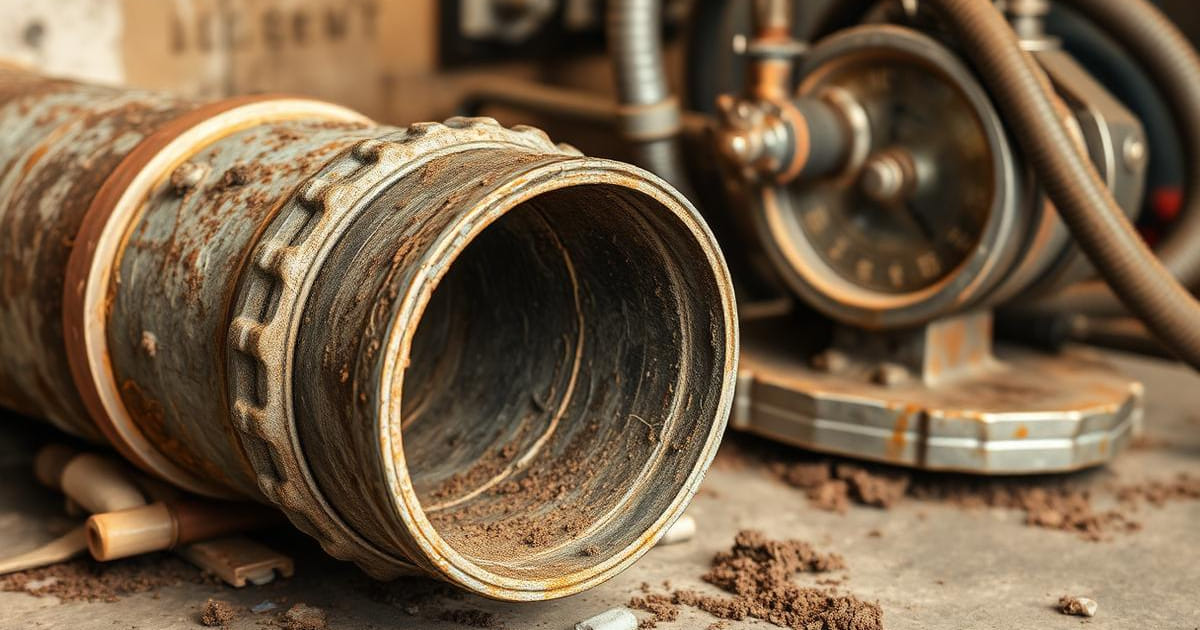
In many Funchal buildings put up before the 1990s, the hot and cold water network is galvanised steel. After decades of service with Madeira's hard water, the inside of those pipes is no longer smooth: a hard layer of limescale mixed with corrosion products narrows the usable bore. The result is always the same — weak pressure, a shower that goes cold when someone opens a tap, and cloudy water on the first morning draw. The good news is that there is a middle path between living like that and cutting open every wall.
📉 Why Pressure Drops So Much
1) Head loss rises steeply as the bore shrinks: halving the diameter can leave only a small fraction of the flow. 2) In a 1/2" pipe, 1 to 2 mm of scale per wall is enough to ruin performance. 3) The galvanised zinc layer is consumed over time and the iron then corrodes, forming rough tubercles. 4) Internal roughness multiplies friction even where the bore still looks acceptable. 5) Elbows, tees and unions are the first points to close up with deposits. 6) Hot water accelerates calcium carbonate precipitation, so the hot branch is usually the worst.
🔍 Diagnosis Before Any Intervention
1) Measure static and dynamic pressure with a gauge at several points, not just at the inlet. 2) Time flows in l/min at representative taps and compare with expected values. 3) Open an accessible point — usually a union or an old tap body — to see the real cross-section. 4) Run a borescope inspection on accessible runs to grade scale and corrosion. 5) Establish whether the issue is local (one branch) or general to the building riser. 6) Rule out simple causes: clogged meter filter, failed pressure reducer or a half-closed valve.
💨 Technical Air/Water Pulse Flushing
1) The principle is mechanical: inject controlled compressed-air pulses into water, creating turbulence that detaches loose deposits. 2) Pressure is controlled and capped, always below what the pipework and joints can take. 3) The network is sectioned in runs, with defined discharge points to carry debris out. 4) Sensitive appliances — cylinder, mixer taps, white goods — are isolated before starting. 5) Work proceeds in stages, measuring flow and pressure between cycles. 6) It is a recovery of usable bore, not a miracle: deeply corroded pipe must be replaced.
🎥 Borescope Verification and Realistic Results
1) Before-and-after borescope footage objectively documents the gain achieved. 2) Typical outcome: significant partial flow recovery when limescale is the dominant problem. 3) Where corrosion tubercles and thin walls appear, the honest verdict is replacement. 4) A pressure-tightness test after flushing confirms nothing was weakened. 5) We log pressures and flows before and after so the client has data, not impressions. 6) If the inspection shows imminent perforation, we stop and propose replacing that section.
🚫 What Not to Do
1) Do not use strong acids on old galvanised networks: they attack already weakened metal and cause leaks. 2) Do not raise mains pressure to 'compensate' — it only accelerates bursts and water hammer. 3) Do not use rigid rotating cables in small-bore supply pipes. 4) Do not ignore persistent cloudy water: it signals active corrosion, not just scale. 5) Do not replace only the tap when the problem is in the branch. 6) Do not proceed without a borescope: working blind in thin pipe almost always ends in unplanned building work.
🛡️ After Flushing: Protecting the Network
1) Fit a washable particle filter at the inlet to remove sediment in circulation. 2) Regulate pressure with a reducing valve between 3 and 4 bar to stabilise the whole system. 3) Consider anti-scale treatment to slow new carbonate deposition. 4) Progressively replace accessible runs with multilayer or PEX, starting with the most critical. 5) Purge and check flows annually under a simple maintenance plan. 6) Want to know whether your galvanised network is recoverable? Message us on WhatsApp.
FAQ
Does pulse flushing always fix low pressure?
No. It works well when limescale and sediment dominate. With deep corrosion and thin walls, the only safe solution is replacing the pipework.
Can the process cause leaks?
We use controlled pressure and prior borescope inspection precisely to minimise that risk. If inspection shows pipe at its limit, we recommend replacement instead of flushing.
How long does it take in a villa?
Typically one working day for the main network and accessible branches, including diagnosis, sectioning, staged flushing and borescope verification.
Is it worth it if I plan to renovate in a few years?
Yes, as a bridge measure: it restores immediate comfort at a fraction of a renovation's cost and lets you plan replacement calmly.
Weak pressure in old pipework? Message us on WhatsApp.
We work in Funchal, Câmara de Lobos, Caniço, Santa Cruz, Machico, Ribeira Brava, Ponta do Sol, Calheta, Santana, São Vicente and across the whole island of Madeira.