Protecting Water Heaters and Taps on Well and Spring Water (Magnetic Anti-Sand Filters)
In high and rural areas of Madeira — Santo António, Monte, Camacha, Santana, São Vicente, Calheta or Porto Moniz — many homes are supplied by their own borehole, well or spring. That water can be excellent to drink, but it carries sand, micro-silica and iron particles that the public network normally filters out. The damage always shows in the same places: a clogged water block in the gas heater, tap aerators blocked within weeks and mixer seals scored by abrasive grit. The answer is not cleaning everything every two months: it is filtering at the inlet.
🔎 Symptoms & Initial Diagnosis
1) A gas heater that fires and cuts out, or fails to ignite for lack of flow, even with good mains pressure. 2) Tap aerators full of fine sand and metal filings after only a few weeks. 3) Mixers that start dripping shortly after being fitted — the abrasive scores the ceramic discs and seals. 4) Slightly cloudy water or a brownish deposit at the bottom of a glass or bath. 5) Cistern mechanisms building up deposit and letting water run. 6) Shower heads with blocked holes and an irregular spray. 7) If you have your own borehole, well or storage tank, these symptoms almost always point to suspended particles rather than faulty equipment.
🧪 Why Sand Destroys Equipment
1) The heater water block has narrow passages and a tiny internal filter: a small amount of sand is enough to drop the flow below the ignition threshold. 2) Micro-silica acts like liquid sandpaper: it passes the seals at high speed and wears out rubbers and ceramic discs in mixers. 3) Iron and rust particles — from old pipework, pumps or the borehole itself — settle in low-velocity spots and start localised corrosion. 4) In a storage cylinder, sand settles at the bottom, forms an insulating layer over the element and raises both consumption and the risk of burnout. 5) In washing machine and irrigation solenoid valves, deposit prevents full closure and causes continuous leaks. 6) That is why a cheap plastic mesh filter at the heater does not solve it: it saturates in days and traps no magnetic particles.
🛠️ Practical Step-by-Step
1) Confirm the water source (mains, borehole, well, spring or tank) and take a sample in a clear glass after 24 hours of settling. 2) Check the heater's internal filter and the aerators to gauge the particle load. 3) Choose the installation point: the main inlet right after the stop valve, or immediately upstream of the heater or cylinder if only hot water is to be protected. 4) Fit the filter with isolating valves upstream and downstream and, ideally, a bypass so it can be serviced without cutting the water. 5) Leave clear space underneath (at least 20 cm) for a bucket under the purge. 6) Run the first purge after 48 hours of use to assess sediment volume. 7) Set the interval: monthly on heavily loaded borehole water, quarterly in light cases.
🎯 Definitive Technical Solution
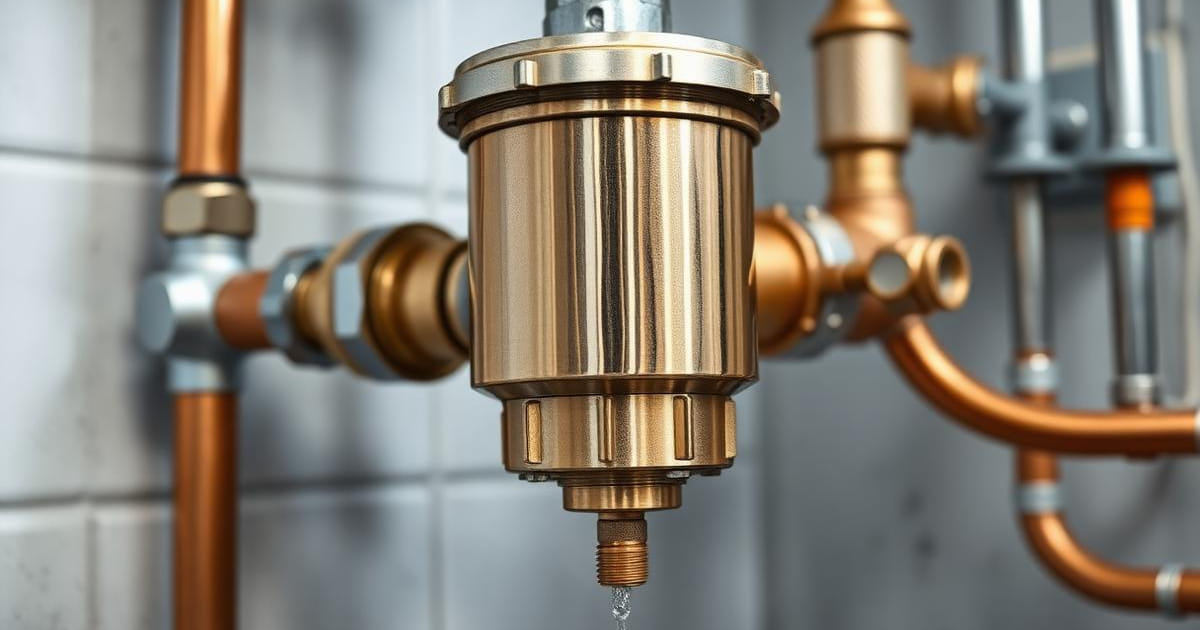
1) Install a Brass Magnetic Sludge and Sand Separator Filter with a Bottom Purge Valve at the main inlet of the property or upstream of the heater/cylinder. 2) The system combines two technologies: cyclonic filtration, which spins the water and settles sand and micro-silica into the lower chamber by centrifugal force, and a high-power neodymium magnet that captures all suspended metallic and rust particles. 3) Cleaning takes 3 seconds: place a bucket underneath and open the bottom purge valve — no shutting off the house water, no dismantling and no tools. 4) The brass body handles pressure and temperature without embrittling over time, unlike transparent plastic bowls that crack under UV and heat. 5) On installations with a gas heater this filter permanently ends flow-related cut-outs and extends the life of the water block and the mixers.
🚫 What to AVOID
1) Do not rely on a sediment cartridge filter with no purge: it saturates quickly with sand and then throttles pressure throughout the house. 2) Do not trust the small mesh screen inside the heater — it is a last barrier, not a filtration system. 3) Do not mount the filter at floor level or inside a tight cupboard: with no room for a bucket, the purge never gets done. 4) Do not skip isolating valves upstream and downstream; without them any service means shutting off the whole house. 5) Do not use plastic-bowl filters in sunlit locations or next to hot equipment. 6) Do not skip the purge for months: the chamber fills, settling stops and sand passes downstream again.
🧰 Preventive Maintenance
1) Purge the filter at the defined interval — 5 seconds with a bucket is enough. 2) Once a year close the valves, open the bowl, remove the magnetic rod and clean off the metallic deposit. 3) Take the chance to clean tap aerators and the heater inlet filter. 4) If you have a storage tank, clean and disinfect the bottom annually, where most sand settles. 5) On pumped boreholes, check the suction strainer and foot valve — much of the sand enters there. 6) Fold this routine into an annual preventive maintenance plan for the plumbing system.
FAQ
Does this filter remove limescale from the water?
No. A magnetic filter separates solid particles — sand, micro-silica, filings and rust — but does not change water hardness. Limescale needs a different answer: a polyphosphate doser upstream of the cylinder, or a softener. On Madeira borehole water both are often needed: the filter protects against abrasives, the doser protects the element and coils from calcium deposits.
Will the filter reduce water pressure in the house?
When correctly sized the pressure drop is practically irrelevant, because cyclonic filtration does not use a fine mesh that throttles flow. Pressure loss only appears if the filter is undersized for the household demand or if the lower chamber has gone unpurged for a long time. That is why we always size by peak flow rather than by pipe diameter alone.
Borehole or spring water damaging your heater? We fit the right filter.
We install magnetic anti-sand filters in Funchal, Câmara de Lobos, Caniço, Santa Cruz, Machico, Ribeira Brava, Ponta do Sol, Calheta, Santana, São Vicente and Porto Moniz, across Madeira Island.