The Magnesium Anode in Your Water Heater: The €15 Part That Prevents Cylinder Corrosion
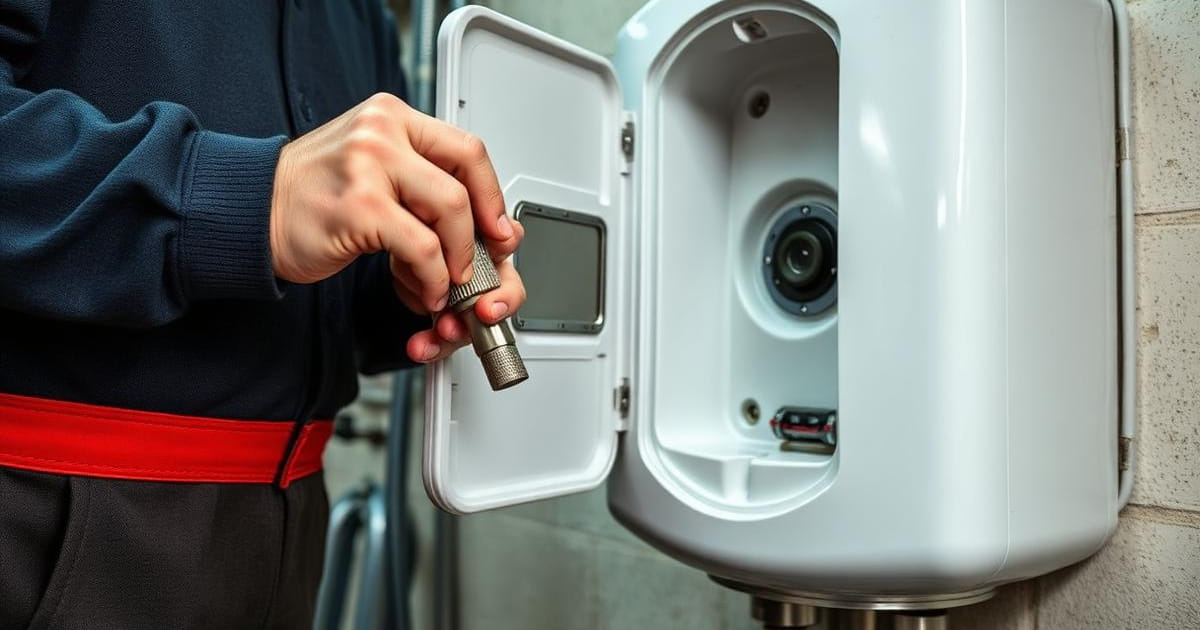
Most water heaters we replace in Madeira do not die of old age: they die of neglect. Inside the tank sits a low-cost part, the magnesium anode, whose only job is to be destroyed so that the steel tank is not. When nobody replaces it — and almost nobody does — corrosion moves on to the enamel and the steel until a permanent pinhole appears, and that cannot be repaired. Understanding this mechanism is the difference between spending €15 on a consumable and hundreds of euros on a new appliance.
🔬 Galvanic Corrosion: What Happens Inside the Tank
The inside of a water heater is an electrochemical cell running permanently. 1) The tank is steel lined with vitrified enamel, and that enamel always has micropores and microcracks. 2) Hot water is an electrolyte — the more mineralised the water and the higher the temperature, the more conductive and aggressive it is. 3) At those exposed spots the steel would oxidise and lose material. 4) Magnesium has a more negative electrochemical potential than steel, meaning it is 'more sacrificial'. 5) By placing a magnesium anode inside the tank, it dissolves and gives up electrons, keeping the steel polarised and protected. 6) This is called sacrificial-anode cathodic protection. 7) That is why a consumed anode is not a fault: it is proof the system worked. The mistake is not replacing it.
⏱️ How Long It Lasts and When to Replace It
Life depends on the water and the usage, not on a manufacturer's calendar. 1) Practical rule in Madeira: check at 18 months, typical replacement every 2 to 3 years. 2) Hard water rich in calcium and magnesium speeds up consumption — with well or spring water the wear can be far faster. 3) Storage temperatures above 65 °C make the electrolyte more aggressive and consume more anode. 4) Heavy use with frequent water renewal (holiday lets, large families) consumes faster than a holiday home. 5) Technical replacement criterion: when the anode has lost roughly 60% to 70% of its original diameter or is reduced to fragments on the steel core. 6) Always use the visit to remove limescale from the base and check the element and flange gasket. 7) If the unit is over 5 years old and has never been serviced, the anode has been gone for a long time.
⚡ Magnesium, Aluminium and Powered Titanium
They are not equivalent and the choice has consequences. 1) Magnesium: the most reactive, best protection, cheap, and the standard for most European manufacturers; it is consumed faster and, in high-sulphate water, can contribute to rotten-egg odour through bacterial activity. 2) Aluminium: consumed more slowly and reduces odour risk, but offers less energetic protection; used in some specific ranges. 3) Impressed-current titanium (powered anode): it is not consumed. A small module applies a controlled DC current that polarises the tank. 4) Advantage: practically no maintenance for the life of the appliance and no magnesium-related odour. 5) Limitation: it needs a permanent electrical supply — no power, no protection. 6) Never mix anodes of different metals in the same tank unless the manufacturer says so. 7) In second homes left switched off for months, magnesium remains the safer choice precisely because it needs no electricity.
🧾 Signs the Anode Has Already Failed
The appliance warns you before it perforates, but the signals are subtle. 1) Hot water smelling of rotten eggs — sulphate-reducing bacteria in an unbalanced tank. 2) Slightly cloudy or yellowish water on first draw after days of no use. 3) Small dark flakes or rust traces in tap and shower filters. 4) Higher electricity use and slower heating, from limescale and sludge on the base. 5) Crackling and popping while heating, typical of sediment over the element. 6) Persistent damp at the base of the unit or on the wall beneath it — at that stage replacement is almost always unavoidable. 7) Whenever there is damp under the appliance, switch off the power and close the water inlet before any diagnosis.
🛠️ How We Replace It Safely
It is a short job, but no step can be skipped. 1) Isolate the electrical supply at the board and confirm there is no voltage. 2) Close the cold-water inlet and open a hot tap to release pressure. 3) Drain the tank in a controlled way through the safety valve or a drain cock. 4) Remove the flange, inspect the interior, remove sludge and carefully descale the base mechanically. 5) Check the element and replace the flange gasket — reusing gaskets is the most common cause of leaks after servicing. 6) Fit the new anode with correct torque and without forcing the thread. 7) Refill with air purging, run a tightness test and only then restore power. 8) Record the date to plan the next check.
✅ Preventive Maintenance That Saves Money
1) Schedule an anode check every 18 months and replace when indicated. 2) Keep storage temperature at 60 °C: it protects the appliance and limits bacterial risk. 3) Fit a particle filter at the property inlet, especially with well or spring water. 4) Consider water treatment in high-hardness areas to slow limescale and wear. 5) Test the safety valve annually and confirm the potable expansion vessel is correctly charged. 6) Keep the service invoice: many manufacturer warranties require proof of periodic maintenance. 7) Want to know the state of your anode? Send a photo of the data plate and the installation on WhatsApp and we will advise the right interval for your unit.
FAQ
How often should the magnesium anode be replaced?
In Madeira we recommend checking at 18 months and typical replacement every 2 to 3 years. With hard water, temperatures above 65 °C or heavy holiday-let use, consumption is faster. The technical criterion is to replace once it has lost roughly 60% to 70% of its diameter.
Is a powered titanium anode worth fitting?
Yes in permanently occupied homes: it is not consumed, needs no replacement and removes the magnesium-related odour. It does, however, depend on a permanent electrical supply — in homes left empty for months a magnesium anode remains safer.
My hot water smells of rotten eggs. Is that the anode?
Often yes: the smell comes from interaction between magnesium and sulphate-reducing bacteria inside the tank. The fix involves thermal disinfection, tank cleaning and, in recurring cases, changing to a different anode type.
If the tank is already pinholed, can it be repaired?
Not reliably. Once enamel and steel perforate, any repair is temporary and the flood risk remains. At that point we assess replacement and correct the root causes — missing anode, excessive temperature, no expansion vessel or high mains pressure.
Never serviced your water heater? Contact us on WhatsApp.
We work in Funchal, Câmara de Lobos, Caniço, Santa Cruz, Machico, Ribeira Brava, Ponta do Sol, Calheta, Santana, São Vicente and across Madeira Island.