Limescale in Recessed Shower Mixers: Why Hot Water Loses Pressure
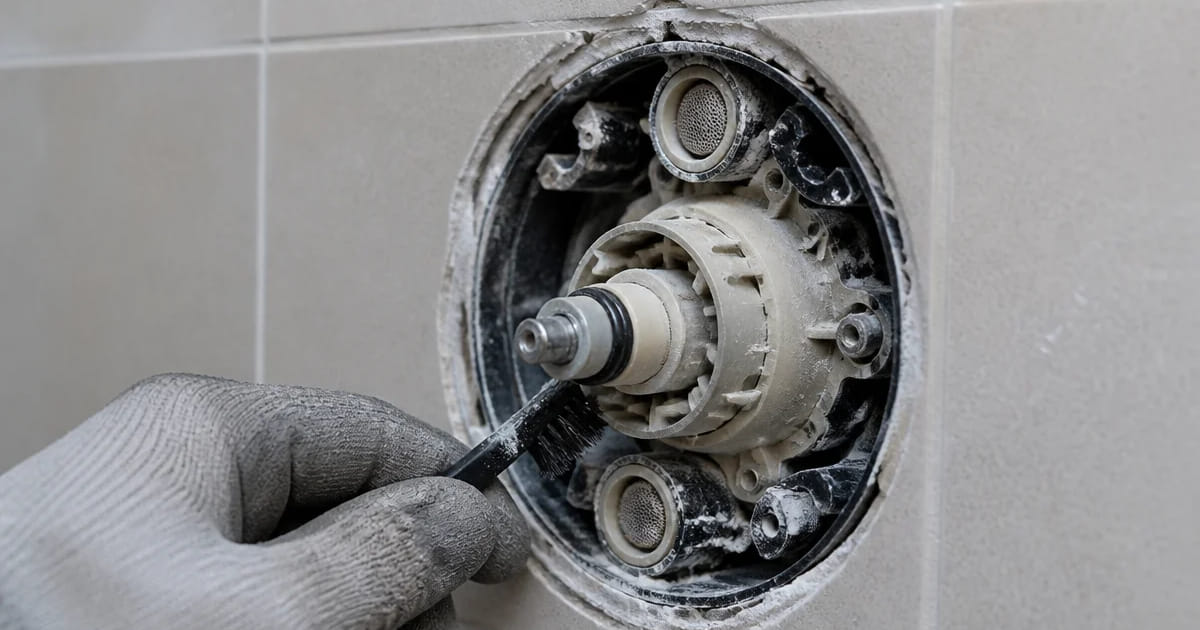
This is one of the most misleading plumbing diagnoses in the home: the cold water in the bathroom runs strong, the basin fills quickly and the kitchen has good pressure. But in the recessed shower, the hot water comes out weaker and weaker, almost in drips, and sometimes it does not even reach the minimum flow to fire the water heater or boiler. The user immediately suspects a network pressure problem, a faulty pump or a tank running low. In reality, the cause is often hidden behind the wall plate: the ceramic cartridge and mesh filters inside the recessed valve body are obstructed by limescale and mineral deposits. At Canalizador Funchal® we call it «false pressure loss from localized limescale» — and the good news is that, with the right intervention, it can be solved without replacing the entire plumbing run.
🚿 The Classic Symptom: Strong Pressure in the House, Weak at the Shower
The signature of this fault is its location. 1) Cold water at the basin, kitchen and toilet has good pressure. 2) The problem is concentrated in the recessed shower, especially in hot-water mode. 3) Flow drops gradually over weeks or months, not overnight. 4) The water heater or boiler may take a long time to fire or switch off because the minimum flow is not reached. 5) Hot water may come out irregularly, in pulses. 6) Cold water at the same shower may be better than hot, but already affected. 7) There are no visible leaks, the meter is not running excessively and there are no wall stains. Everything points to a localized mechanical obstruction, not a general pressure problem.
🧪 The Hidden Cause: Limescale in the Ceramic Cartridge and Mesh Filters
Modern recessed mixer valves, such as iBox-type bodies, have very fine components that are sensitive to water hardness. 1) The thermostatic or single-lever ceramic cartridge has narrow passageways and ceramic discs that slide against each other. 2) Madeira water, although not the hardest in Europe, carries enough calcium, iron and sediment to deposit over the years. 3) Hardened incrustations build up in the cartridge channels, reducing the cross-section and increasing friction between the discs. 4) The mesh filters embedded in the recessed body — normally brass or plastic — trap impurities and become clogged. 5) The cartridge O-ring hardens with heat and loses elasticity, worsening internal leaks. 6) The mixing of hot and cold water inside the cartridge accelerates mineral precipitation. 7) The result is a localized hydraulic restriction: pressure exists in the network, but it cannot pass freely through the clogged cartridge.
⚙️ Hydraulic Impact: Why It Feels Like Low Pressure
The hydraulics of this problem are simple but deceptive. 1) Static pressure in the network remains high — if measured at an open tap, the gauge reads normal values. 2) When the shower is opened, hot water must pass through the partially blocked cartridge. 3) The local restriction drops much of the available pressure, leaving little energy for the shower jet. 4) Flow falls below the minimum needed to activate the water heater flow sensor. 5) The heater thinks no water is passing and does not fire. 6) With an electric storage heater the problem is less obvious, but the shower always stays weak. 7) Because the restriction is downstream of the meter and inside the wall, the user cannot see it and attributes the symptom to the network or the hot-water appliance.
🔍 Differential Diagnosis: Cartridge vs. Network vs. Water Heater
Before opening the wall plate, it is essential to confirm the source. 1) We measure static and dynamic pressure at a reference tap (kitchen or basin) outside the affected bathroom. 2) If pressure is normal, the problem is not the network or the pressure-reducing valve. 3) We test the shower in pure cold-water mode: if it is still weak, the obstruction affects the whole cartridge; if it improves, the incrustation is concentrated in the hot channel. 4) We remove the shower head and inspect the nozzle/anti-splash device: it is often also clogged with limescale. 5) We compare hot-water flow at this shower with another hot-water point in the house. 6) If the water heater only fails to fire at this shower, the cause is the local restriction, not the appliance. 7) Only after this triage do we remove the plate and extract the cartridge for visual inspection.
🛠️ Professional Repair: Disassembly, Descaling and Rebuild
Correction requires patience and the right products so as not to damage expensive components. 1) We shut off the main water and open the shower to depressurize. 2) We remove the wall plate and handle carefully to avoid scratching the chrome finish. 3) We extract the thermostatic or single-lever ceramic cartridge, identifying the make and model for possible replacement. 4) We inspect the mesh filters in the recessed body and remove solid sediment with a soft brush. 5) We submerge the cartridge in a neutral acid descaling bath for the time recommended by the manufacturer, never in aggressive acid. 6) We mechanically brush the channels with nylon bristles, never metal that scratches the ceramic. 7) We rinse thoroughly under running water and dry with compressed air. 8) We lubricate the O-rings with food-grade silicone or suitable grease and reinstall the cartridge. 9) We reassemble, test for leaks and measure final flow.
⚠️ What to AVOID
1) Do not force the handle when hot water is weak — it can break the cartridge spindle. 2) Do not use neat vinegar or strong acids on your own: they can attack plastic parts and damage the polish of the ceramic discs. 3) Do not replace the water heater or pressure pump without first checking the cartridge — it is an unnecessary cost. 4) Do not ignore the shower head, which also accumulates limescale and can be the apparent cause. 5) Do not overtighten the outer plate: the brass threads in the recessed body are fine and break easily. 6) Do not use metal tools directly on chrome finishes. 7) Do not leave the cartridge soaking in aggressive product overnight: the ceramic can lose its internal polish.
🛡️ Prevention: Maintain Flow and Extend Cartridge Life
The best solution is to delay limescale accumulation. 1) Install a small particle filter at the meter inlet to retain sediment before it reaches cartridges. 2) Check and clean the mesh filters in the recessed body annually. 3) Do not leave the shower dripping: constant drops accelerate salt deposition. 4) Set the storage heater thermostat to around 55–60 °C — higher temperatures precipitate more limescale. 5) In homes with very hard water, consider a polyphosphate doser on the hot-water branch. 6) Replace the cartridge O-rings every 3–5 years, even if no fault is apparent. 7) Arrange periodic plumbing inspections to detect restrictions before they become critical.
FAQ
Why is my shower hot water weak while cold water is fine?
Because the ceramic cartridge in the recessed shower builds up limescale mainly in the hot-water channel. The local restriction reduces flow at that point, while other taps that do not pass through the same cartridge keep normal pressure.
Can limescale stop the water heater from firing?
Yes. If the flow through the clogged cartridge falls below the minimum required by the water heater flow sensor, the appliance will not fire. Many people replace the heater unnecessarily when the cartridge is to blame.
Can I descale the cartridge myself with vinegar?
It is not advisable. Vinegar can damage seals, plastics and the polish of the ceramic discs. Professional descaling uses controlled neutral acid baths and proper brushing to recover flow without ruining the cartridge.
When should the cartridge be replaced instead of descaled?
When the ceramic discs are scratched, the O-rings are hardened or the cartridge has internal leaks that cleaning cannot fix. In those cases, replacement with an original cartridge is the definitive solution.
Is your shower hot water losing pressure? Precise diagnosis and professional descaling in Funchal.
We work in Funchal, Câmara de Lobos, Caniço, Santa Cruz, Machico, Ribeira Brava, Ponta do Sol, Calheta, Santana, São Vicente and across Madeira Island.