Treating Mill or Levada Water for Irrigation and Washing: A Dual Filtration System
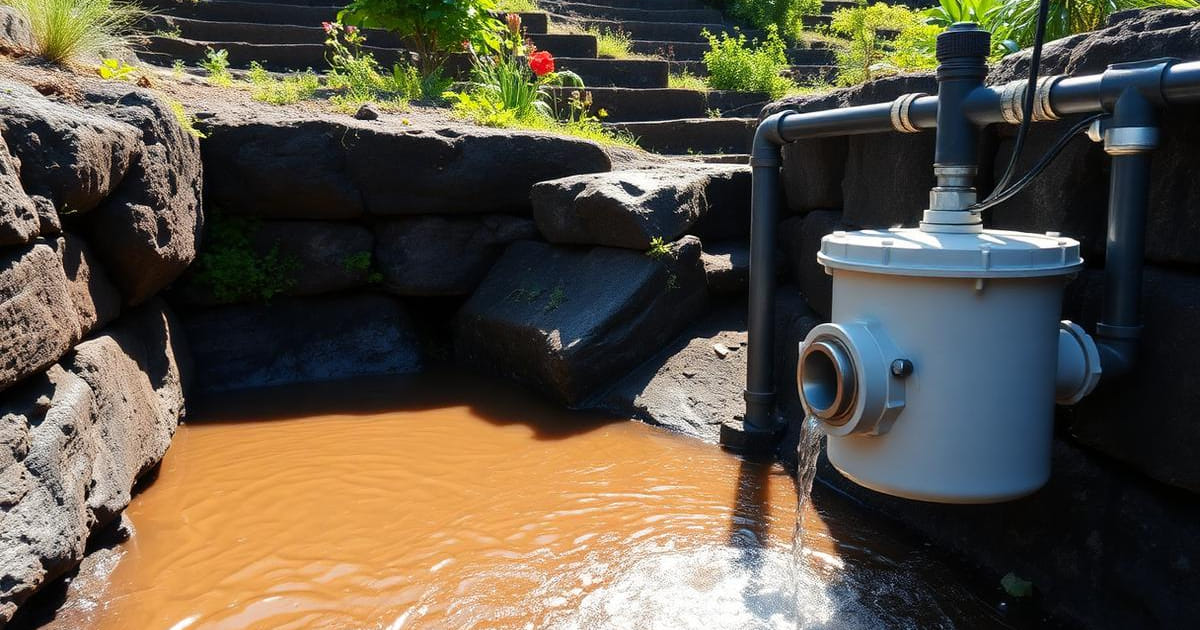
In Madeira, levada and mill water remains the smartest resource for irrigation, patio washing and tank filling. The problem is never the water itself: it is what comes with it. Silt, volcanic sand, leaf debris and plant fibres enter the system, block tap aerators, jam irrigation solenoid valves and wear out pumps. The technical answer is not one big filter — it is staged filtration, with a cyclonic separator up front and a washable stainless mesh behind it.
💧 What Levada Water Really Carries
1) Volcanic sand and fines, highly abrasive to pumps and seals. 2) Suspended silt, which rises sharply after heavy rain at higher altitudes. 3) Plant fibres, moss and fragmented leaves from open channels. 4) Organic matter that feeds biofilm inside irrigation pipework. 5) Small snails and larvae that breed in uncovered tanks. 6) Highly variable loads through the year — the system must be sized for the worst day, not the average.
🚿 Why It Blocks Filters, Taps and Solenoid Valves
1) Tap aerators have very fine meshes and clog within days on unfiltered water. 2) Irrigation solenoid valves have a tiny pilot orifice: one grain of sand stops them closing and leaves the water running. 3) Drippers and micro-sprinklers block completely with particles of just tens of microns. 4) Sand acts like sandpaper on pump impellers, cutting pressure and flow over months. 5) Ceramic cartridges in mixer taps get scored and start dripping. 6) Sediment stored in branches suddenly releases and blocks everything downstream.
🌀 Stage 1: Cyclonic Sand Separator
1) A cyclonic separator spins the water, throwing denser particles to the wall and into the collection cup. 2) It removes most of the sand with no mesh to clog, so there is no progressive flow loss. 3) It must be installed right after the intake or pump, before any fine filter. 4) A timed automatic purge empties the cup with no user intervention. 5) Choose the model by real flow in m³/h, never by pipe diameter alone. 6) It is the part that protects the stainless mesh from work it should not be doing.
🔎 Stage 2: Washable 100-Micron Stainless Mesh Filter
1) A 100-micron mesh captures whatever passes the cyclone and protects valves and drippers. 2) Being washable, there are no consumables: open the purge, turn the brush and the mesh is clean. 3) Inlet and outlet gauges show clogging: 0.5 bar of difference means wash it now. 4) Brass or stainless bodies handle sun exposure far better than clear plastic. 5) For fine drip lines, a second 50-micron stage can be added. 6) Fitting it on a bypass with two valves allows washing without stopping irrigation.
🛠️ Correct Assembly, Automatic Purge and Tanks
1) Recommended sequence: intake → cyclone → mesh filter → check valve → solenoid valves. 2) The automatic purge should discharge to a visible line so continuous leakage is noticed. 3) Irrigation tanks need an opaque lid, an overflow and an outlet above the base to avoid drawing sludge. 4) Never connect the levada network to the potable network — only full physical separation is acceptable. 5) Label non-potable taps clearly, which is mandatory in short-term rentals. 6) Provide a sampling point to verify filtration performance.
📅 Seasonal Maintenance in Madeira
1) After the first autumn rains, check filters weekly: that is the peak silt period. 2) In summer, control algae in tanks and clean the mesh monthly. 3) Log differential pressure: fast rises point to a problem upstream. 4) Clean the cyclone cup quarterly even with an automatic purge. 5) Inspect end drippers — they are always the first sign of insufficient filtration. 6) Want a dual filtration system sized for your property? Message us on WhatsApp.
FAQ
Can I use levada water at household taps?
Not for human consumption. For irrigation, washing and tanks, yes, with adequate filtration and a fully separate, clearly labelled network.
Is one filter enough to protect irrigation?
Rarely. A single fine filter clogs in days. The stable answer is dual: a cyclonic separator for sand and then a washable 100-micron stainless mesh.
How often should the stainless mesh be washed?
It depends on silt load. Follow the differential pressure: above 0.5 bar between inlet and outlet, wash immediately, even twice a week.
Sand already damaged my pump. Is filtering still worth it?
Yes. Filtration prevents further damage and, in most cases, restores flow and pressure once the already worn components are replaced.
Irrigation clogging with silt and sand? Message us on WhatsApp.
We work in Funchal, Câmara de Lobos, Caniço, Santa Cruz, Machico, Ribeira Brava, Ponta do Sol, Calheta, Santana, São Vicente and across the whole island of Madeira.