Kitchen Sinks and Basins: Stainless Steel, Granite Composite and Ceramic in Professional Practice
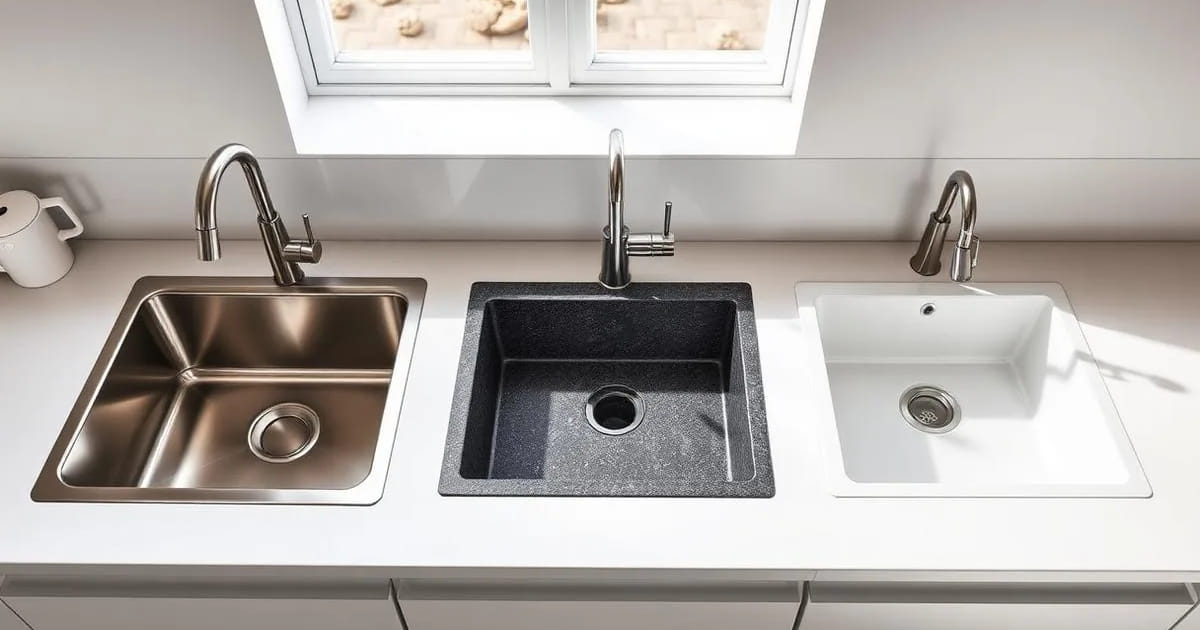
The sink is the most used water point in a home and, in many kitchens, the first to cause trouble. That is no accident: it takes grease, food waste, hot water, aggressive detergents and heavy daily use. As plumbers we judge a sink by very practical criteria — material thickness and quality, mounting type, bowl geometry and above all what sits underneath: the waste, the trap and the drain pipe. This guide compares stainless steel, granite composite and ceramic honestly, and explains what lasts under real conditions in Funchal and across Madeira.
🍽️ Stainless Steel: The Professional Standard and Why
Stainless steel remains the most balanced choice for most kitchens. 1) It handles thermal shock, pan impacts and virtually every household cleaner. 2) The alloy matters: 18/10 stainless with nickel resists marine-environment corrosion far better than budget grades. 3) Sheet thickness is decisive — between 0.8 and 1 mm the bowl does not flex or drum. 4) Good sinks have anti-vibration and anti-condensation coating under the bowl, greatly reducing water noise. 5) Brushed and textured finishes hide scratches and water marks better than mirror finishes. 6) Honest drawback: stainless steel scratches with use and shows limescale marks if not dried, especially with the harder water of some island areas.
🪨 Granite Composite: Solid Looks With Usage Rules
Granite-and-acrylic composite sinks have gained ground for valid reasons. 1) They are quiet, absorb water noise well and feel solid. 2) They resist surface scratching and keep their colour for years when the composite quality is good. 3) They tolerate high temperatures but dislike extreme thermal shock — repeatedly pouring boiling then cold water is a bad habit. 4) In light colours, strong dyes (coffee, wine, turmeric) can stain if not cleaned the same day. 5) Sharp impacts from heavy objects can chip the edge, and repair is harder than dealing with a dent in steel. 6) Cleaning must use non-abrasive products: metal scourers ruin the finish irreversibly.
🏺 Ceramic: Beauty With Weight and Care
Ceramic is unbeatable for classic looks, especially in farmhouse kitchens and bathroom basins. 1) The glaze resists stains strongly and does not change colour over time. 2) It is the easiest material to clean chemically, as long as abrasives are avoided. 3) Weight is high: a large ceramic sink needs a reinforced unit and proper structural support. 4) The main risk is impact chipping — a falling pan can cause permanent damage. 5) For bathroom basins, ceramic remains the most rational choice for durability and hygiene. 6) In kitchens it works very well where daily use is careful and heavy crockery is not being handled by children.
🔧 Mounting: Over, Under or Flush With the Worktop
The mounting type affects both cleaning and durability. 1) Overmount (with visible rim) is the most tolerant of irregularities and the easiest to replace. 2) Undermount gives an easy-to-wipe surface and a cleaner look, but needs a stable worktop material — stone or composite, never unprotected chipboard. 3) Flush mounting demands the most cutting precision and depends heavily on sealant quality. 4) In every case the worktop cut must be properly sealed against moisture; this is where many warped units begin. 5) The waste must be tightened with correct sealing and never forced, and excess silicone is no substitute for good mechanical sealing. 6) Always keep clear access to the trap: a unit packed with unreachable pipework turns a simple repair into a full strip-down.
🚰 Traps, Drains and Real Blockages
Most sink problems we solve are not in the bowl, they are underneath. 1) The trap should have an accessible cleaning cap — the detail that dramatically cuts intervention time. 2) Corrugated flexible pipe as a waste run is a common mistake: grease builds up in the ridges and blocks within months. 3) We always prefer rigid pipe with gentle bends and correct fall. 4) Kitchen grease is the main cause of blockages: it solidifies as it cools and gradually reduces the usable diameter. 5) Dishwashers connected to the trap need a correct anti-backflow loop to avoid odours and backflow. 6) If a waste disposal unit is fitted, drain sizing and fall become critical. 7) Persistent kitchen smell is almost always a dry or badly sealed trap, or insufficient drain venting.
✅ What We Recommend Case by Case
No material is best in absolute terms; there is a right material for each use. 1) Heavy-use kitchen, rental or holiday let: 18/10 stainless steel with good thickness, for resistance and easy repair. 2) Design kitchen with moderate use: granite composite, accepting the cleaning rules and thermal-shock care. 3) Classic kitchen with a careful user: ceramic, with a reinforced unit. 4) Bathroom: a ceramic basin remains the longest-lasting choice. 5) In every case, invest in what you cannot see — waste, trap with cleaning cap and rigid, well-sloped drain pipe. 6) Need help deciding or installing? Send photos of the worktop and unit on WhatsApp and we will advise the best solution.
FAQ
Which sink lasts longest in a heavily used kitchen?
In our experience, an 18/10 stainless steel sink with 0.8 to 1 mm sheet and anti-vibration coating. It handles impact and thermal shock, and even with use scratches it stays watertight and functional for many years.
Do granite composite sinks stain easily?
Good-quality ones resist well, but light colours can mark from coffee, wine or turmeric if left for hours. The practical rule is to clean the same day and never use abrasive scourers.
Why does my sink always block in the same place?
Almost always because of corrugated flexible waste pipe or insufficient fall, where grease accumulates. Replacing it with correctly sloped rigid pipe and fitting a trap with a cleaning cap solves it permanently.
Can I replace only the sink without changing the worktop?
In many cases yes, especially overmount sinks with compatible dimensions. For undermount or flush fitting the cut is specific and needs assessment first. Send photos and measurements and we will confirm.
Choosing or replacing a sink? Contact us on WhatsApp.
We work in Funchal, Câmara de Lobos, Caniço, Santa Cruz, Machico, Ribeira Brava, Ponta do Sol, Calheta, Santana, São Vicente and across Madeira Island.