Kitchen Extractor Hoods: Airflow (m³/h), Energy Efficiency and Brands
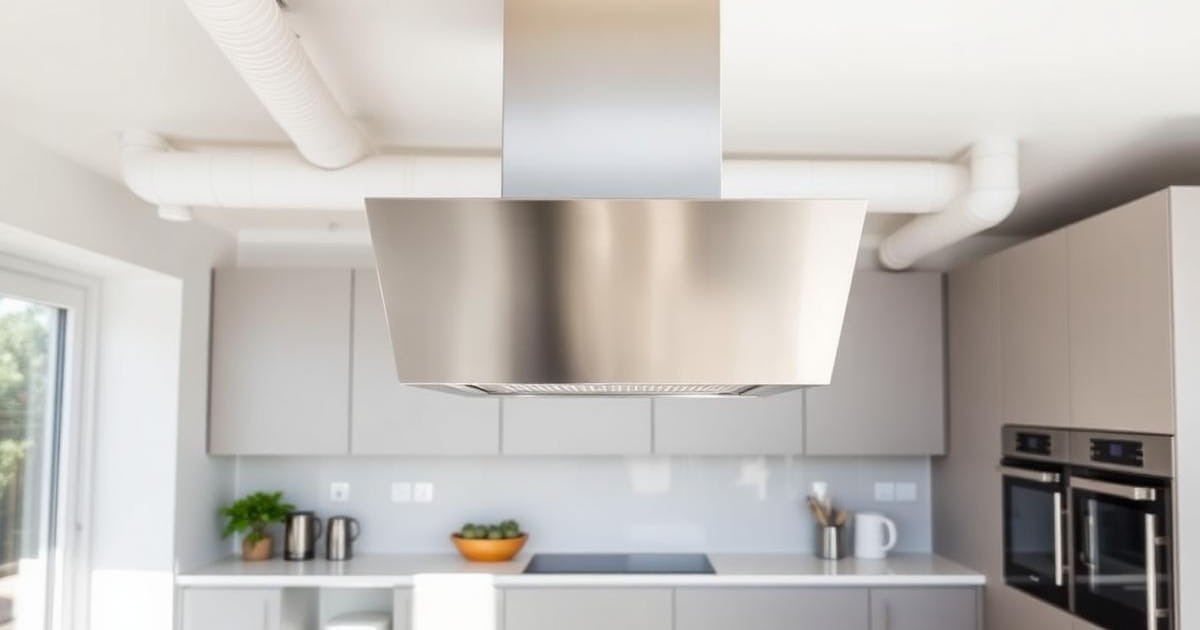
Most extractor-hood complaints we hear — «it doesn't pull anything», «the noise is unbearable», «the whole house smells of frying» — are not caused by the appliance but by sizing and installation. A hood is a ventilation machine: what matters is the airflow it can actually move against the real resistance of the duct, not the figure printed on the box. This guide shows how to calculate the airflow your kitchen needs, what happens when the duct is throttled, how to read noise ratings, and where brands like Teka, Cata, Balay, Bosch and Falmec genuinely differ in kitchens across Funchal and Madeira.
📐 Calculating the Airflow You Actually Need (m³/h)
The professional rule is simple and it works: 1) Measure kitchen volume — length × width × height in metres. 2) Multiply by 12 air changes per hour, the recommended figure for domestic kitchens. 3) Worked example: a 4 × 3 × 2.6 m kitchen is 31.2 m³; 31.2 × 12 = 375 m³/h as a useful minimum. 4) If you fry, grill or wok often, use 15 air changes — around 470 m³/h in the same example. 5) For kitchens open to the living room, include the adjoining volume or at least add 30%. 6) Choose an appliance whose airflow at intermediate speed (not maximum) covers that figure: nobody lives with the hood on full because the noise is unbearable. 7) Be sceptical of catalogues that only quote maximum «boost» airflow: that is a laboratory figure measured with no ducting.
🌀 Pressure Loss: The 150 mm to 120 mm Mistake
This is the most common error we find in kitchen refits in Madeira. 1) Flow resistance rises sharply as diameter drops: going from 150 mm to 120 mm cuts usable area by roughly 36%. 2) In practice we routinely measure 30% to 40% losses in effective airflow, plus more noise and motor vibration. 3) Every 90° bend is equivalent to several metres of straight duct; two or three badly placed bends wipe out half the performance. 4) Corrugated flexible aluminium has far more friction than rigid pipe — if unavoidable, keep runs short and fully stretched. 5) Never fit fine-mesh external grilles: they clog with grease and act as a plug. 6) The outlet needs a backdraft valve and protection against wind and rain, essential on exposed façades in Funchal and along the north coast. 7) Golden rule: keep the appliance's outlet diameter end to end, minimise bends and choose the shortest route outdoors.
🔇 Noise: The Factor That Decides Whether You Use It
Noise is the number one reason people stop switching the hood on. 1) Compare dB(A) figures at the same speed — speed 2 or 3 is usually the real-world setting. 2) Below 45 dB(A) at intermediate speed is comfortable; above 60 dB(A) is intrusive in an open kitchen. 3) Electronically controlled (brushless/inverter) motors are quieter and use less power than traditional multi-speed motors. 4) Much of the noise is not the motor but turbulence: throttled ducting, tight bends and restrictive grilles. 5) An oversized hood running on minimum speed is almost always quieter than a small hood on maximum. 6) Remote-motor solutions, with the fan outside or in the duct run, dramatically cut in-kitchen noise. 7) Loose fixings and missing anti-vibration pads transmit vibration into the cabinet and amplify sound.
🏷️ Brands in Practice: Teka, Cata, Balay, Bosch and Falmec
This is our field reading, based on real service calls and replacements. 1) Teka: very common in the Portuguese market, good price/performance, easy spares and filters; entry range is noisy, mid range is well balanced. 2) Cata: a ventilation specialist, with strong airflow in compact models and bathroom extraction options too; excellent for refits where space is tight. 3) Balay: BSH-group robustness at a friendlier price, simple controls and nationwide service — a safe choice for rentals and holiday lets. 4) Bosch: quiet EfficientDrive motors, good electronics and quality LED lighting; the best behaviour in open kitchens, at a higher price. 5) Falmec: Italian design range with remote-motor options and very low noise levels; needs careful installation to justify the investment. 6) With any brand, check availability of charcoal filters (recirculation mode) and dishwasher-safe metal grease filters.
⚡ Energy Efficiency, Filters and Recirculation Mode
The energy label says more than it seems. 1) The class (A to G) reflects motor consumption and fluid-dynamic efficiency, not just airflow. 2) The grease filtering efficiency class matters: multilayer metal filters capture better and protect the impeller. 3) LED lighting cuts consumption and heat above the hob. 4) Ducting outdoors always beats recirculation: it removes humidity, heat and odours instead of returning them. 5) Where no outlet is possible, recirculation with an active charcoal filter works, but the filter must be replaced every 4 to 6 months of normal use. 6) In flats where extraction joins a shared stack, a backdraft valve is mandatory to avoid receiving neighbours' odours. 7) Clean metal filters every 3 to 4 weeks: saturated filters raise pressure loss and power consumption.
✅ Final Recommendation and a Proper Installation
In summary, what we recommend: 1) Calculate airflow as volume × 12 and pick the appliance by its intermediate-speed figure. 2) Define the duct route before buying the hood, not after. 3) Keep 150 mm whenever the appliance requires it and prefer rigid pipe with gentle bends. 4) Fit an external outlet with a backdraft valve and a wide-mesh grille. 5) Respect the manufacturer's mounting height — typically 65 to 75 cm above induction hobs and slightly more above gas. 6) Provide make-up air: a completely sealed kitchen will not let the hood work. 7) Need help sizing, installing or fixing an existing setup? Send photos of the kitchen and the outlet on WhatsApp and we will advise the correct solution.
FAQ
How many m³/h do I need for a normal kitchen in Funchal?
Multiply kitchen volume by 12 air changes per hour. A 4 × 3 × 2.6 m kitchen (31.2 m³) needs around 375 m³/h. If you fry often, or the kitchen is open to the living room, aim for 450 to 600 m³/h at intermediate speed.
Can I reduce the duct from 150 mm to 120 mm to fit the cabinet?
Technically yes, but it is expensive in performance: usable area drops about 36% and real airflow often falls 30% to 40%, with much more noise. We always prefer changing the route or the cabinet over throttling the duct.
Ducted outdoors or recirculation with a charcoal filter?
Ducting outdoors is always better because it removes humidity, heat and odours. Recirculation is an acceptable fallback when no outlet exists, as long as the charcoal filter is changed every 4 to 6 months.
My hood is very noisy. Is the appliance faulty?
Usually not. Noise comes from a throttled duct, tight bends, over-long flexible pipe or a restrictive external grille. Correcting the route and diameter can make the same appliance dramatically quieter.
Choosing or installing the right hood? Contact us on WhatsApp.
We work in Funchal, Câmara de Lobos, Caniço, Santa Cruz, Machico, Ribeira Brava, Ponta do Sol, Calheta, Santana, São Vicente and across Madeira Island.