Leaks in PEX and Multilayer Pipes: Causes and Thermal Expansion Mistakes
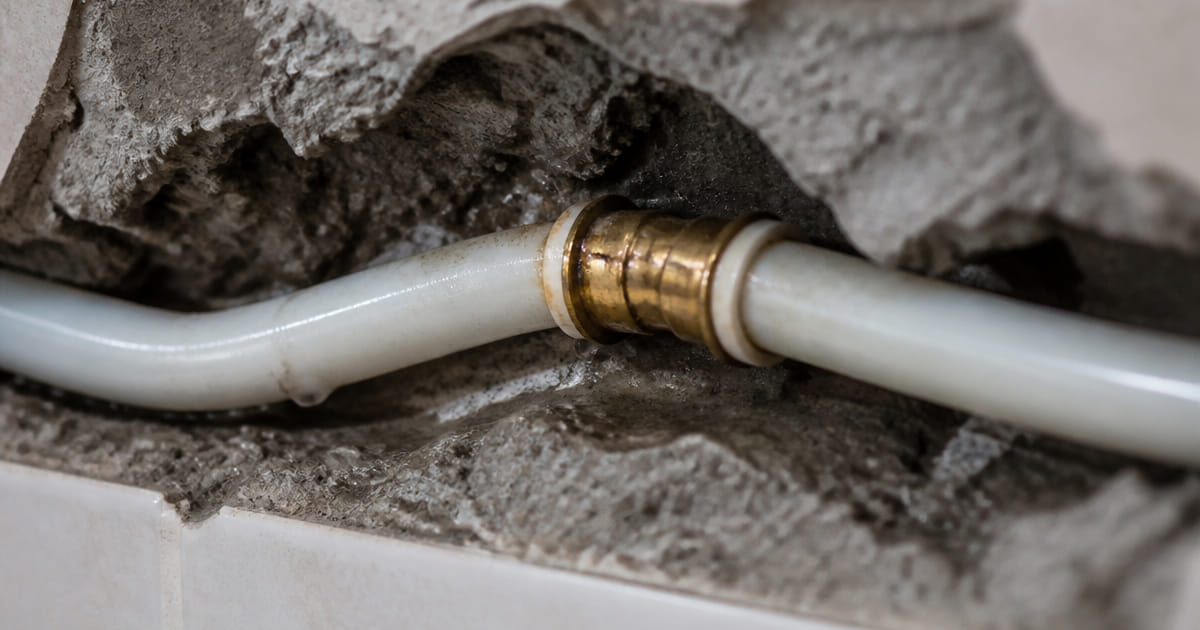
It is one of the subtlest diagnoses in modern plumbing: the bathroom wall starts to dampen, but only about 10 to 15 minutes after turning on the hot shower. When the water cools, the dampness disappears — or almost. The next day, the same film plays again. There is no sewage smell, no water running on the floor, and the meter does not spin. The culprit is often not the joint or the pipe itself, but the way it was embedded. When a PEX or multilayer pipe is locked directly into cement or mortar without room to expand, heat creates a silent mechanical pressure that only translates into a leak when the pipework is hot. At Canalizador Funchal® we call it a «thermal leak caused by blocked expansion» — and the solution lies in respecting the physics of the pipe.
🌡️ The Typical Symptom: A Leak that Rises and Falls with Temperature
The signature of this fault is its timing. 1) The wall is dry before the shower. 2) Ten to fifteen minutes after opening the hot tap, a stain or droplet appears near the crimped fitting. 3) After half an hour, once the shower is off, the leak reduces or stops. 4) The next day the cycle repeats with precision. 5) This happens because the pipe expands with heat (about 0.15 mm/m·K for PEX) and contracts as it cools. 6) If that linear expansion is blocked by the cement, the material cannot lengthen: stress moves to the weakest point — usually the metal fitting — and opens a temporary micro-crack. 7) When the pipe cools and contracts, the crack closes again, explaining the intermittent behaviour.
🚫 Installation Error: PEX and Multilayer Pipes Buried Directly in Cement
Standards and good technical practice require these pipes to run inside a corrugated sleeve or protective conduit. 1) The sleeve creates an annular gap that lets the pipe slide as it expands. 2) Without it, hardened cement «grips» the PEX or the aluminium layer of multilayer pipe along its entire length. 3) Multilayer pipe is particularly sensitive: the aluminium layer gives rigidity but also transmits stress straight to the compression fittings. 4) Crimped fittings have brass sleeves and compression rings that are not designed to absorb repeated bending. 5) Over time, the cyclic expansion/contraction fatigues the compression ring and the metal coupling. 6) The result is a microscopic crack that only opens under thermal stress. 7) The leak can be so small that it evaporates before running, appearing only as persistent dampness.
⚙️ Leak Mechanics: Linear Expansion vs. Metal Fitting
The physics are simple but relentless. 1) A 10-metre length of PEX heated from 15 °C to 55 °C expands by about 6 cm along its run. 2) If the pipe is straight and free, that elongation is absorbed by compensation loops or by the material's own flexibility. 3) If it is embedded in cement, the expansion is locked and converts into axial compression force. 4) The force concentrates at the fittings, which are rigid and discontinuous. 5) The crimped fitting flexes slightly, breaking the seal between the compression ring and the pipe. 6) Hot water escapes through that gap until pressure and temperature drop. 7) As the temperature falls, the pipe contracts, stress decreases and the crack closes again, stopping the leak.
🔍 Diagnosis with Thermal Imaging and Hot-Water Load Test
The intermittency makes detection difficult for conventional methods. 1) We start by interviewing the client to confirm the time pattern: the leak only appears with hot water. 2) We inspect the pipe route and embedding points, looking for stains or saltpetre. 3) We run a thermal load test: turn on the hot shower, wait 10–15 minutes and watch for dampness. 4) We use a thermal imaging camera to visualise the temperature gradient in the wall: the wet zone appears cooler due to evaporation, while the hot pipe appears warmer. 5) We compare images before, during and after the shower to confirm the thermal correlation. 6) If necessary, we use endoscopic cameras through small openings to inspect the fitting without major demolition. 7) The goal is to prove, before opening, that the leak is thermal rather than constant hydrostatic.
🛠️ Professional Repair: Targeted Opening and Expansion Sleeve
Correction requires respecting the natural movement of the pipe. 1) We precisely locate the critical section, minimising wall opening. 2) We cut out the damaged section and remove the mortar that was gripping the pipe. 3) We install a flexible corrugated sleeve or expansion conduit along the entire pipe run inside the wall. 4) We insert the new PEX or multilayer pipe into the sleeve, leaving enough longitudinal slack to absorb expansion. 5) We remake the joints with quality couplings and rings, ensuring they are not subjected to bending. 6) We thermally insulate the pipe with polyethylene foam sleeving to reduce thermal shocks and energy losses. 7) We close the wall with suitable material and test the network with hot and cold pressure. 8) Only then does the thermal leak disappear permanently.
⚠️ Mistakes to Avoid
1) Do not seal the leak with silicone or cement: thermal stress will keep reopening the micro-crack. 2) Do not replace only the crimped fitting without solving the embedding — the new fitting will fail the same way. 3) Do not use rigid copper pipe as a patch in a PEX run without thermal compensation. 4) Do not ignore the problem because «it went away on its own»: the crack is propagating cycle after cycle. 5) Do not open walls at random without thermal imaging: the wrong diagnosis multiplies repair costs.
🛡️ Prevention During Installation and Renovation
The best solution is to avoid the mistake from the outset. 1) Whenever PEX or multilayer pipe is embedded in a wall, use a protective corrugated sleeve along the entire run. 2) At bends and direction changes, leave enough radius for the pipe to slide without kinking. 3) In slab or masonry crossings, use expansion sleeves or adequately sized junction boxes. 4) In Madeira's old stone houses, where walls are thick and damp, thermal insulation is even more important. 5) Document the pipe route and joint locations for future work. 6) Hire a plumber who tests the network with both hot and cold water before handing over the job.
FAQ
Why does the leak only appear with hot water?
Because the pipe expands with heat. If it is locked in cement, that expansion creates mechanical stress at the fittings and opens a temporary micro-crack. When the water cools, the pipe contracts and the crack closes.
Is PEX a bad material for embedded plumbing?
No. PEX and multilayer pipes are excellent when installed correctly. The problem occurs when they are embedded directly in cement without an expansion sleeve, preventing natural thermal movement.
How do you confirm a thermal-expansion leak?
Through the time pattern (appears with hot water, disappears on cooling) and thermal imaging, which shows the wall temperature gradient and confirms the correlation between heat and dampness.
What is the permanent solution?
Open the wall at the precise point, remove the mortar gripping the pipe, install a corrugated sleeve or expansion conduit, remake the joints without stress, and thermally insulate the pipe.
Leak that comes and goes with hot water? We diagnose the thermal cause and fix it permanently.
We work in Funchal, Câmara de Lobos, Caniço, Santa Cruz, Machico, Ribeira Brava, Ponta do Sol, Calheta, Santana, São Vicente and across Madeira Island.