Ideal Sewer Pipe Slope: Why Too Much Pitch Causes Blockages
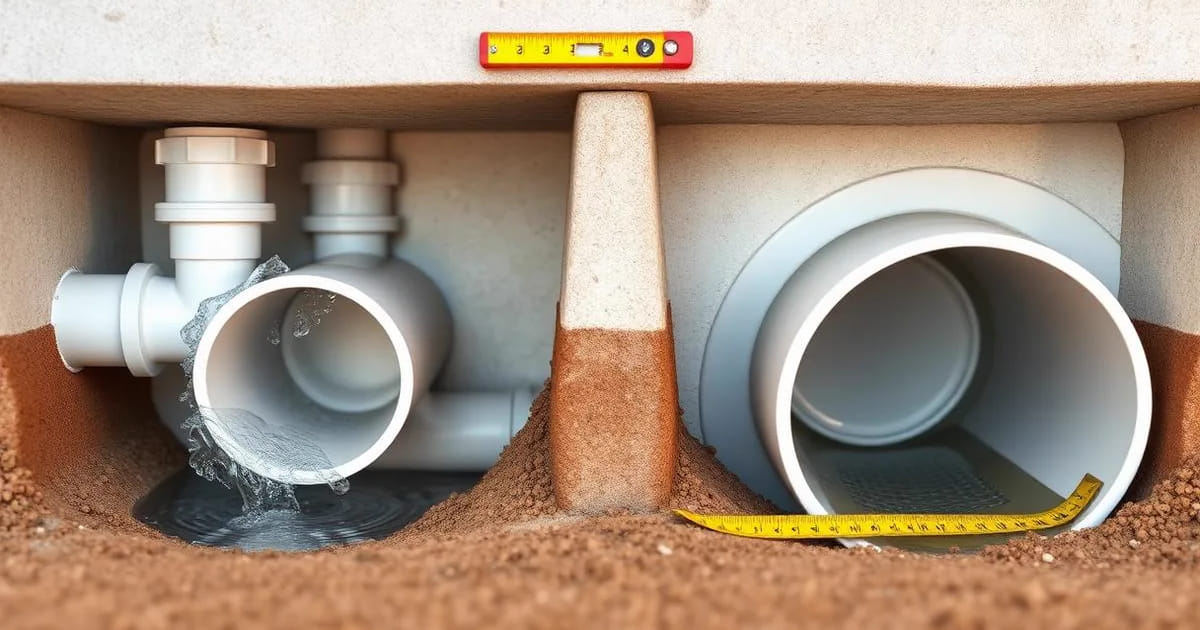
A common myth in construction and renovation is that «the steeper the sewer pipe, the faster the water drains and the better the system works». From a hydraulic physics standpoint, this is completely false — and it is responsible for countless mysterious blockages in homes across Madeira.
🔎 The Most Common Hydraulic Mistake
Sanitary drainage depends on a delicate balance between liquid velocity and solid transport. 1) Many builders believe a steep slope «helps water flow». 2) In reality, the water outruns the solids. 3) The result is recurring blockages in apparently well-installed branches. 4) The problem worsens in rarely used bathrooms or secondary branches. 5) The fix is to respect the correct hydraulic gradient on every run.
⚠️ What Happens with Excessive Slope (Over 3% - 5%)
When the grade is too steep, physics works against the installation. 1) Water moves much faster than solid waste. 2) The liquid rushes ahead, leaving paper and solids stuck to the dry pipe walls. 3) Over time these residues build up and block the pipe. 4) The phenomenon repeats even in generously sized pipes. 5) In poorly supervised renovations, this error is common on vertical drops into floor gullies.
🧊 What Happens with Too Little Slope (Under 1%)
Insufficient slope is equally dangerous. 1) Water velocity is too low to create drag force. 2) Water stagnates, letting grease and solids settle on the pipe floor. 3) Crusts form and gradually reduce the usable pipe diameter. 4) Drainage becomes slow and gurgling. 5) Within months the blockage can become total, requiring professional unclogging.
🎯 The Golden Rule: 1% to 2% Grade
For perfect domestic sewer drainage, the ideal slope is strictly 1 cm to 2 cm of fall per metre of pipe (1% to 2%). 1) Zero Hydraulic Separation: water and waste travel at the same speed. 2) Self-cleansing: the water film scours the pipe bottom with every flush. 3) Prevents grease and sediment deposition. 4) Reduces the need for periodic unclogging. 5) Extends the working life of the drainage system by decades.
🚫 What to AVOID
1) Do not accept slopes over 3% on domestic sewer branches. 2) Do not rely on «visual experience» — demand measurement with a level or inclinometer. 3) Do not install perfectly horizontal pipes to «save floor height». 4) Do not ignore sanitary fixture manufacturers' recommended gradients. 5) Do not remodel bathrooms without checking the slope of existing branches.
🧰 Preventive Maintenance
1) Check the slope of all new branches with a spirit or laser level before closing the floor. 2) Flush rarely used bathrooms periodically to maintain the water film and prevent sedimentation. 3) Fit drains and traps that are easy to clean. 4) Avoid pouring fats and oils down the sink, especially on branches already at minimum slope. 5) Book a technical inspection if you notice slow drainage or recurring gurgling.
FAQ
What is the minimum and maximum acceptable slope for a sewer pipe?
The practical rule is 1% to 2% grade (1 to 2 cm per metre). Below 1% risks sedimentation; above 3% to 5% the water outruns the solids and causes blockages.
Can a pipe slope be corrected without tearing out the whole bathroom?
Often yes. A technical inspection identifies the mis-sloped section, and in many cases it can be corrected with localised adjustments, gully replacements or partial branch renewal.
Persistent blockages in Funchal? We diagnose and correct sewer gradients across Madeira.
We work in Funchal, Câmara de Lobos, Caniço, Santa Cruz, Machico, Ribeira Brava, Ponta do Sol, Calheta, Santana, São Vicente and across Madeira Island.