Garden Irrigation Networks: Pressure Sizing, Solenoid Valves and Filtration
In Madeira almost every house has a garden, and many are watered from a well, spring, levada channel or cistern. A well-built irrigation network is discreet, cheap to run and lasts decades. Built badly, it clogs every summer, runs at the wrong pressure and bursts drippers — and worst of all, it can contaminate the drinking water in the house. This guide covers pressure and flow sizing, protecting the potable supply, and keeping valves and filters working.
🚱 Separating Irrigation from the Drinking Supply
1) Irrigation is a «dirty» network: drippers sit in contact with soil, fertiliser and organic matter. 2) A pressure drop in the mains can suck that water back into the house pipework — that is backflow. 3) So the irrigation feed must carry proper backflow protection: a double check valve or a backflow preventer, depending on the risk. 4) With fertiliser injection (fertigation) the risk level demands a backflow preventer, not just a simple check valve. 5) Where the source is a well, spring or cistern, the irrigation network must be physically independent from the potable supply, with no direct connection at all. 6) Outdoor take-off points should be labelled and ideally fitted with a removable key to stop misuse. 7) A garden tap with a hose submerged in a tank is already a real backflow risk: a check valve at the tap is a cheap fix.
📊 Sizing Pressure and Flow per Zone
1) Start by measuring what you have: static pressure with a gauge at the garden tap and available flow with a timed bucket. 2) Irrigation is split into zones because the supply cannot feed every sprinkler at once. 3) Each zone should draw at most around 75% of available flow, leaving margin for pressure losses. 4) Sprinklers typically work between 2 and 3.5 bar; drip lines work between 1 and 2 bar. 5) Mixing sprinklers and drip in one zone is a classic mistake: their optimum pressures are incompatible. 6) On Madeira's hillside properties, height changes pressure by roughly 1 bar per 10 metres — it has to enter the calculation. 7) Undersized pipe creates high velocity, noise and wear; 25 to 32 mm HDPE mains suit most domestic gardens.
🎚️ Pressure Regulators for Drip Irrigation
1) Drip is the most efficient system but also the most pressure-sensitive. 2) Above 2 to 2.5 bar, plain drippers distort, pop out of the line and joints start to weep. 3) The answer is a dedicated pressure regulator on the drip line, after the filter and before the manifold. 4) Pressure-compensating drippers hold constant flow across a pressure range — ideal on sloping ground. 5) On long slopes it pays to regulate per zone rather than only at the main inlet. 6) A simple gauge on the manifold lets you check real working pressure in seconds. 7) Invisible drip leaks show up as waterlogged patches and dry plants on the same line: a sign of poorly distributed pressure.
🧽 Filtration: Sand, Algae and Limescale
1) Well, spring or levada water carries sand, silt and plant matter — direct enemies of drippers. 2) Minimum filtration is a 120 to 150 mesh screen or disc filter at the irrigation inlet. 3) For higher flows or heavily loaded water, an upstream sand filter greatly extends system life. 4) The filter goes before the solenoid valves: it protects diaphragms and seats, which are the first parts to fail. 5) Cleaning the cartridge or discs is routine work — monthly in summer with the system in heavy use. 6) In hard water, limescale coats drippers; an annual acid flush of the lines restores flow. 7) Always leave a line end with a flush cap so sediment can be washed out at the start of the season.
🔌 Solenoid Valves: Installation and Maintenance
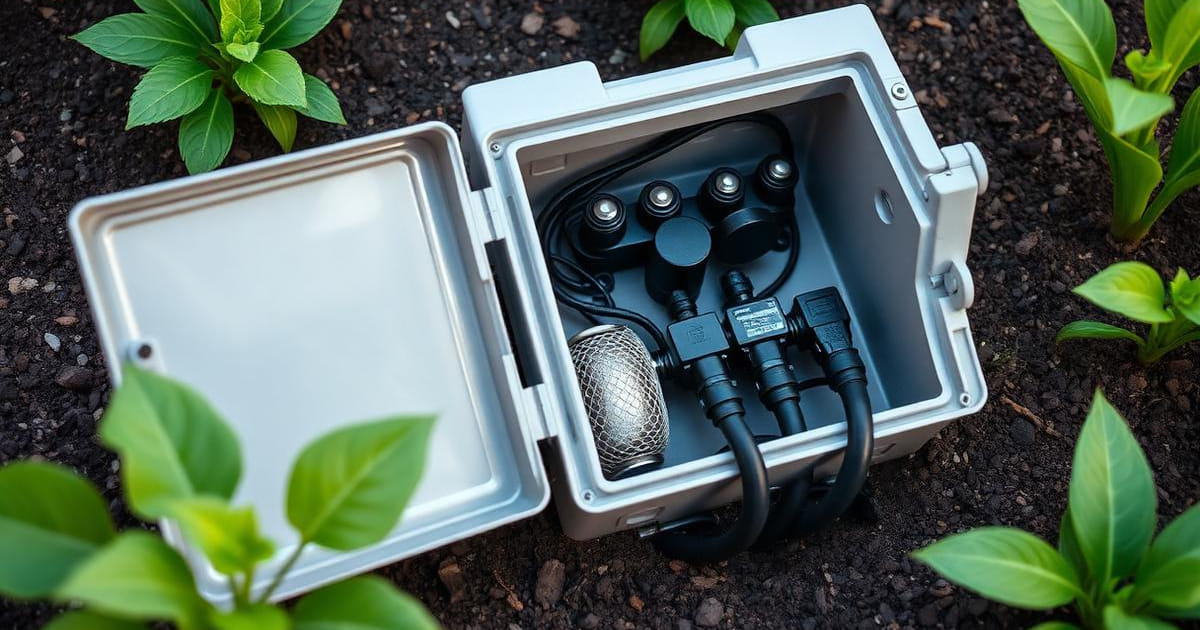
1) The solenoid valve is the heart of automation and the component that fails most often from sand and debris. 2) Always install them in an accessible valve box, with gravel at the bottom for drainage, never loose in the soil. 3) Mount them above ground level where possible to reduce soil ingress into the box. 4) Accumulated sand damages the diaphragm and the valve stays half open — the classic symptom is a zone that keeps dripping after shutdown. 5) Wiring must use gel-filled waterproof connectors; taped joints fail in the first wet season. 6) A valve that will not open may be a burnt solenoid, dirt in the pilot port or insufficient pressure — check in that order. 7) A manual isolating valve per zone lets you work without shutting down the whole garden.
✅ Scheduling, Winter and Mistakes to Avoid
1) Water at dawn: less evaporation, less fungal disease and better mains pressure. 2) Adjust the schedule by season; in Madeira a wet winter removes almost all irrigation need on the south coast. 3) A rain or soil moisture sensor pays for itself in a few months of saved water. 4) In highland areas, drain or protect exposed lines ahead of frost nights. 5) Classic errors: mixing sprinklers with drip, skipping the filter, ignoring backflow protection and burying valves with no box. 6) Run a full inspection each early spring: filters, pressure, leaks, blocked drippers and scheduling. 7) Document the zone map — it saves hours on any future work. Want to install or restore your garden irrigation? Send photos on WhatsApp.
FAQ
Do I need a backflow preventer on garden irrigation?
Yes. Irrigation is a contamination-risk network and a pressure drop can suck soil water back into the drinking pipework. Depending on the risk, use a double check valve or a full backflow preventer.
What pressure should drip irrigation run at?
Typically between 1 and 2 bar. Above that, drippers distort and joints weep. Fit a pressure regulator dedicated to the drip line, placed after the filter and before the manifold.
Why do my solenoid valves keep dripping?
Almost always sand or debris on the diaphragm and pilot port, preventing full closure. A 120 to 150 mesh filter upstream plus cleaning the valve resolves most cases.
Can I irrigate with well or levada water?
You can, provided the irrigation network is physically independent from the potable supply and properly filtered. Spring or levada water carries sand and silt that block drippers within weeks without a filter.
Want reliable, properly protected irrigation? Message us on WhatsApp.
We work in Funchal, Câmara de Lobos, Caniço, Santa Cruz, Machico, Ribeira Brava, Ponta do Sol, Calheta, Santana, São Vicente and across Madeira Island.