Galvanic Corrosion: The Danger of Mixing Copper, Steel and Brass in One System
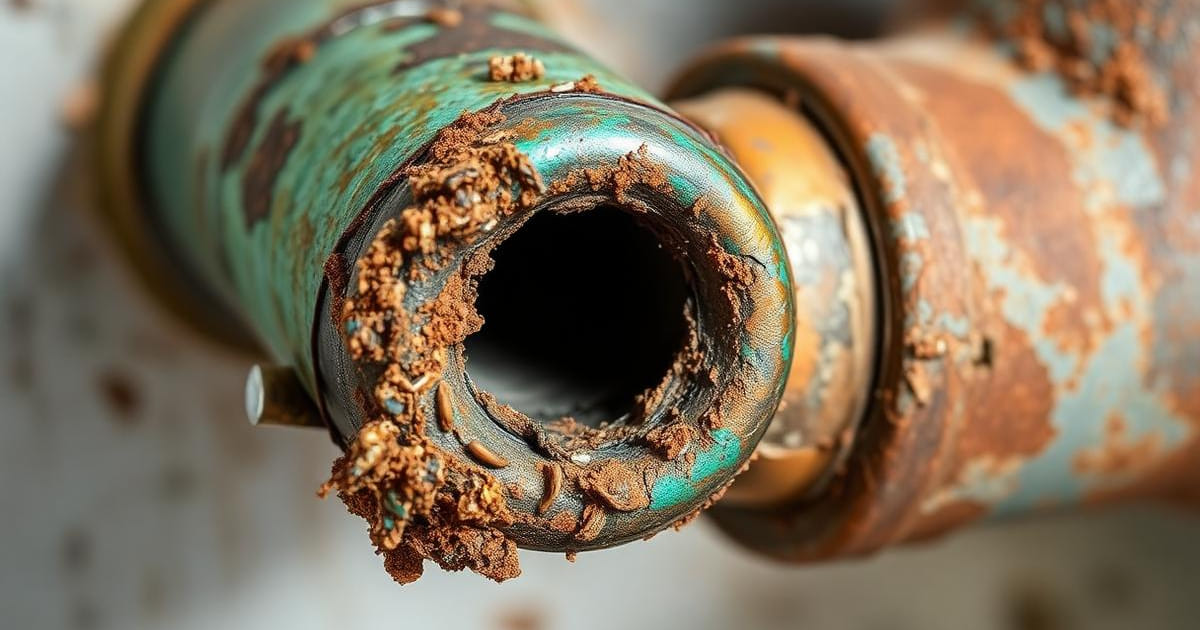
It is one of the diagnoses that surprises clients the most: the pipework has no impact damage, no excessive pressure and no visible scale, yet a tiny pinhole is spraying water. When we open the wall, the explanation is almost always in plain sight — copper connected directly to galvanised steel. Two dissimilar metals in contact, with water acting as the electrolyte, create a miniature battery. One of the metals is sacrificed and degrades far faster than normal. In Madeira, with sea air and high humidity in Caniço, Santa Cruz, Machico and the lower areas of Funchal, the process runs even faster.
🔎 Symptoms & Initial Diagnosis
1) Very small pinholes or cracks at isolated points of the pipework, with no sign of mechanical impact. 2) Green-blue oxide (copper) mixed with orange rust (steel) exactly at the junction between two materials. 3) Reddish water or dark particles the first time you open the tap after hours of no use. 4) Seized threads and fittings that snap when undone, a sign of metal already eaten from inside. 5) Repeated repairs in the same area of the house even after replacing pipe — clear proof the cause was never removed. 6) In older partial refurbishments: check every transition, because that is where the problem concentrates.
🧪 Main Causes
1) Direct union between metals with different electrochemical potentials: copper acts as the cathode and accelerates corrosion of galvanised steel, which becomes the sacrificial anode. 2) Water as electrolyte: the higher the conductivity (dissolved salts, chlorides, sea air), the faster the reaction. 3) Partial refurbishments: half the network is replaced with copper or multilayer while the old steel half remains, creating dozens of bimetallic points. 4) Hot and cold water heater connections made with brass fittings screwed straight into steel pipe. 5) Stray currents: poorly earthed electrical installations that use the pipework as a conductor aggravate electrolysis. 6) No insulating transition fittings at all in the original build.
🛠️ Practical Step-by-Step
1) Map the materials in your network: identify visually where copper, galvanised steel, brass and multilayer pipe sit. 2) Photograph every accessible transition — that inventory guides the works. 3) Close the main valve before touching any suspect joint. 4) Where corrosion is active, cut out and replace the compromised section; tightening or sealant will not do. 5) Rebuild the transition with a dielectric fitting (see next section). 6) Check the earthing of the electrical installation: pipework must never serve as a current path. 7) Document the work photographically before closing the wall.
🎯 Definitive Technical Solution
1) Never join copper directly to galvanised steel without protection. Copper acts as the cathode and accelerates corrosion of the steel, producing electrolysis pinholes within a few years. 2) Always fit dielectric insulating sleeves and unions (bimetallic unions with a PTFE or polymer separator) at every transition between dissimilar metals, especially on the hot and cold connections of the water heater and in refurbishments over old networks. This fitting physically interrupts electrical continuity between the two metals and breaks the galvanic current path, removing the cause rather than the symptom. 3) Alternatively, isolate the transition with an intermediate section of PEX-AL-PEX multilayer pipe or suitable brass, ensuring the two incompatible metals never touch directly. 4) Always complement with correct earthing at the electrical panel, so the pipework never carries stray currents.
🚫 What to AVOID
1) Do not fix a corrosion pinhole with a clamp, tape or epoxy: the electrochemical reaction continues and the hole reappears next to it. 2) Do not use PTFE tape as an 'electrical insulator' — it seals the thread but does not break metal contact. 3) Do not mix steel and copper fittings on the same manifold just because they screw together. 4) Do not bond the electrical earth to the water pipework as a workaround. 5) Do not bury bimetallic transitions with no access: if they fail, finishes have to be broken. 6) Do not assess only the leaking point — inspect every similar joint in the house.
🧰 Preventive Maintenance
1) Inspect the visible connections of the water heater, meter and service risers annually. 2) In seafront homes, increase inspection frequency because of chlorides in the sea air. 3) Keep transitions accessible, in inspection boxes or removable panels. 4) Use any building work as an opportunity to remove remaining galvanised steel sections. 5) Record in writing which materials were used in each intervention, for future technicians. 6) Pressure test for tightness after every repair.
FAQ
Can I join copper to galvanised steel if I use plenty of PTFE tape?
No. PTFE tape seals the thread against water leaks but it is not a reliable electrical barrier: metal-to-metal contact remains along the thread and galvanic current keeps flowing. The only correct solution is a dielectric union or sleeve with a PTFE or polymer separator, which physically breaks continuity between the two metals.
Which metal fails first in this reaction?
The less noble metal, which acts as the sacrificial anode. In a copper/galvanised steel union it is always the steel or zinc side that degrades, even if the pinhole shows up a few centimetres from the joint. That is why we often find copper in good condition and, immediately after the fitting, steel completely eaten from the inside.
Repeated pinholes in your pipework? Let us identify the bimetallic transitions at home.
We correct galvanic corrosion and bimetallic transitions in Funchal, Câmara de Lobos, Caniço, Santa Cruz, Machico, Ribeira Brava, Ponta do Sol, Calheta, Santana, São Vicente and Porto Moniz, across Madeira Island.