Frost Protection for Plumbing: Thermal Valves and Insulation for Exterior Pipes
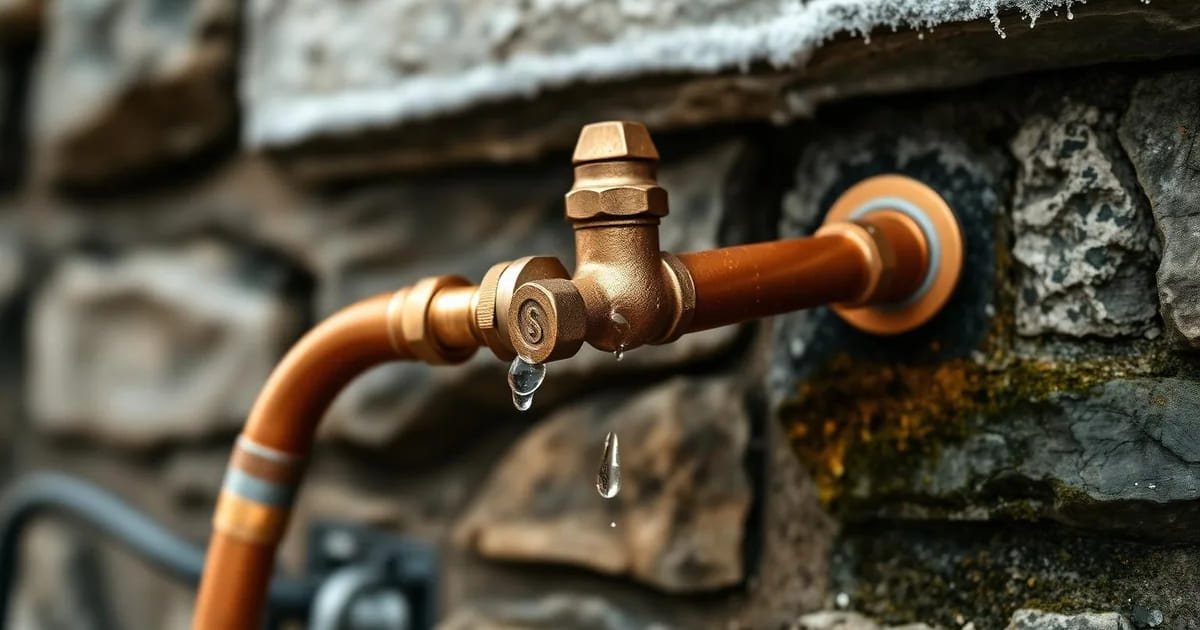
In Madeira frost is not an island-wide problem, but it is a very real one above a certain altitude and on clear winter nights. One unprotected exterior pipe at Paul da Serra, Areeiro, or in the higher parts of Santana, São Vicente or Curral das Freiras is enough for a night below zero to end in a burst pipe discovered only when it thaws. Water expands as it freezes and a closed pipe has nowhere to give: the wall gives instead. Frost protection is cheap when it is preventive and very expensive when it is corrective, because the damage almost never stops at the pipe.
❄️ Why Pipes Burst in Freezing Weather
1) Water expands by around nine per cent when it turns solid, and that expansion has no escape route in a closed pipe. 2) Ice forms first where flow is lowest and exposure highest, typically exterior runs unused overnight. 3) It is the pressure trapped between two ice plugs that splits the pipe, not the ice touching the wall. 4) Copper tears in a line, multilayer pipe cracks at fittings and exterior PVC breaks in a brittle way. 5) The failure often shows only on thawing, when water flows again and floods whatever sits below. 6) Meters, garden taps, façade risers and irrigation pipework are the most affected points. 7) In homes closed out of season the risk multiplies, because no use is refreshing the water inside the pipes.
🌡️ Wax-Expansion Thermal Drain Valves
1) A frost valve is an automatic device that opens a small discharge when water temperature falls to around three degrees. 2) The internal element is a thermally expanding wax actuator that changes volume with temperature and moves the valve stem. 3) On opening it releases a small flow that refreshes water in the exposed run and prevents ice forming. 4) It closes automatically as temperature rises, with no electrical supply or remote control of any kind. 5) It is always fitted at the lowest, most exposed point of the run being protected, with a free and visible discharge. 6) The discharge must be routed where water drains away without creating ice on a walking surface. 7) It is the most robust solution for irrigation networks, outside taps and isolated branches with no power available.
🧵 Elastomeric Lagging and Continuous Insulation
1) Closed-cell elastomeric lagging is the correct insulation outdoors, because it does not absorb water the way mineral wool does. 2) Thickness must match the diameter: insulation that is too thin merely delays freezing instead of preventing it. 3) Continuity is decisive — every centimetre of bare pipe acts as a thermal bridge and a starting point for ice. 4) Bends, fittings, valves and the meter body need their own insulation and cannot be left bare. 5) Joints are bonded with the proper adhesive and reinforced with tape so rain cannot get between lagging and pipe. 6) In permanent outdoor use, insulation needs UV protection or it degrades within a few seasons. 7) Insulation generates no heat: it protects pipework that still circulates, but will not save a run standing still for days below zero.
🔌 Self-Regulating Cables: Choosing and Installing
1) A self-regulating cable varies its output along its length according to the local pipe temperature. 2) That behaviour prevents overheating and allows the cable to be cut to length, unlike constant-wattage cables. 3) It is applied straight or spiralled, always in direct contact with the pipe and underneath the insulation. 4) The cable must never cross over itself, to avoid creating localised hot spots. 5) The supply needs dedicated RCD protection and earthing, which must be carried out by an electrician. 6) An in-line thermostat or ambient sensor avoids needless consumption outside risk periods. 7) Cable plus lagging is the complete answer: the cable offsets losses while insulation drastically cuts the energy required.
🏔️ Madeira's Highlands: Where It Actually Matters
1) Above seven to eight hundred metres, winter nights regularly reach values close to zero. 2) Paul da Serra, Areeiro, Poiso, Encumeada and the higher parts of Santana, São Vicente and Curral das Freiras are the areas that genuinely need attention. 3) Façade orientation matters a great deal: north-facing walls and shaded runs freeze before the rest. 4) Wind increases heat loss and freezes pipework that would survive the same temperature in still air. 5) On properties with a borehole, always protect the booster set, the suction pipe and the pressure vessel. 6) Irrigation networks should have a drain valve at the low point and be capable of complete emptying in the cold season. 7) In second homes, shutting off and draining down is the most effective protection during long absences.
🛠️ Emergency Response and Annual Preventive Checks
1) If an outside tap stops delivering water on a cold morning, close that branch before attempting any warming. 2) Never use a direct flame to thaw pipework: it deforms metal, burns seals and starts fires. 3) Thaw with hot cloths, moderate warm air or space heating, always working from the tap back towards the interior. 4) Inspect the whole run after thawing: hairline cracks reveal themselves when pressure returns. 5) Before each winter, inspect insulation, test the thermal valve and confirm electrical continuity of the cable. 6) Photograph the protected exterior route — it makes future work and quick checks far easier. 7) Want your exterior pipework prepared for winter? Message us on WhatsApp.
FAQ
Does frost protection make sense in Madeira?
Not at sea level, but it certainly does in the highlands. Above seven to eight hundred metres there are winter nights close to zero, enough to freeze unprotected exterior pipework.
Does a frost valve waste much water?
No. It only opens near freezing conditions and releases a small flow. Annual consumption is negligible compared with the cost of a burst pipe and the water damage that follows.
Is lagging the pipe enough on its own?
Often yes, provided the insulation is continuous and of adequate thickness. On very exposed runs, or where there is no draw-off for days, combine it with a thermal valve or a self-regulating cable.
Can I fit a self-regulating cable myself?
Applying it to the pipe is simple, but the electrical supply needs RCD protection and earthing installed by an electrician. That point, not the cable itself, determines whether the installation is safe.
Want your exterior pipework protected against frost before winter? Message us on WhatsApp.
We work in Funchal, Câmara de Lobos, Caniço, Santa Cruz, Machico, Ribeira Brava, Ponta do Sol, Calheta, Santana, São Vicente and across Madeira Island.