The Silent Danger of Flexible Hoses: How to Prevent a Catastrophic Flood in Your Home
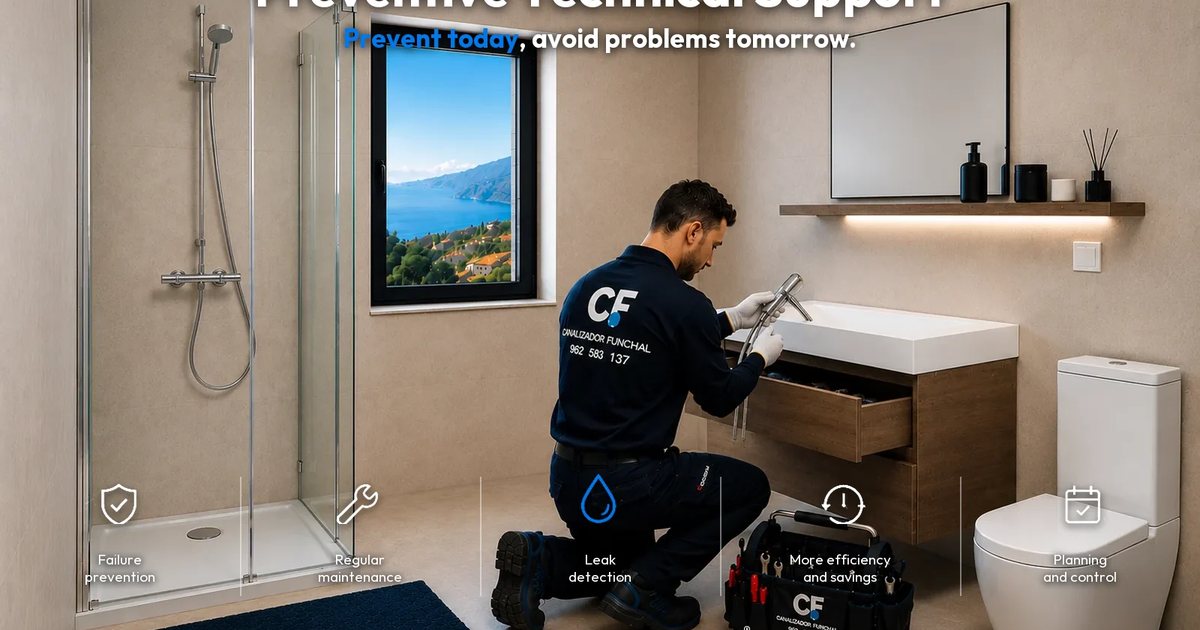
Stainless-steel braided flexible hoses connect the mains supply to the washbasin, bidet, kitchen sink, toilet and washing machine. They are permanently pressurised, day and night, even while you sleep or are on holiday, and they have a real lifespan that many homeowners are unaware of. In Madeira, sea-air corrosion and condensation inside closed cabinets speed up rust on the steel mesh, making preventive replacement every 5 years one of the cheapest and most effective ways to avoid a catastrophic flood in Funchal, Caniço, Santa Cruz, Machico or Câmara de Lobos.
🔎 Symptoms & Initial Diagnosis
1) Rough, dry stainless-steel mesh or visible rust spots, especially under the washbasin, bidet, kitchen sink and toilet. 2) Small blisters, cracks or deformation of the inner rubber tube visible near the brass nuts. 3) Greenish oxidation (verdigris) on the brass connections. 4) Intermittent dripping or permanent dampness at the bottom of the cabinet even with taps closed. 5) Unknown hose age or a fitting older than 5 years that has never been checked — reason enough for an immediate inspection in any home in Funchal, Caniço, Santa Cruz or Machico.
🧪 Main Causes
1) Sea air: Madeira's coastal salt air speeds up corrosion of the steel mesh and brass nuts, especially in Funchal, Câmara de Lobos and Machico. 2) Constant condensation inside closed bathroom cabinets, where shower vapour settles drop by drop on the mesh over the years. 3) Mains pressure spikes: in higher areas of the island pressure can exceed recommended levels, fatiguing the mesh and seals every time a tap is opened. 4) Natural wear of the inner rubber tube, which loses elasticity over time and fails under constant pressure. 5) Use of budget-grade hoses, with thin mesh and lower-quality seals that degrade within 1 to 2 years.
🛠️ Ideal Step-by-Step / Immediate Action
1) Immediately close the local shut-off valve next to the hose or, if not visible, the main safety valve at the meter. 2) Cut the power if water is near sockets, panels or the washing machine. 3) Contain the water with towels and buckets while assessing the extent of the damage, protecting wooden floors and furniture. 4) Photograph the damaged hose and affected area with date and time for insurance purposes. 5) Replace the hose with a professional-grade one or contact a technician immediately to inspect every hose in the home.
🚫 What to AVOID
1) Do not postpone replacing hoses older than 5 years just because they "are not dripping yet" — failure is sudden and without warning. 2) Do not use unsuitable tools (needle-nose pliers, screwdrivers) on brass connections: it scratches the thread, deforms the nut and creates leak points. 3) Do not overtighten joints hoping to stop a drip — excess force cracks the brass or crushes the internal seal, worsening the leak. 4) Do not reuse hoses removed from another fitting or buy the cheapest ones available: the price difference is minimal compared with the flooding risk.
🧰 Preventive Maintenance
Visually inspect every hose (washbasin, bidet, sink, toilet, washing machine and dishwasher) at least twice a year. Replace them preventively every 5 years and never exceed 8 years of use, even if they still look fine. Also check the safety valves and inlet filters, making sure they turn freely for a quick shut-off in an emergency. Whenever you leave home for several days, close the main safety valve at the meter — it prevents 99% of hose-related flooding.
FAQ
What is the lifespan of a stainless-steel mesh flexible hose?
On average between 5 and 8 years, depending on material quality and the environment. In coastal areas of Madeira exposed to sea air, or in small, poorly ventilated bathrooms, we recommend preventive replacement at 5 years and never exceeding 8 years, even without visible wear.
How do I know if a hose is about to burst?
Warning signs are: rust spots on the steel mesh, rough or dry mesh, small blisters or deformation of the inner rubber, dripping at the joints and greenish oxidation of the brass connections. If you notice any of these, replace the hose immediately.
Do washing machine and toilet hoses also need replacing?
Yes. The hoses feeding the washing machine, dishwasher and the toilet/bidet supply are subject to the same constant pressure and the same oxidation process, sometimes worsened by heat and humidity in the room. They should follow the same 5-year inspection and replacement routine.
Need help now? Fast response on WhatsApp.
We inspect and preventively replace flexible hoses across the island of Madeira: Funchal, Câmara de Lobos, Caniço, Machico, Ribeira Brava, Ponta do Sol, Calheta, Santa Cruz, Santana, São Vicente and Porto Moniz.