Fire Hose Reel Systems: Preventive Maintenance and Service Pressure
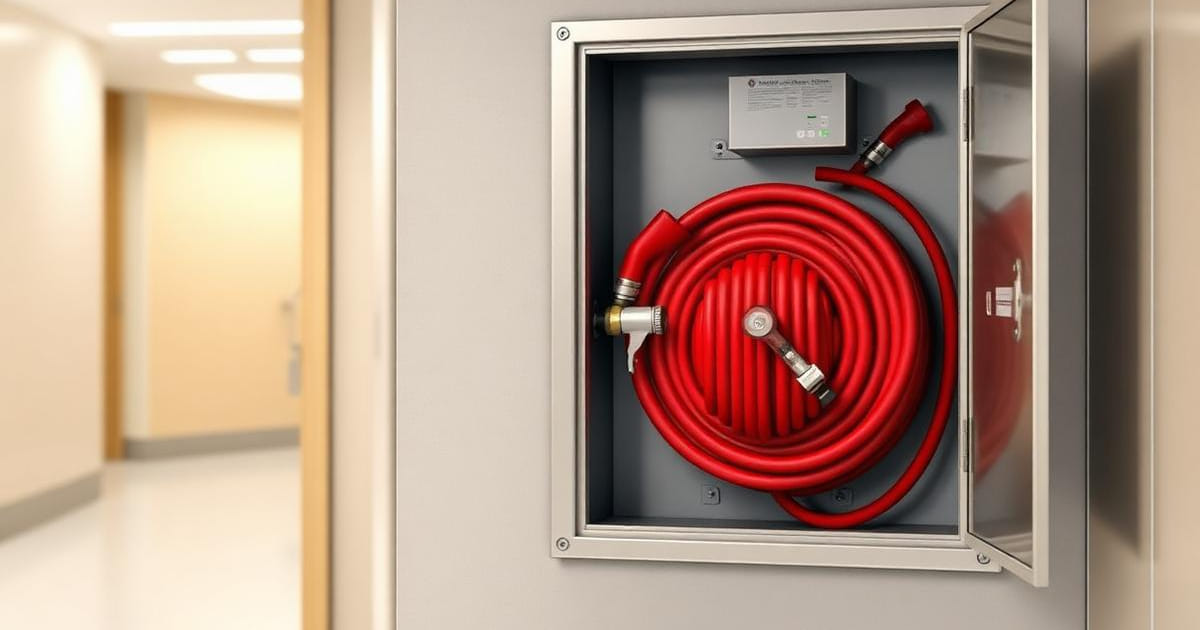
A fire hose reel system is the one piece of building equipment that sits unused for decades and must work perfectly the first time somebody opens the valve. In many Funchal buildings the reels are installed, painted and signed — but never tested. When the valve opens, what comes out is dark water at insufficient pressure, or nothing at all. This article explains what gets inspected, how the right pressures are measured and why the fire riser is the critical point of the whole installation.
🧯 What a Fire Hose Reel System Is
1) It is a water network dedicated to firefighting, independent from domestic use, with a riser and outlets on every floor. 2) The usual equipment is semi-rigid hose reels (25 mm type) and landing valves with lay-flat hose (45 mm type). 3) The 25 mm reel is the one suited to use by occupants, because one person can handle it alone. 4) The supply may come directly from the mains, from a private tank with a booster set, or a combination of both. 5) The network must be permanently charged: an empty or isolated system is decorative. 6) Signage, clear access and an unobstructed cabinet are part of the installation, not a detail. 7) In Madeira's residential and tourist buildings this network is often the only defence available in the first minutes.
📏 Static vs Dynamic Pressure
1) Static pressure is measured with the system closed — it only proves there is charged water. 2) Dynamic pressure is measured at the most unfavourable outlet, open and flowing — that is the figure that matters. 3) It is common to find systems with good static and inadequate dynamic pressure: flow collapses as soon as the valve opens. 4) Testing is always done at the hydraulically worst point, typically the top floor at the end of the branch. 5) A practical reference flow for 25 mm reels is in the order of 1.5 to 2 m³/h per unit for the assumed simultaneous use. 6) The drop between static and dynamic reveals restrictions: half-closed valves, dirty strainers or scaled pipework. 7) With no gauge and no flow measurement, any assessment of a fire system is an opinion, not a verification.
🔧 Inspecting Reels and Landing Valves
1) Open the cabinet and confirm it is not blocked by stored material or a door sealed shut by paint. 2) Unroll the hose fully and check for cracks, permanent kinks, material drying out and coupling integrity. 3) Confirm the drum turns freely and the hose is not twisted on itself. 4) Open the valve and check flow and jet at the nozzle, testing both jet and spray positions. 5) Check nozzle condition: blocked by limescale or corrosion is a very common failure. 6) Close, drain the hose and rewind it properly — a hose rewound wet degrades from the inside. 7) Record everything on a dated sheet: date, pressures, flow, defects and corrective work done.
🧱 Scaling and Corrosion in the Riser
1) The fire riser is pipework that stands almost permanently stagnant — ideal conditions for corrosion and deposits. 2) In old galvanised steel, scaling reduces the effective bore and kills dynamic pressure long before any leak appears. 3) The classic sign is dark or reddish water on first opening, with particles that block the nozzle. 4) Along Madeira's coastline, salt spray accelerates external corrosion of pipework and supports in ventilated areas. 5) Long-term stagnation also favours microbiologically influenced corrosion at low points and dead legs. 6) Periodically flushing the system through its drain points reduces accumulated sediment. 7) Once the bore is compromised, no pressure adjustment compensates: the section has to be replaced.
🧪 Testing Gauges and Control Devices
1) A stuck or out-of-calibration gauge is worse than none, because it creates false confidence. 2) Check that the needle returns to zero on depressurisation and compare readings against a reference gauge. 3) Glycerine-filled gauges cope better with booster-set vibration. 4) Confirm isolating valves are fully open and locked or sealed in the correct position. 5) On systems with a booster set, test automatic start, pump changeover and fault alarms. 6) Check level and automatic top-up of the private fire tank, where one exists. 7) If a pressure reducing valve is fitted, confirm its setting is still at the design value.
✅ Annual Preventive Maintenance Plan
1) Quarterly visual inspection of cabinets, signage and access — simple work with a big payoff. 2) Full annual check: unroll hoses, measure static and dynamic pressure, test nozzles and valves. 3) Annual riser flushing through drain points, recording water quality at first opening. 4) Annual verification of the booster set and its alarms. 5) Hose pressure testing at the interval defined by the manufacturer and applicable regulations. 6) Documented records of every intervention: that is what supports any inspection and any insurance claim. 7) In apartment blocks and tourist accommodation, a contracted plan avoids the usual scenario of a system with no maintenance history. Need your building's fire system checked? Message us on WhatsApp.
FAQ
What is the difference between static and dynamic pressure in a fire system?
Static is measured with the system closed and only confirms there is charged water. Dynamic is measured with the outlet open and flowing, at the worst point, and it determines whether the system actually works.
How often should a fire hose reel be inspected?
We recommend a quarterly visual check of cabinet, signage and access, plus a full annual technical verification with the hose unrolled, pressures measured and nozzle and valve tested.
Dark water comes out when I open the reel. Is that normal?
It is not acceptable. It indicates long-term stagnation with scaling or corrosion in the riser. Those particles block the nozzle at the critical moment and the reduced bore collapses dynamic pressure.
Can the fire system share pipework with the domestic supply?
It should not. A fire system is dedicated and independent, with its own control devices. Sharing pipework compromises available flow and creates stagnation and cross-contamination risks.
Want hose reels and fire main pressure verified? Message us on WhatsApp.
We work in Funchal, Câmara de Lobos, Caniço, Santa Cruz, Machico, Ribeira Brava, Ponta do Sol, Calheta, Santana, São Vicente and across Madeira Island.