Electric Shock or Tingling in Shower Water (Current Leaking to Earth Through the Pipework)
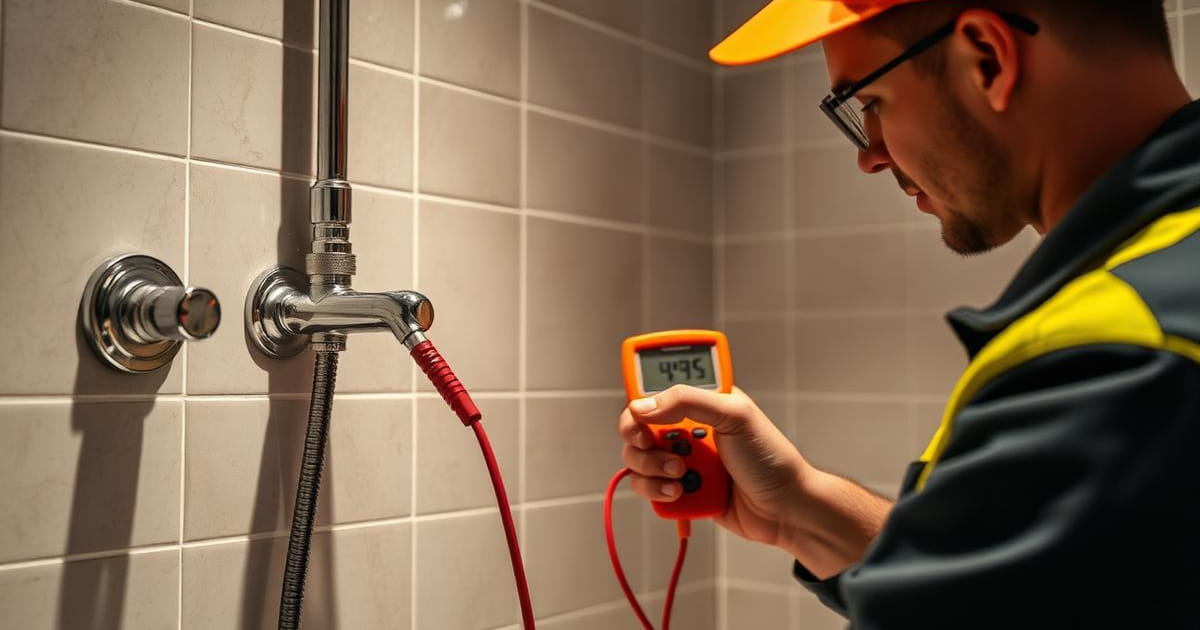
Feeling a mild tingle when touching the shower water, the tap body or the drain is neither normal nor 'just an old installation'. It means electrical current is reaching the plumbing, almost always through insulation failure in a piece of equipment — typically the water heater element. In many older buildings in Funchal, Câmara de Lobos and Santa Cruz the metal pipework ends up acting as a conductor. This article explains how it is diagnosed and how it is eliminated for good. Golden rule: until it is fixed, switch off the water heater breaker at the board and do not use the shower.
⚠️ Warning Signs and Immediate Safety
1) Tingling in hands or feet when touching the water, the tap or the shower tray — stronger with wet feet. 2) A sensation that grows while the cylinder is heating and vanishes when it is switched off. 3) Small sparks or crackles when touching metal parts in the bathroom. 4) An RCD tripping for no apparent reason, especially after long showers. 5) Immediate action: switch off the water heater breaker at the consumer unit and do not use the bathroom until it has been diagnosed. 6) If the tingling persists with the heater off, the source may be another appliance or the building installation — switch off the main RCD and call for urgent technical support. 7) Never 'test' with your hand and never attempt repairs with the circuit live.
🧪 Why It Happens
1) Failed element: the cylinder element loses insulation and injects current straight into the stored water, which carries it through the whole system. 2) A consumed magnesium anode and limescale over the element accelerate that degradation — very common with hard Madeira water. 3) Washing machines, circulation pumps and electric showers with degraded insulation can inject current by the same route. 4) No equipotential bonding: in older installations the metal pipework was never bonded to earth, leaving it at a floating potential. 5) A poor or missing building earth: with no path to discharge, current looks for the human body. 6) Mixed installations (copper, galvanised steel, brass) with parasitic galvanic currents make it worse. 7) In apartment blocks a fault in one unit can appear in another through shared metal risers.
🛠️ Step-by-Step Diagnosis
1) Cut power to the cylinder at the board and check whether the tingling stops — isolating the prime suspect. 2) Measure voltage between the pipework/tap and the board earth with a multimeter; more than a few volts confirms a leak. 3) Measure element insulation with a megger between terminals and the tank body. 4) Test each appliance separately, switching circuits off one by one. 5) Check that bathroom equipotential bonding exists and is continuous, along with the building earth electrode. 6) Verify RCD operation with proper test equipment, not just the test button. 7) Document everything: in a block, the report is essential to attribute responsibility for the fault.
🎯 Definitive Technical Solution
1) Diagnose and immediately isolate the failed water heater element or the faulty appliance, replacing the element and the degraded anode — fixing the symptom without replacing the element only postpones the accident. 2) Install Equipotential Bonding (earth bonding) on the main water run, linking metal pipework, bath and structure to the protective conductor, and ensure a break with an insulating section of PEX or multilayer pipe to cut conductivity across the plumbing network. 3) Install a Dedicated High-Sensitivity RCD (10 mA) on the water heater circuit, guaranteeing automatic, instantaneous disconnection at the slightest sign of leakage into the water — far tighter than general 30 mA protection. 4) Final verification with residual voltage measurement at every water point and an RCD trip test. 5) The electrical work is carried out by a qualified electrician alongside the plumbing intervention.
🚫 What to AVOID
1) Do not keep showering 'carefully' — body resistance drops sharply with wet skin and the risk is real. 2) Do not simply switch the cylinder off and consider it closed without replacing the element and measuring insulation. 3) Do not connect wiring to a water pipe as an 'improvised earth': it is not an earth electrode and can spread the problem through the building. 4) Do not swap the RCD for a less sensitive one because 'it keeps tripping' — the trip is the warning, not the fault. 5) Do not carry out electrical work without qualification and confirmed isolation. 6) Do not ignore it because it is intermittent: insulation faults always get worse.
🧰 Prevention and Maintenance
1) Replace the cylinder sacrificial anode every 2 to 3 years, or annually on hard water. 2) Clean limescale off the element during the same visit. 3) Test the RCD button monthly. 4) In renovations always require bathroom equipotential bonding — it is mandatory and cheap when done during the works. 5) Prefer PEX or multilayer pipe on replacements: it does not conduct current. 6) In holiday rentals and lettings, include electrical and plumbing checks in a documented annual maintenance plan.
FAQ
Can I shower if the tingling is very mild?
No. How mild it feels depends on footwear, floor moisture and skin condition, not on how serious the leak is. The same fault that tingles today can, with a more degraded element or a wet body on a metal tray, deliver a dangerous shock. Switch off the water heater breaker at the board and do not use the shower until it has been measured and repaired.
If I replace the element, is it solved for good?
It removes the source of that fault, but it is only safe if the protections are right. Without equipotential bonding and a suitable RCD, a future insulation failure — in another appliance or another flat — will put current back into the water. That is why the correct intervention combines all three parts: repair the source, bond with an insulating section and fit the dedicated 10 mA RCD.
Feeling shocks in the shower water? Switch off the heater and talk to us now.
We diagnose tingling water and current leaking through the pipework in Funchal, Câmara de Lobos, Caniço, Santa Cruz, Machico, Ribeira Brava, Ponta do Sol, Calheta, Santana, São Vicente and Porto Moniz.