Drain Unblocking: High Pressure Jetting vs. Mechanical Auger
When a drain blocks, there are two families of professional solution: mechanical, with a rotating auger (the familiar snake), and hydrodynamic, with high pressure jetting. They are not competitors — they are tools with different physics. The auger pierces, cuts and drags whatever is blocking the section; jetting washes the inner wall of the pipe and restores its original diameter. Choosing badly means clearing the drain today and blocking again within weeks, or worse, damaging old pipework. This article explains when to use each method, how they combine, and what you can demand from a job done properly.
🌀 How the Mechanical Auger Works
1) A flexible steel cable is fed into the pipe and driven by a rotating machine with controlled speed and direction. 2) A head is fitted at the tip — bulb, spear, blade or root cutter — chosen according to the blockage. 3) Rotation lets it pass bends and pierce plugs of grease, paper, hair or debris. 4) It is the most effective solution against solid objects, compacted wipes and woody roots. 5) It works well in small diameters such as sink, basin and WC branches. 6) The limitation is clear: it opens a path through the centre but leaves the encrustation on the walls. 7) In badly degraded pipework, excessive force can worsen existing cracks.
💦 How High Pressure Jetting Works
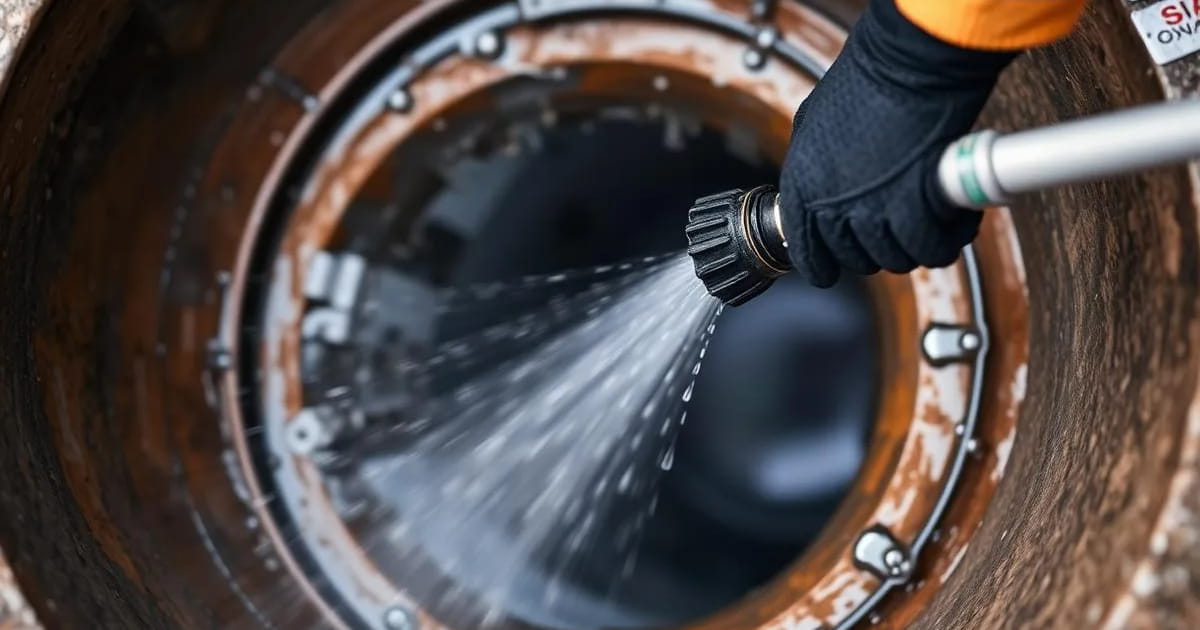
1) A high pressure pump sends water through a hose to a nozzle with calibrated jets. 2) Rear jets propel the hose into the pipe while front jets attack the blockage. 3) The washing effect removes mineralised grease, limescale, sludge and sand stuck to the wall. 4) The result is recovery of usable diameter, not just the opening of a narrow channel. 5) There are specific nozzles: washing, penetrating, rotating and hydraulic root cutters. 6) Pressure and flow are matched to the pipe material and diameter. 7) It is the method of choice for planned preventive cleaning of stacks and collectors.
⚖️ Which to Choose: Technical Criteria
1) Jammed solid object or thick roots: start with the mechanical auger and a cutting head. 2) Built-up grease, limescale and sludge along metres of pipe: jetting is clearly superior. 3) Small branches and tight bends inside the home: the auger, more manoeuvrable and faster. 4) Collectors, inspection chambers and building stacks: jetting, for reach and complete cleaning. 5) Repeat blockages at the same point: require camera inspection before repeating any method. 6) Asbestos cement, old stoneware or already cracked pipe: moderate pressure and mandatory prior diagnosis. 7) The most effective approach combines both: auger to open, jetting to clean, camera to confirm.
🛡️ Protecting PVC and Older Materials
1) Sound PVC drainage handles jetting well with suitable pressure and nozzle. 2) Damage occurs when excessive pressure is used on pipe that is already cracked, badly bedded or with loose joints. 3) Aggressive rotating nozzles should be avoided on thin walls and small diameter pipework. 4) In asbestos cement and old stoneware the risk lies in degraded joints and already weakened material. 5) A misused auger also causes damage: forcing a jammed rotation can break fittings and traps. 6) The safest step is always to inspect first: the camera shows material, condition and location of the problem. 7) A correct job ends with a flow check and a record of the pipe's internal condition.
🍳 Mineralised Grease: The Silent Enemy
1) Kitchen grease cools inside the pipe, sticks to the wall and hardens with the calcium in hard water. 2) The result is a rigid crust that progressively reduces the pipe's usable section. 3) The auger passes through that crust but leaves it in place — the blockage returns easily. 4) Jetting lifts and carries the deposit away, restoring diameter and original flow. 5) In restaurants and holiday lets, scheduled cleaning avoids shutdowns in full operation. 6) Grease traps and clean inspection chambers are an essential part of prevention. 7) Never pour cooking oil down the sink: it is the number one cause of these blockages.
📋 Prevention and Planned Maintenance in Madeira
1) In apartment buildings, preventive stack cleaning avoids cascade blockages on lower floors. 2) Filter strainers in showers and sinks drastically reduce hair and debris entering the branch. 3) Accessible, properly covered inspection chambers make any future work easier. 4) Records of previous work help identify chronic points in the network. 5) In hard water areas the cleaning interval should be shorter because of limescale. 6) Camera inspection after cleaning documents the condition and anticipates needed repairs. 7) Slow or blocked drain? Message us on WhatsApp and we will use the right method.
FAQ
Does high pressure jetting damage PVC pipes?
With suitable pressure and nozzle, no. The risk exists in pipework that is already cracked, badly bedded or with degraded joints, which is why prior camera inspection is always recommended.
Why does the drain block again after using an auger?
Because the auger opens a path through the centre of the blockage but leaves the grease and limescale crust on the pipe wall. Without jet washing, the section closes again within weeks.
What is the best method for roots inside the collector?
Mechanical cutting with a dedicated head, followed by jetting to flush the debris. Afterwards it is essential to locate the root entry point by camera and repair it.
Do supermarket chemicals work?
Rarely. They may temporarily clear light blockages but attack traps, seals and metals and do not remove mineralised grease. In older pipework the risk clearly outweighs the benefit.
Slow or blocked drain? Message us on WhatsApp and we will use the right method.
We work in Funchal, Câmara de Lobos, Caniço, Santa Cruz, Machico, Ribeira Brava, Ponta do Sol, Calheta, Santana, São Vicente and across the whole island of Madeira.