Copper Pinhole Leaks: What Pitting Corrosion Is and How to Fix It
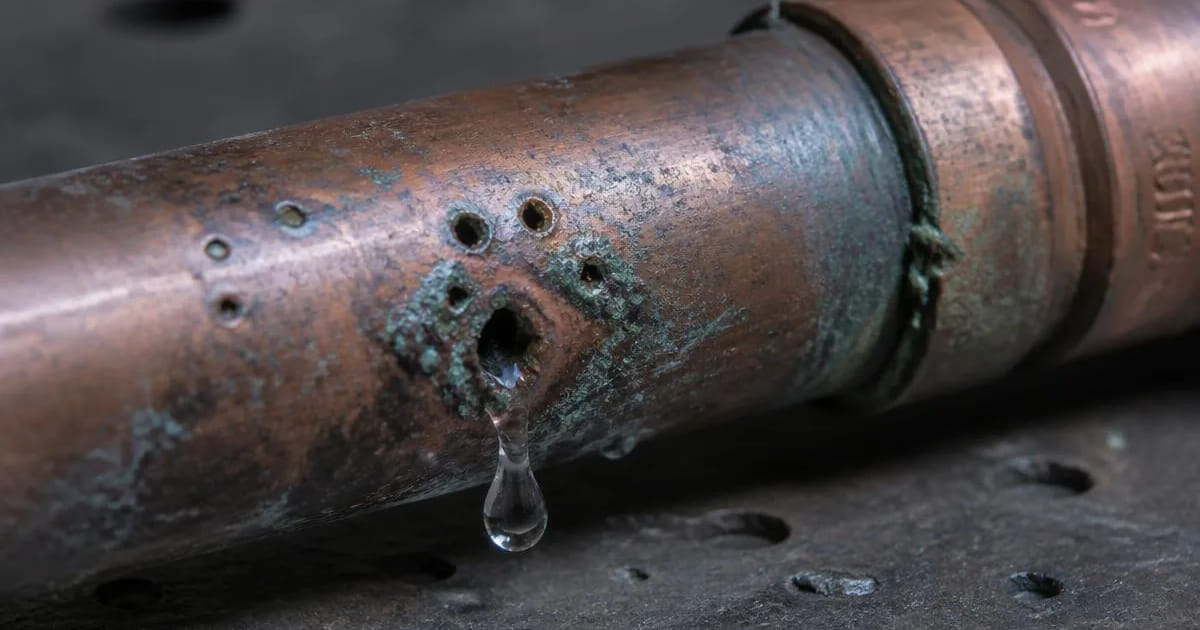
Some leaks never announce themselves with lost pressure or spraying water: they begin as a faint damp patch on the plaster, a tile that sounds hollow, or a persistent musty smell in a wall that should be dry. When the finish is opened, you find a copper pipe that looks perfectly healthy — bright, undeformed — with one or more tiny holes the size of a needle prick, ringed by a green crown of verdigris. That is the classic signature of pitting corrosion: an extremely localised chemical attack that punches through the pipe wall at a single point while leaving the rest of the metal untouched. At Canalizador Funchal® we see this pattern above all in properties supplied with soft, slightly acidic water, typical of several springs on the island.
💧 The Symptom: Micro-Leaks That Appear Out of Nowhere
Pitting develops slowly and deceptively. 1) A damp patch grows gradually, often days or weeks before any visible dripping. 2) Paint blisters or plaster crumbles at an isolated spot with no relation to a tap or joint. 3) Greenish-blue stains or drips appear on the pipe, the ceiling below or the skirting — verdigris carried by the water. 4) The meter keeps turning very slowly with every outlet closed. 5) System pressure stays practically normal, because the lost flow is minimal. 6) There is no noise, or just a whisper audible only at night. 7) When one leak is repaired, another appears a few metres away months later — proof the problem is the run, not the point.
⚗️ The Chemical Cause: Soft, Slightly Acidic Water
Copper is durable, but it depends on a stable protective film inside. 1) Under normal conditions a thin layer of oxides and carbonates passivates the surface and halts corrosion. 2) Very soft water, poor in calcium and magnesium, does not supply the minerals needed to consolidate that film. 3) If the pH is also slightly acidic, the layer dissolves at isolated spots, exposing bare metal. 4) An electrochemical cell then forms at that micro-spot: a tiny anodic area surrounded by a vast cathodic area. 5) The whole corrosion current concentrates in the pit, so perforation is fast and deep instead of uniform. 6) Aggravating factors include excess soldering flux, cutting burrs, high flow velocities and abrasive particles. 7) In Madeira, many hillside homes are supplied from springs and boreholes with naturally soft, slightly acidic water — exactly the profile that favours pitting.
⚠️ The Hidden Danger: Sound Outside, Perforated Inside
That contrast is what makes pitting so expensive when ignored. 1) The pipe looks externally healthy, so a superficial visual inspection detects nothing. 2) Water loss is so small it triggers no consumption alarm and no pressure drop. 3) The infiltration is slow and continuous, saturating plasterboard, concrete and insulation for months. 4) Permanent damp brings mould, efflorescence, loose tiles and rotting timber and skirting. 5) In underfloor heating or embedded runs, the damage spreads far beyond the leak itself. 6) Pitting is rarely a one-off: where a run has the right chemistry, multiple pits form along the same pipe. 7) Patching a single hole with a clamp or solder gives a false sense of resolution — the corrosion is still active centimetres away.
🔎 Diagnosis: Pinpointing the Micro-Leak Without Demolition
The priority is finding the exact spot before touching the wall. 1) We run a pressure-tightness test with a gauge, isolating circuits to confirm the loss and estimate its rate. 2) We use an electroacoustic ground microphone to capture the characteristic hiss of a micro-leak under finishes. 3) We add infrared thermography, which reveals the moisture pattern and the pipe route. 4) We map the genuinely affected area with a contact moisture meter. 5) Where needed we use tracer gas (hydrogen/nitrogen) for very small, difficult leaks. 6) We confirm pipe material and age and check for mixed copper-iron joints that worsen the process. 7) Only then do we define the minimum opening — usually a window a few centimetres wide, not a demolished wall.
🛠️ Professional Technical Fix: Cut, Transition, Replace
A correct repair removes the cause, not just the symptom. 1) We cut out the affected section with a safety margin on both sides of the pit, removing already compromised metal. 2) We inspect the inside of the removed pipe: if there are multiple pits, we extend the replacement to the whole run. 3) We fit appropriate transition unions (press or dielectric) between the existing copper and the new material. 4) We replace with PEX-AL-PEX multilayer pipe, immune to pitting and galvanic corrosion and free of hot soldering inside the wall. 5) We make certified press connections and pressure-test before closing any wall. 6) We lower flow velocity with correct diameters and, if needed, fit a pressure-reducing valve. 7) We dry the area before restoring plaster, tiling and paint, with photographic records of the new route for future work.
🚫 Mistakes to Avoid
These decisions are what bring the leak back. 1) Do not seal the hole with epoxy, self-amalgamating tape or a clamp and consider the matter closed. 2) Do not solder onto already pitted metal: the wall is thin and the solder opens a new leak alongside. 3) Do not join new copper directly to galvanised iron without a dielectric union, adding galvanic corrosion. 4) Do not leave excess flux in soldered joints — a frequent cause of pitting in the first years. 5) Do not oversize pumps or run above 4 bar without a reducing valve. 6) Do not ignore recurring green stains: they are the chemical warning before an open leak. 7) Do not close the wall without a documented pressure test.
🗓️ Prevention in Madeira: Springs, Pressure and Maintenance
The local context calls for specific care. 1) On private supplies (spring, well, borehole) we recommend water analysis with pH and hardness readings. 2) Where water is acidic, correcting pH upstream protects the entire existing copper installation. 3) A particle filter at the inlet prevents the internal erosion that destroys the passive film. 4) A pressure-reducing valve keeps pressures stable and velocities within recommended limits. 5) On new builds and refurbishments we choose multilayer over embedded copper whenever the route allows. 6) In holiday homes and short-term rentals we flush every outlet after long closed periods. 7) Our maintenance plans include periodic tightness testing, catching minimal losses before the building fabric is damaged.
FAQ
Can a pinhole be repaired without replacing the pipe?
It can be sealed temporarily to stop the water, but that is not a solution. Pitting means the chemistry of that run favours corrosion, so new pits will appear. The definitive repair is to cut out and replace the affected section.
Why does only one pipe in the house have holes?
Because pitting depends on very local factors: water velocity in that run, soldering flux residue, cutting burrs and temperature. A hot-water run with fast circulation is far more vulnerable than a rarely used branch.
Do green stains on the wall always mean a leak?
Almost always. Verdigris is dissolved copper carried by water; if it is showing on the outside, water is passing through the pipe wall even if you cannot see drops yet.
Is multilayer really better than new copper?
For embedded runs, yes. Multilayer suffers neither pitting nor galvanic corrosion, is immune to aggressive soft water and is installed by pressing, with no flame or flux inside the wall.
Damp patches or verdigris on a wall? Talk to us on WhatsApp.
We work in Funchal, Câmara de Lobos, Caniço, Santa Cruz, Machico, Ribeira Brava, Ponta do Sol, Calheta, Santana, São Vicente and across Madeira island.