Central Thermostatic Mixing Valves: Hot Water Safety and Temperature Control
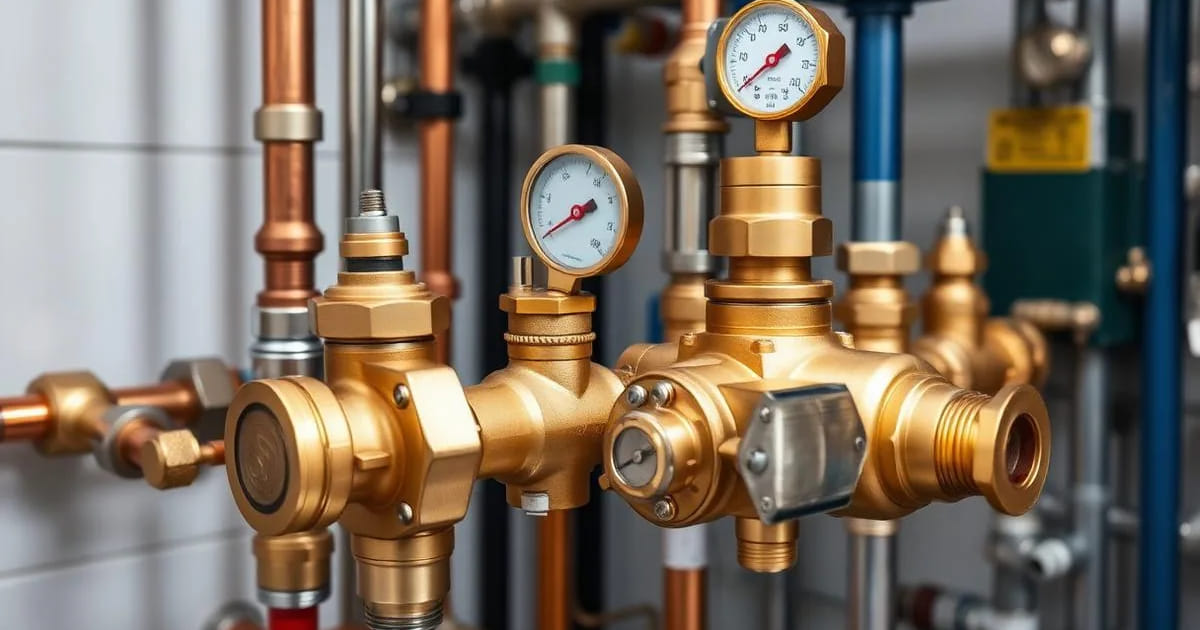
There is a contradiction at the heart of every domestic hot water installation: for hygiene reasons water should be stored above 60 °C, yet for safety reasons it should never reach a tap above 45 °C. The central thermostatic mixing valve resolves precisely that conflict. Fitted at the cylinder outlet or on the distribution manifold, it blends hot and cold water and delivers a constant, safe temperature to the network regardless of what happens inside the store. In houses, apartment blocks and above all in holiday lets across Madeira, it is the component that separates a modern installation from a risky one.
🔥 The Conflict Between Hygiene and Safety
1) Legionella multiplies easily between 20 °C and 45 °C inside cylinders and dead legs. 2) Water should therefore be stored at 60 °C or above, a temperature the bacterium does not survive. 3) But water at 60 °C causes second-degree skin burns within seconds. 4) Children, older people and those with reduced mobility are the highest-risk groups. 5) Turning the cylinder thermostat down solves scalding and creates the hygiene problem. 6) A central mixing valve gives both: store hot, distribute at a safe temperature. 7) It is the only technically coherent answer for installations with stored hot water.
⚙️ How Centralised Control Works
1) The valve body takes two inlets: hot water from the cylinder and cold from the mains. 2) A wax or bimetallic thermostatic element expands and contracts with outlet temperature. 3) That movement shifts a shuttle which continuously adjusts the blend ratio. 4) The response is mechanical and immediate, with no electricity or electronics involved. 5) The setpoint is dialled on a graduated head and locked to prevent accidental changes. 6) Models with a safety function shut off flow if cold water fails, preventing 60 °C discharge. 7) With the correct Kv rating selected, temperature stays stable across the useful flow range.
🚿 Flow Stabilisation and Real Comfort
1) Without a central valve, every tap opened elsewhere changes the shower temperature. 2) With centralised control, the network receives pre-stabilised water and swings are far smaller. 3) Users stop constantly fiddling with the shower mixer hunting for balance. 4) In installations with several simultaneous outlets, flow sizing is decisive. 5) An undersized valve throttles flow and turns the shower into a trickle. 6) An oversized valve loses accuracy at very low flow, such as a single basin tap. 7) In multi-apartment buildings, a central valve is combined with zone valves per riser.
⚡ Energy Efficiency with Heat Pumps and Heaters
1) With a central valve, the cylinder can run hot and deliver far more usable litres. 2) A 100 litre cylinder at 65 °C provides much more shower water than at 45 °C. 3) That allows a smaller store for the same real household demand. 4) With heat pumps, it stops the unit switching to the electric element so often. 5) With solar thermal, it protects the network when the store overheats on sunny days. 6) With modulating instantaneous heaters, it damps abrupt outlet temperature swings. 7) The result combines safety, more hot water autonomy and less wasted energy.
🦠 Compatibility with Preventive Thermal Shock
1) Thermal shock means temporarily raising cylinder temperature for disinfection. 2) With a central valve fitted, the network stays protected during the procedure. 3) Some models offer a bypass or sanitisation function to pass high temperature in a controlled way. 4) Without it, thermal shock should be run by a technician with outlets supervised. 5) In holiday lets and homes closed for weeks, the procedure should precede new occupancy. 6) Flushing dead legs is essential: stagnant water is the main risk focus. 7) Log every disinfection with date, temperature and duration — it is evidence of good practice.
🛠️ Installation, Maintenance and Best Practice in Madeira
1) The valve is fitted at the cylinder outlet, with isolating valves and strainers on both inlets. 2) Check valves on the inlets prevent hot water crossing into the cold network. 3) Always leave access for inspection: a valve buried inside a wall is a classic mistake. 4) Water hardness in Madeira scales the thermostatic element over time. 5) An annual check of outlet temperature with a calibrated digital thermometer is recommended. 6) A drift over 2 °C from setpoint means the cartridge needs cleaning or replacement. 7) Want central temperature control? Message us on WhatsApp and we will size the solution.
FAQ
What temperature should the central mixing valve be set to?
Typically 43 °C to 45 °C for showers and basins, with the cylinder kept at 60 °C or above. That gives scald protection without compromising Legionella control.
Does it replace thermostatic shower mixers?
It complements rather than replaces them. The central valve protects the whole network and stabilises inlet temperature; the shower mixer still provides local fine tuning.
Can it be used with a heat pump or solar thermal?
Yes, and it is particularly recommended. In those systems store temperature varies widely, and the central valve ensures the network always receives the same safe temperature.
Does it need maintenance?
It needs an annual outlet temperature check and, in hard water like Madeira's, periodic cleaning or replacement of the thermostatic cartridge once drift exceeds 2 °C.
Want central temperature control and anti-scald protection? Message us on WhatsApp and we will size the right solution.
We work in Funchal, Câmara de Lobos, Caniço, Santa Cruz, Machico, Ribeira Brava, Ponta do Sol, Calheta, Santana, São Vicente and across the whole island of Madeira.