Cavitation Wear in Pressure Reducing Valves (PRV): Whistling and Pressure Oscillation in the Network
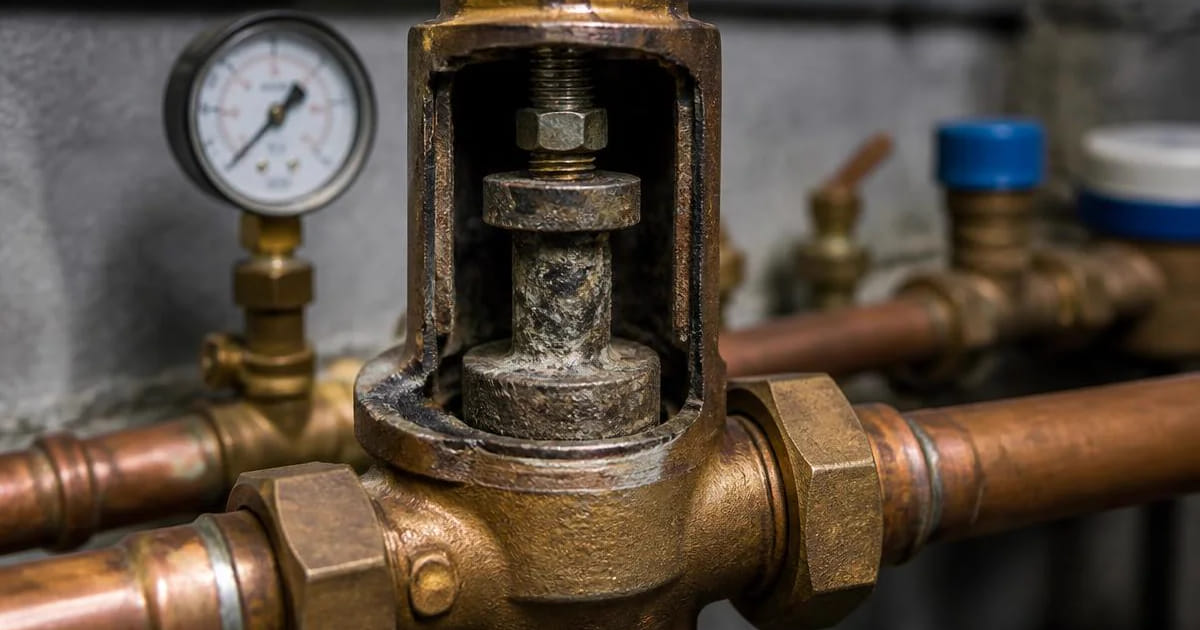
It is one of the hardest faults to trace in domestic plumbing: water pressure begins to oscillate for no apparent reason, toilets fill irregularly, taps 'breathe', and worst of all, a continuous high-pitched whistle seems to come from the meter cabinet or main inlet. The problem often only appears at night, when street consumption drops and municipal pressure rises. The culprit is not the external network nor a faulty pump: it is the pressure reducing valve (PRV) being destroyed from the inside by a hydraulic phenomenon called cavitation. At Canalizador Funchal® we see this case with increasing frequency in buildings in Funchal, Câmara de Lobos and Caniço, where network pressure can be high and old reducers can no longer handle the differential. The good news is that, with the right model and correct installation, the problem disappears forever.
🚰 Classic Symptom: Oscillation and Whistling Without Visible Leak
The signature of this fault is the absence of visible leaks combined with strange pressure behaviour. 1) Pressure in the house fluctuates during the day, strong in the morning and weak at night, or vice versa. 2) A sharp, continuous whistle is heard near the meter or main inlet, especially when someone opens a tap. 3) Toilets fill slowly or with 'hiccups' of air. 4) The water heater or storage heater switches off by itself because the minimum flow is unstable. 5) Water from taps comes out in pulses, with varying intensity. 6) The pressure gauge, if present, vibrates slightly and the needle oscillates instead of staying steady. 7) There are no damp stains, the meter does not over-run and there is no sewer smell. Everything points to a mechanical component failing at the house inlet, not a leak in the plumbing.
⚙️ The Cavitation Phenomenon: Micro Vacuum Bubbles Eroding Metal
Cavitation is a physical phenomenon that occurs when water passes through a restriction at very high speed. 1) In the PRV, water enters at high municipal pressure and is forced through the small gap between the piston and the seat. 2) Local velocity increases dramatically and static pressure drops below the water's vaporisation point. 3) Micro-bubbles of vapour and vacuum form at the edge of the obturator. 4) Further downstream, where the section widens, pressure rises again and these bubbles collapse violently. 5) Each collapse generates a microscopic shock wave that strikes the seat, piston and internal walls. 6) Over months or years, this continuous bombardment tears away metal particles, creating a spongy, eroded surface. 7) The PRV loses its regulating ability: the piston vibrates, pressure oscillates and the whistle is the sound of the micro-bubbles collapsing and the mechanical vibration.
💥 Network Damage: Uncontrolled Night-Time Spikes Can Burst Pipes
A PRV with advanced cavitation stops being a protector and becomes a hazard. 1) The seat becomes irregular and porous, so the piston cannot close hermetically. 2) When network pressure rises — which often happens at night — the valve lets through uncontrolled spikes. 3) These spikes reach taps, toilets, water heaters and internal pipes designed to work at much lower pressures. 4) O-rings and crimped unions suffer fatigue cycles and begin to drip. 5) Rubber flexibles on toilets and basins swell and can burst. 6) The water hammer caused by quickly opening and closing taps is amplified by the unstable pressure. 7) In extreme cases, poorly sized PVC or multilayer collectors can crack, causing serious flooding while the family sleeps.
🔍 Differential Diagnosis: PRV vs. Network vs. Pump
Before replacing the PRV, it is essential to confirm that it is really the source. 1) We measure static pressure at a reference tap and compare it with pressure upstream of the reducer — the differential reveals the wear. 2) We check whether the whistle stops when we partially close the main stopcock: if it stops, the source is the PRV; if it continues, it may be the external network. 3) We test dynamic pressure with several outlets open at once: a healthy PRV keeps the outlet pressure stable. 4) We visually inspect the PRV: a spongy-looking seat, an eroded piston or a body with loose metallic deposits. 5) We compare the installed model with the actual municipal pressure — many domestic PRVs are not sized for differentials above 4 or 5 bar. 6) We check whether there is a relief valve upstream and whether it is operational. 7) We assess the age of the component: after 8 to 12 years in high-pressure zones, preventive replacement is recommended.
🛠️ Professional Solution: Stainless Steel PRV and Staged Reduction
Correction requires choosing the right equipment for the actual pressure differential. 1) We measure network pressure at peak and off-peak hours to calculate the maximum differential. 2) If the differential exceeds 4 bar, we install an industrial PRV with a stainless steel seat and piston, resistant to cavitation. 3) We prefer models with a pressure compensation chamber (pilot-operated), which respond without oscillations even when consumption varies. 4) For extreme differentials — for example, network at 8 bar and need for outlet at 2.5 bar — we opt for staged reduction: two PRVs in series, each absorbing half the differential. 5) We place pressure gauges upstream and downstream for continuous monitoring. 6) We install a relief valve or anti-water-hammer device when the pipe length justifies it. 7) We check tightness and set the outlet pressure between 2.5 and 3 bar, ideal for domestic installations in Madeira.
⚠️ Mistakes to Avoid
Do not replace a damaged PRV with the same model without understanding why it failed — the cycle repeats. 1) Do not install a low-cost domestic PRV on networks with more than 4 bar differential. 2) Do not tighten the adjustment screw to the maximum to compensate for lost capacity: this accelerates destruction. 3) Do not ignore the initial whistle — it is the first warning of active cavitation. 4) Do not forget the particle filter upstream: sediment accelerates seat wear. 5) Do not combine PRVs with pressure pumps without a hydraulic study — the two can conflict. 6) Do not leave the valve unmaintained for more than 5 years in high-pressure zones. 7) Do not install the PRV without access space for future replacement and gauge reading.
🗓️ Preventive Maintenance and Monitoring
A properly sized and installed PRV lasts many years, but needs monitoring. 1) Annual check of outlet pressure with a calibrated gauge. 2) Visual inspection every 2 years: signs of corrosion, body leaks or abnormal vibration. 3) Preventive replacement every 8 to 12 years in high-pressure zones in Funchal, Câmara de Lobos and Caniço. 4) Cleaning of the upstream inlet filter every 6 months in sediment-prone areas. 5) Checking the relief valve and anti-water-hammer device. 6) Advice to the condominium or owner when municipal pressure repeatedly exceeds 6 bar. 7) Photographic record of the installation for long-term follow-up.
FAQ
Why is the PRV whistle louder at night?
At night, consumption in the municipal network drops and pressure rises. With a greater differential, cavitation intensifies and the whistle becomes more audible. It is also during this time that pressure spikes can cause the most damage.
Can a damaged PRV increase the water bill?
Not by itself. The PRV does not let water escape from the pipe. However, the pressure spikes it lets through can force toilets, taps and flexibles to drip, causing leaks that increase consumption.
What is the ideal outlet pressure for a domestic PRV?
For domestic installations in Madeira, the regulated outlet pressure should be between 2.5 and 3 bar. Higher values accelerate wear on taps and toilets; lower values compromise comfort.
How much does it cost to replace a PRV with a cavitation-resistant model?
The cost depends on access, pressure differential and whether staged reduction is needed. On average, replacing it with a stainless steel PRV with a compensation chamber ranges from €180 to €350, including labour and gauges.
Need help now? Fast response on WhatsApp.
We work in Funchal, Câmara de Lobos, Caniço, Santa Cruz, Machico, Ribeira Brava, Ponta do Sol, Calheta, Santana, São Vicente and across Madeira Island.