Borehole and Well Water Treatment: Filters, UV and Chlorinators
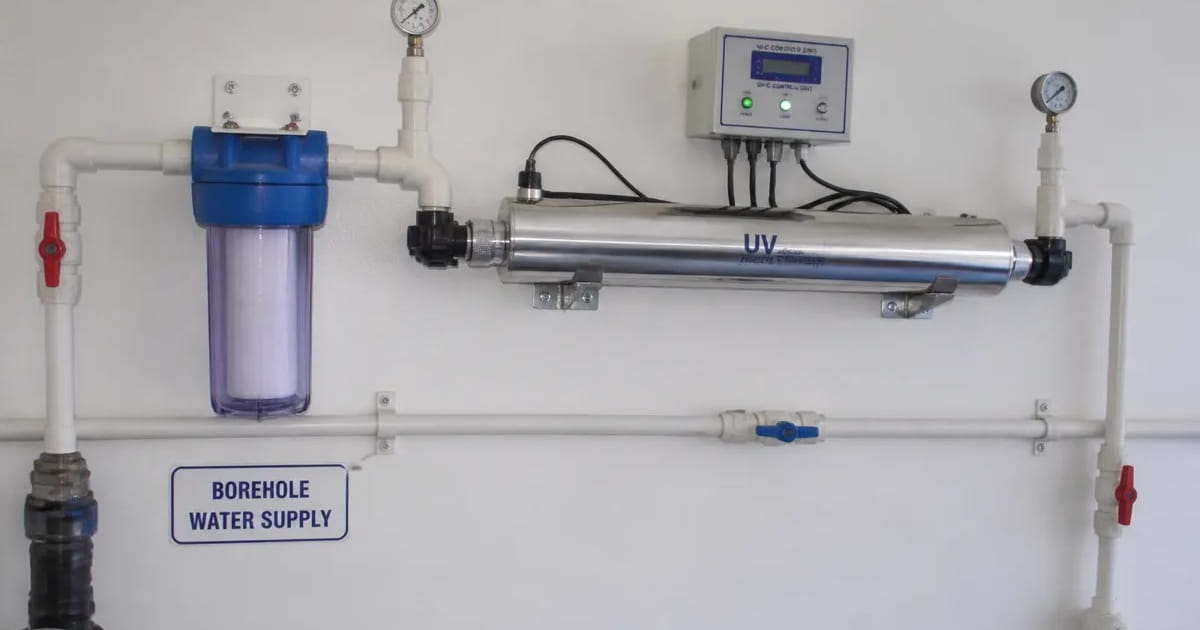
Madeira has many houses, farms and rentals served by a private water source: a borehole, a well, a spring or a levada. The water arrives in abundance and with no bill, but it does not arrive drinkable. Sand, clay, organic matter, iron, manganese and microbiological contamination are normal in untreated sources, especially after heavy rain. Making water potable is not about buying a device: it is about assembling the correct treatment sequence, where each stage protects the next. Done in order, it works for years. Done backwards, it fails within weeks.
🔎 Start with Testing, Not with Equipment
1) No treatment solution can be sized without knowing what is in the water: test first, buy second. 2) The baseline parameters are turbidity, pH, hardness, iron and manganese, conductivity and a microbiological analysis. 3) Take the sample in a suitable container, at the tap nearest the source, following the laboratory's instructions. 4) Repeat the test in the wet season and the dry season: results in Madeira vary widely through the year. 5) Water with iron or manganese needs specific treatment before any fine filter, otherwise that filter clogs immediately. 6) Microbiological contamination confirms the need for disinfection, not just filtration. 7) Keep the reports: they document how quality evolves and justify every piece of equipment installed.
🪨 Pre-filtration: Sand, Sediment and Coarse Matter
1) The first stage is always removing coarse particles: sand, clay, leaves and mineral fragments. 2) On sandy sources, use a self-cleaning or backwash filter, purged by operating its valve. 3) Next comes a cartridge filter, usually with a transparent bowl for immediate visual inspection. 4) The recommended sequence is staged: coarser cartridge first, finer afterwards, never the fine one alone. 5) Wound-string and washable pleated cartridges serve different purposes: wound retains better, pleated lasts longer between cleanings. 6) Fit pressure gauges before and after: the pressure drop tells you when the cartridge needs changing. 7) Without this stage, everything downstream — UV, dosing, reverse osmosis — has a short life and poor performance.
☀️ UV-C Ultraviolet Sterilisation
1) A UV-C steriliser inactivates bacteria, viruses and protozoa by passing water alongside an ultraviolet lamp. 2) It changes no taste, adds no chemicals and leaves no residual: it disinfects only at the point where it is installed. 3) Effectiveness depends directly on water clarity: high turbidity blocks the radiation and disinfection fails. 4) That is why UV always goes downstream of pre-filtration, ideally with a five-micron filter immediately before it. 5) The lamp loses output over time and is replaced on an annual routine, even if it still lights up. 6) The quartz sleeve around the lamp collects limescale and must be cleaned in the same visit. 7) Because it leaves no residual, UV protects neither downstream pipework nor storage tanks: that requires a residual disinfectant.
🧪 Chlorinators and Proportional Dosing
1) Chlorination provides residual disinfectant across the whole network and in storage tanks, which UV cannot do. 2) Proportional dosing injects product according to measured flow, keeping concentration stable. 3) A typical system has a dosing pump, an injection point, a graduated tank with suction lance and a pulse-output water meter. 4) Sufficient contact time between injection and first use is essential, normally provided by a storage tank. 5) Fixed dosing without flow measurement overdoses at low demand and underdoses at high demand. 6) The product must be suitable for drinking water, stored in shade, in a bund and well ventilated. 7) Check the residual with a simple colorimetric kit: it is the only way to know the system is actually working.
🧰 Final Polishing and Special Cases
1) Very hard water benefits from a softener downstream of disinfection, to protect the water heater and mixer taps. 2) Taste, excess residual chlorine and odours are treated with an activated carbon filter at the point of use. 3) Never place activated carbon before the UV: it strips the residual and becomes a substrate for microbial growth. 4) For drinking water, an under-sink reverse osmosis unit is the usual complement, not a replacement for whole-house treatment. 5) Iron and manganese need oxidation plus a specific filter, otherwise they stain fittings and laundry and clog cartridges. 6) Storage tanks must be opaque, covered and cleaned periodically: light and dust create algae and sediment. 7) The whole installation needs isolation valves and unions so each stage can be isolated without shutting down the house.
🗓️ Planned Maintenance and Records
1) Sediment cartridges: monthly visual inspection and typical replacement every three to six months, depending on load. 2) UV-C lamp: annual replacement, with quartz sleeve cleaning in the same visit. 3) Dosing pump: quarterly check of product level, injection valve and tubing tightness. 4) Chlorine residual: monthly measurement at a point far from injection, to confirm whole-network coverage. 5) Full laboratory analysis once a year, and always after structural work on the source. 6) After heavy rain, inspect turbidity and pre-filters: that is when Madeira's private sources degrade fastest. 7) Want your borehole or well water made potable with a properly sized sequence? Message us on WhatsApp.
FAQ
My borehole water looks clean. Do I really need treatment?
Water that looks clean can carry microbiological contamination, which is invisible and odourless. Only a laboratory analysis answers that question, and in untreated sources a positive result is common, particularly after rain.
Does ultraviolet replace chlorination?
No. UV disinfects only at the point where it is fitted and leaves no residual disinfectant, so it protects neither downstream pipework nor tanks. Where there is storage or an extensive network, the two are combined.
How often should the filter cartridge be changed?
Typically every three to six months, but the right criterion is the pressure drop measured on the gauges before and after the filter. On sandy sources it can be much more frequent.
Can I connect borehole water to the same network as the mains supply?
Only with proper separation and backflow protection, so there is no cross-contamination or backfeed into the public network. This connection must be carried out and verified by a professional, never improvised.
Borehole or well water to make potable? Message us on WhatsApp.
We work in Funchal, Câmara de Lobos, Caniço, Santa Cruz, Machico, Ribeira Brava, Ponta do Sol, Calheta, Santana, São Vicente and across Madeira Island.