Bathroom Extractor Fans Without Natural Ventilation: Airflow, Humidistats and Backdraft Valves
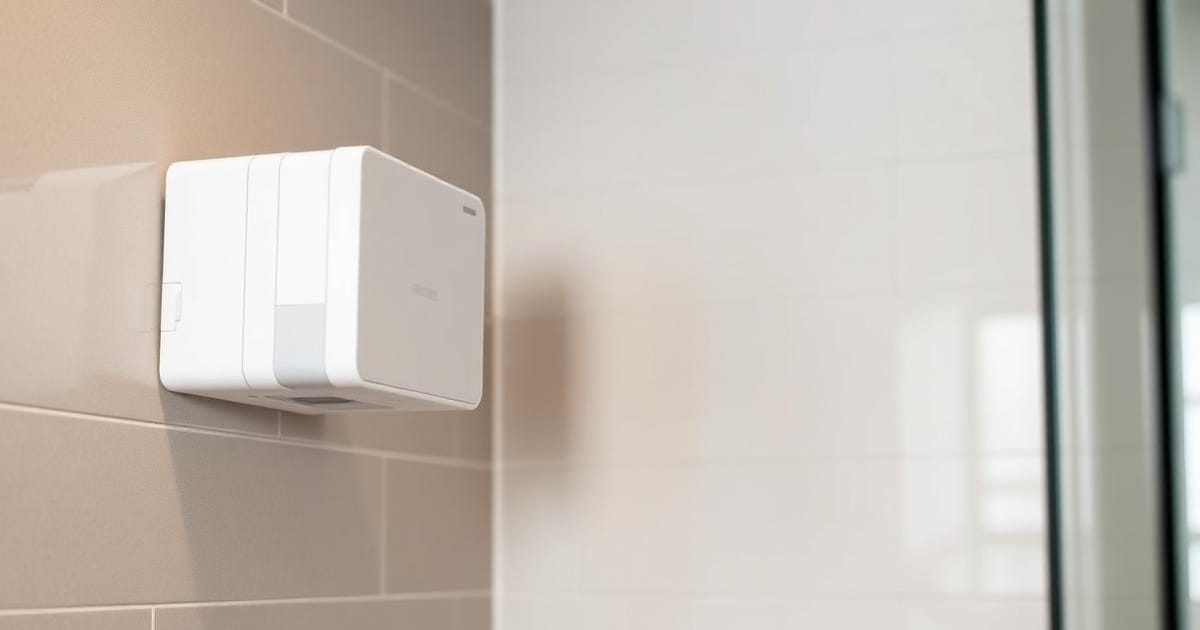
Internal, windowless bathrooms are very common in Funchal flats and in refits where space was gained at the cost of natural ventilation. In those rooms the extractor fan is the only humidity control there is: undersized, badly ducted or without backdraft protection, the result is mould in the grout, peeling paint, permanently fogged mirrors and, very often, sewer smell arriving from the shared stack. This guide explains how to size airflow properly, which automatic controls are worth the money, and what really separates S&P (Soler & Palau), Cata and Maico in practice.
📐 Correct Airflow for a Windowless Bathroom
Sizing is quick and prevents 90% of problems. 1) Calculate bathroom volume — length × width × height. 2) The reference for bathrooms is 6 to 8 air changes per hour; with heavy shower use, go to 10 to 12. 3) Example: a 2 × 1.6 × 2.5 m bathroom is 8 m³; at 10 changes that is 80 m³/h. 4) In practice a domestic fan of 90 to 110 m³/h covers most small bathrooms, provided the duct is clear. 5) Watch the declared airflow: it is measured with no ducting. With 3 to 4 metres of pipe and two bends, expect a significant loss. 6) Check there is an air inlet — a 10 to 15 mm gap under the door, or an inlet grille. Without incoming air the fan spins but does not extract. 7) Where a tumble dryer is present or showers are long, consider higher airflow or continuous low-speed running.
💧 Humidistat, Timer and Presence Detection
Automatic controls are what make the fan run when needed rather than when someone remembers. 1) Humidistat: switches on automatically when relative humidity passes a set threshold (typically 60% to 75%) and stops when it normalises. Best solution against mould. 2) Run-on timer: keeps the fan going 5 to 20 minutes after the light goes off, exactly when vapour is still airborne. 3) Presence detection: useful in cloakrooms and holiday lets, where guests have no fixed habits. 4) Continuous low-flow extraction with automatic boost is the most effective solution in very humid internal bathrooms, at minimal consumption. 5) Wiring: humidistats and timers need a permanent live supply as well as the lighting switch — if the bathroom only has the light cable, plan for this during the works. 6) Set the humidistat above the home's average ambient humidity, or the unit will run non-stop on rainy days.
🛡️ Backdraft Valves and the Building's Shared Stack
This is the issue that causes us most callouts in flats. 1) In apartment buildings several bathrooms discharge into the same ventilation stack. 2) Without a backdraft valve, when the neighbour's fan runs, air (and odour) can enter through your bathroom. 3) A shutter valve opens only in the extraction direction and closes by gravity when the motor stops. 4) Many fans include built-in flaps, but they are often flimsy; on a shared stack we prefer a dedicated valve in the duct. 5) The valve must be accessible for cleaning: dust and grease glue the flaps and can jam them open. 6) If the smell appears only at certain times of day, that clearly indicates stack backflow rather than a dry trap. 7) Never discharge bathroom extraction into false ceilings, stairwells or garages: besides often being unlawful, it creates structural mould and building-management disputes.
🏷️ Brands: S&P (Soler & Palau), Cata and Maico
Our field assessment. 1) S&P (Soler & Palau): a Spanish reference widely available in Portugal; ranges with easy-to-set humidistat and timer, reliable bearings and accessible spares. This is the brand we fit most often. 2) Cata: a good balance of price, airflow and noise, with compact models ideal for small bathrooms and short ducts; the higher range has quieter motors. 3) Maico: German engineering, longer-lasting units, low-consumption EC motors and stable performance even against duct back-pressure — the right choice for long runs. 4) With any brand, look for: bearing motors (not bushings), a body that opens for cleaning, the right protection class for wet zones and noise below 35 dB(A) for bathrooms next to bedrooms. 5) Avoid very cheap unbranded fans: they lose airflow within months and cannot be repaired.
🔧 Installation: Mistakes We See Every Week
Installation decides the outcome. 1) Over-long corrugated flexible ducting with tight bends and sagging sections — the most common cause of weak extraction. 2) Diameter reduced below the appliance outlet (for example 100 mm down to 80 mm) to fit a false ceiling. 3) No air inlet: fully sealed door with no undercut. 4) Fan installed far from the shower, when it should be as close as possible to the vapour source. 5) No backdraft valve on a shared stack. 6) Electrical supply without adequate protection for a wet zone, or without a permanent live for the timer. 7) Fine-mesh external grille that silts up with dust and drastically cuts airflow. 8) Each of these is fixable without major works — the hard part is diagnosing without measuring.
✅ Checklist Before Buying and After Fitting
Before buying: 1) Measure the volume and define the airflow needed. 2) Confirm the real duct diameter and length. 3) Choose the control type (humidistat, timer or continuous) and provide the matching wiring. 4) Check whether the stack is shared and plan the backdraft valve. After fitting: 5) Test with a sheet of paper held against the grille — it should stay stuck while the unit runs. 6) Check the mirror clears within a few minutes after a shower. 7) Clean grille and flaps every 6 months. 8) If mould persists despite correct extraction, assess leaks or interstitial condensation, which are different problems. Need help? Send photos of the bathroom and duct on WhatsApp.
FAQ
What airflow should a small bathroom fan have?
Calculate the volume and apply 8 to 12 air changes per hour. For an 8 m³ bathroom that means 65 to 95 m³/h — a domestic fan of 90 to 110 m³/h works, provided the duct is short and keeps its diameter.
Is a humidistat fan worth it?
Yes, especially in windowless internal bathrooms. The humidistat starts the fan when humidity rises and stops it when it normalises, preventing mould without relying on anyone remembering to switch the ventilation on.
Why do I smell sewer odour from the ventilation grille?
Almost always because there is no backdraft valve on the duct connected to the shared stack: when the neighbour's fan runs, air comes back into your bathroom. Fitting a dedicated shutter valve solves it.
The fan runs but the mirror stays fogged. Why?
Usually a lack of incoming air or a throttled duct. With no undercut door gap or inlet grille the fan spins without renewing air. We check and correct both points in the same visit.
Damp or smells in the bathroom? Contact us on WhatsApp.
We work in Funchal, Câmara de Lobos, Caniço, Santa Cruz, Machico, Ribeira Brava, Ponta do Sol, Calheta, Santana, São Vicente and across Madeira Island.