Bathroom Ceiling Mould and Condensation: Why Bleach Fails and How to Fix It
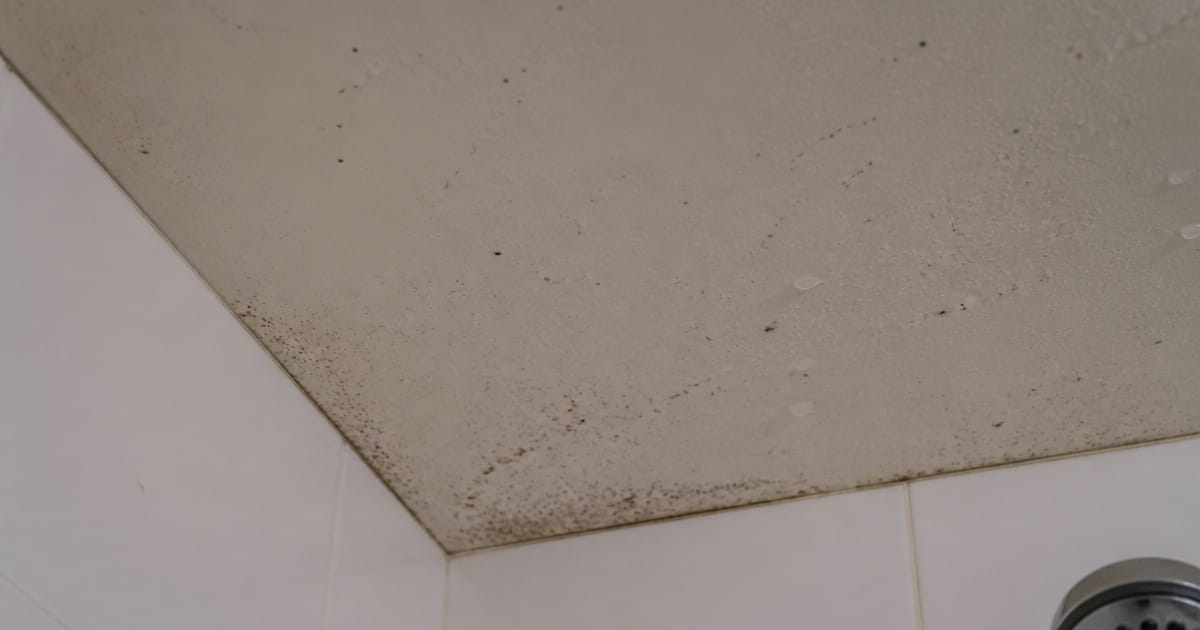
Everyone has done the same thing: stand on a stool, scrub the bathroom ceiling with bleach and enjoy the restored white. Three months later the dark patches return to exactly the same spots. Bleach decolours the fungal pigment but changes nothing about why it grows there: a shower produces more vapour than the room can remove in time. While the balance between vapour produced and vapour extracted is wrong, mould is only a matter of time. Fixing it is simple, verifiable engineering.
🚿 The Physics of Post-Shower Condensation
1) An 8-minute shower typically releases 0.5 to 1 litre of water as vapour. 2) Bathroom RH climbs quickly above 90%, often to saturation. 3) The ceiling is the coldest surface in the room, especially under a roof slab or on the top floor. 4) Vapour rises by convection, meets that cold surface and condenses into micro-droplets. 5) Without effective extraction, that water sits in the paint for hours. 6) Low-permeability plastic paints, dust and soap residue provide exactly the substrate the fungus needs.
🧪 Why Bleach Fails
1) Bleach acts on the surface and decolours pigment, giving an illusion of cleanliness. 2) Mycelium inside the pores of paint and plaster survives and recolonises. 3) The water in the solution itself adds moisture to a surface you want dry. 4) Chlorine can degrade paints and silicones, creating more roughness for the fungus to grip. 5) Mixing bleach with acidic or ammonia products releases dangerous gases in a small enclosed space. 6) Treating helps, but only after extraction is corrected — otherwise it is an endless cycle.
🔧 The Extraction Failures We Find in Practice
1) Fan wired to the light switch: it runs 5 minutes when it needs 20 to 30 minutes after the shower. 2) Crushed flexible duct, tight bends or several extra metres of run, halving the flow rate. 3) Discharge into a false ceiling or shutter box: the vapour merely moves somewhere else. 4) External grille blocked by mesh, paint or nests, with total loss of flow. 5) No air inlet: with no door gap or transfer grille, the fan cannot move any air. 6) No backdraught damper on a shared riser, so neighbours' air returns into the room.
📏 Measure Before Buying Equipment
1) Measure the bathroom volume and set the flow needed: 60 to 90 m³/h intermittent extract. 2) Confirm real flow at the grille with an anemometer — do not trust the box label. 3) Log RH and temperature before, during and 30 minutes after the shower with a hygrometer. 4) Measure ceiling temperature with an infrared thermometer and compare with dew point. 5) Rule out real ingress from the floor above before assuming condensation. 6) Those five data points are enough to choose equipment and size the duct correctly.
🤖 Smart Extractors with Humidity (RH%) Sensors
1) The built-in RH sensor measures room humidity and starts automatically above the set threshold, typically 60% to 75%. 2) It then runs until RH falls, or on a 5 to 30 minute overrun timer. 3) EC motor models hold flow steady and draw only a few watts at base speed. 4) Good acoustics are essential: look for 25 to 33 dB(A) at base speed. 5) Useful functions: continuous trickle flow, RH boost, presence detection and false-start protection. 6) In holiday lets it fixes the structural problem: it works without depending on the guest remembering to switch it on.
🛠️ Correct Installation and Lasting Finish
1) Use rigid or semi-rigid 100 to 125 mm duct, as short and straight as possible, with gentle bends. 2) Insulate duct crossing cold spaces to avoid internal condensation and dripback. 3) Always discharge outside or into a dedicated ventilation riser, never into a false ceiling. 4) Fit a backdraught damper on shared risers and a stainless or salt-resistant technical plastic external grille. 5) Guarantee air supply: a 1 to 2 cm gap under the door or a transfer grille. 6) Repaint with a mineral or permeable anti-mould acrylic after fungicidal cleaning and full drying — and message us on WhatsApp for the complete solution installed.
FAQ
How long should the fan run after a shower?
At least 20 to 30 minutes, to remove the vapour left in the air and on surfaces. With an RH sensor this is automatic: the unit stops once humidity returns to normal.
What if the bathroom has no window or duct?
Extraction can be installed through the facade, or the building's existing ventilation riser can be used. The solution is defined on site by measuring routes and available flow.
Does a more powerful fan always fix it?
No. If the duct is crushed, the grille blocked or there is no air inlet, a bigger motor only adds noise. Correct the air path first, then choose the equipment.
Is anti-mould ceiling paint worth it?
As a complement, yes; never as a stand-alone fix. Applied after extraction is corrected and with the ceiling fully dry, it greatly extends the interval between cleans.
Bathroom ceiling mould that keeps coming back? Message us on WhatsApp and we will fix the extraction properly.
We work in Funchal, Câmara de Lobos, Caniço, Santa Cruz, Machico, Ribeira Brava, Ponta do Sol, Calheta, Santana, São Vicente and across the whole island of Madeira.